

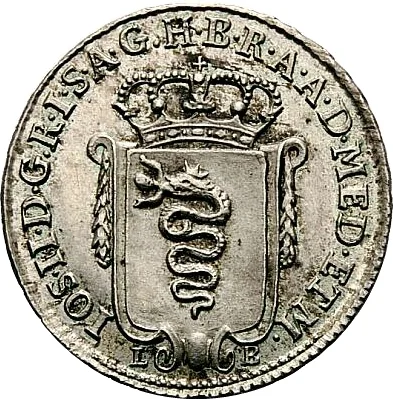

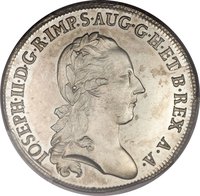
Obverse
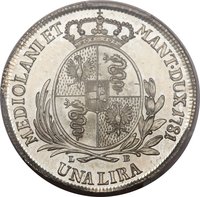
Description:
Milanese crowned shield with serpent arms, flanked by garlands.
Inscription:
IOS·II·D·G·R·I·S·A·G·H. B·R·A·A·D·MED·
Script: Latin
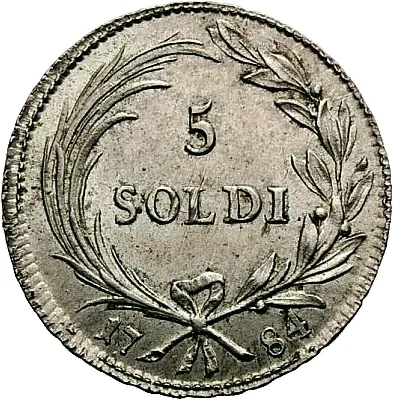
Reverse
Edge
Mints
| Name | Mark |
|---|---|
| Milan | — |
Mintings
| Year | Mint Mark | Mintage | Quality | Collection |
|---|---|---|---|---|
| 1780 | — | — | ||
| 1781 | — | 63,241 | ||
| 1784 | — | 61,982 | ||
| 1787 | — | — |
Historical background
In 1780, Milan operated under a complex and often chaotic monetary system, a legacy of its position as the capital of the Duchy of Milan within the Austrian Habsburg Empire. The official currency was the Milanese lira (divided into 20 soldi or 240 denari), which was tied to the Conventionsthaler, a silver standard used across much of the Habsburg domains. However, this official system coexisted with a plethora of other coins in daily circulation. These included older Spanish and local Italian coins, Venetian ducats, French louis d'or, and various German thalers, all valued by their precious metal content rather than a fixed state decree.
This multiplicity created significant practical difficulties. Exchange rates between these coins fluctuated constantly, leading to confusion, frequent disputes in markets, and opportunities for fraud. The problem was exacerbated by wear and clipping of coins, which reduced their intrinsic silver or gold content and made their official face value unreliable. For merchants and the growing commercial class, this uncertainty was a hindrance to trade and economic calculation, creating a persistent demand for reform and standardization.
The Habsburg administration, under the enlightened absolutist rule of Empress Maria Theresa (and later Joseph II), was aware of these issues and sought to impose greater monetary order as part of broader centralizing reforms. Efforts were made to regulate the coinage and assert the primacy of the imperial system. However, deeply ingrained local practices, the international nature of Milanese commerce, and the sheer inertia of the existing mixed currency stock meant that in 1780, the monetary landscape remained a fragmented and challenging aspect of daily economic life, poised between medieval tradition and the push for modern, state-controlled finance.
This multiplicity created significant practical difficulties. Exchange rates between these coins fluctuated constantly, leading to confusion, frequent disputes in markets, and opportunities for fraud. The problem was exacerbated by wear and clipping of coins, which reduced their intrinsic silver or gold content and made their official face value unreliable. For merchants and the growing commercial class, this uncertainty was a hindrance to trade and economic calculation, creating a persistent demand for reform and standardization.
The Habsburg administration, under the enlightened absolutist rule of Empress Maria Theresa (and later Joseph II), was aware of these issues and sought to impose greater monetary order as part of broader centralizing reforms. Efforts were made to regulate the coinage and assert the primacy of the imperial system. However, deeply ingrained local practices, the international nature of Milanese commerce, and the sheer inertia of the existing mixed currency stock meant that in 1780, the monetary landscape remained a fragmented and challenging aspect of daily economic life, poised between medieval tradition and the push for modern, state-controlled finance.
💎 Extremely Rare