Logo Title
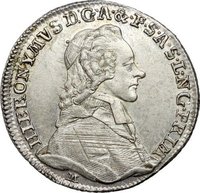
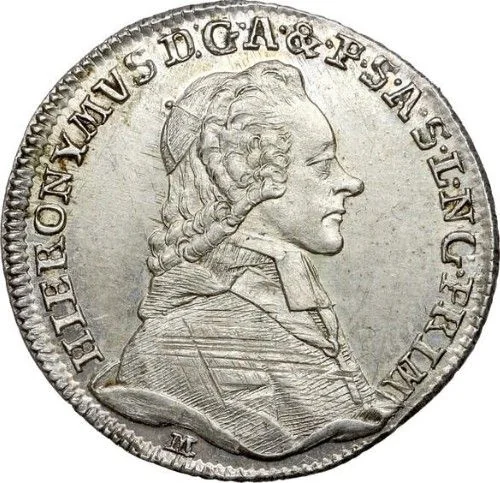
obverse
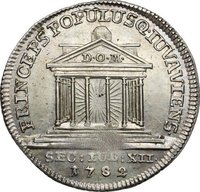
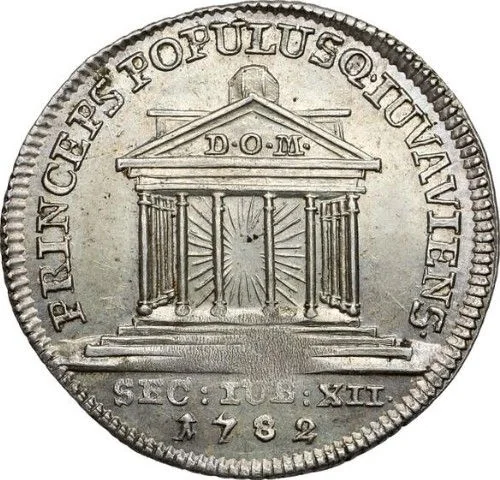
reverse
Gabinet Numizmatyczny D. Marciniak

5 Kreuzer (anniversary milestone) – Bishopric of Salzburg

Non-circulating coins
Commemoration: 600th anniversary
Context
Year: 1782
Currency:
Demonetized: Yes
Material
Diameter: 22 mm
Weight: 1.92 g
Silver weight: 1.92 g
Shape: Round
Composition: Silver
Magnetic: No
Technique: Milled
Alignment: Medal alignment
Obverse
OBVERSE ↑
flip
Reverse
REVERSE ↑
References
KM: #Click to copy to clipboardPn12
Numista: #84972
Value
Bullion value: $5.38

Obverse

Description:
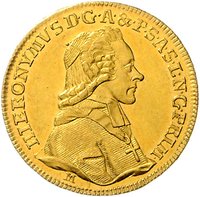
Right-facing portrait of Hiéronymus von Colloredo with encircling legend. "M" for Mazenkopf below.
Inscription:
HIERONYMVS D G A & P S A S L N G PRIM

M
Script: Latin

Reverse

Description:
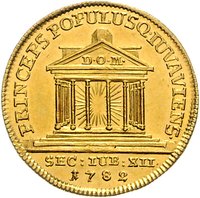
Ancient temple facade, central sun, "DOM" above. Date below.
Inscription:
PRINCEPS POPULUSQ IUVAVIENS

SEC IUB XII

1782
Script: Latin

Edge

Mints

NameMark
Salzburg

Mintings

YearMint MarkMintageQualityCollection
1782

Historical background

In 1782, the currency situation in the Prince-Archbishopric of Salzburg was characterized by a complex and often unstable monetary system, typical of the Holy Roman Empire's fragmented political landscape. The territory did not mint its own major silver coins but instead relied heavily on the widespread circulation of external Reichsthaler and Gulden from neighboring Austrian and Bavarian mints, alongside a plethora of smaller local and regional coins. This created a system where multiple coinage standards coexisted, requiring constant exchange calculations and leading to frequent confusion and potential for debasement in everyday commerce.

The monetary order was formally governed by the imperial regulations, notably the Reichsmünzfuß (Imperial Coinage Standard) of 1763. However, practical control lay with the prince-archbishop, who held the right to mint smaller denomination coins, such as kreuzers and pfennigs. The stability of Salzburg's currency was therefore directly tied to the fiscal discipline of its ruler, Archbishop Hieronymus von Colloredo, who was a reform-minded Enlightenment figure. While he sought modernizing reforms, the financial pressures of the state and the temptation to generate revenue through seigniorage (the profit from minting coins with a face value higher than their metal content) remained a persistent threat to the currency's integrity.

This year fell within a period of significant transition, as Archbishop Colloredo's centralizing policies and Salzburg's deepening economic and political ties with the Habsburg Monarchy increasingly aligned its monetary affairs with the Austrian system. The situation would soon be violently disrupted: within a few years, the Gulden and Kreuzer system would be formally adopted, and by 1803, the secularization of the Prince-Archbishopric would end its independent monetary existence entirely, folding its currency into that of first the Electorate of Salzburg and subsequently the Austrian Empire.
Legendary