

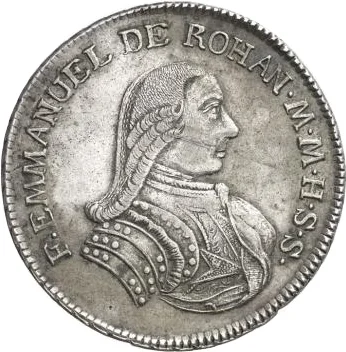
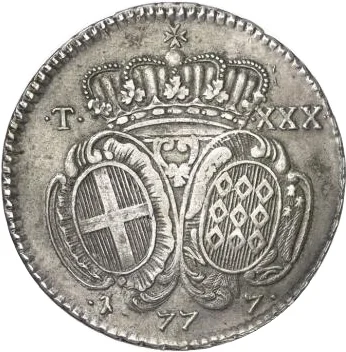
30 tari – Malta
Add to wishlist
Malta
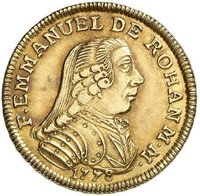
Obverse
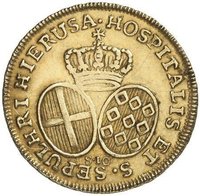
Reverse
Edge
Mintings
| Year | Mint Mark | Mintage | Quality | Collection |
|---|---|---|---|---|
| 1777 | — | — |
Historical background
In 1777, Malta's currency situation was complex and fragmented, reflecting its unique political and economic position as a sovereign state under the governance of the Order of Saint John. The official currency was the Maltese scudo, subdivided into 12 tari, each of 20 grani. However, the monetary system was not based on a strong, centralized minting operation. Instead, the economy relied heavily on a circulation of diverse foreign coins, particularly Spanish silver dollars (pieces of eight), Sicilian and Neapolitan coins, and other European currencies brought by trade and the Order's international connections. This created a constant challenge of valuation and exchange.
The scarcity of small change was a persistent and severe problem that plagued daily commerce. While large foreign silver coins were relatively available, the lack of officially minted low-denomination coins led to chronic inconvenience for ordinary transactions. To alleviate this, the Order periodically authorized the issue of copper tokens, known as "grani di rame" (copper grani), and allowed the circulation of cut fractions of larger coins. These measures were often insufficient and temporary, leading to a reliance on informal and often dubious private tokens, which further complicated the monetary landscape and eroded public trust.
Ultimately, the currency chaos of 1777 was a symptom of the Order's declining financial strength and administrative capacity in its final decades on the island. Without the resources or consistent policy to establish a robust, unified coinage, Malta operated on a de facto system of commodity money, where the value of a coin depended on its metallic content and prevailing market rates rather than a stable face value. This instability would persist until the French occupation in 1798, which introduced a new, though short-lived, monetary system, before the British later established a more formal and lasting currency regime.
The scarcity of small change was a persistent and severe problem that plagued daily commerce. While large foreign silver coins were relatively available, the lack of officially minted low-denomination coins led to chronic inconvenience for ordinary transactions. To alleviate this, the Order periodically authorized the issue of copper tokens, known as "grani di rame" (copper grani), and allowed the circulation of cut fractions of larger coins. These measures were often insufficient and temporary, leading to a reliance on informal and often dubious private tokens, which further complicated the monetary landscape and eroded public trust.
Ultimately, the currency chaos of 1777 was a symptom of the Order's declining financial strength and administrative capacity in its final decades on the island. Without the resources or consistent policy to establish a robust, unified coinage, Malta operated on a de facto system of commodity money, where the value of a coin depended on its metallic content and prevailing market rates rather than a stable face value. This instability would persist until the French occupation in 1798, which introduced a new, though short-lived, monetary system, before the British later established a more formal and lasting currency regime.
✨ Legendary