

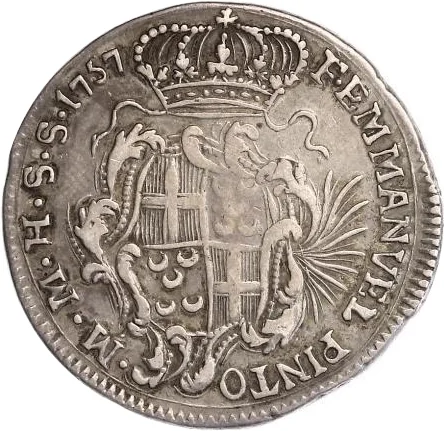
Obverse
Description:
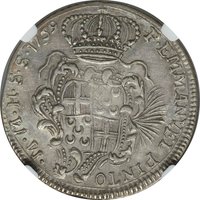
Crowned arms with palm spray on right.
Inscription:
F.EMMANVEL PINTO / .M.M.H.S.S.1757
Script: Latin
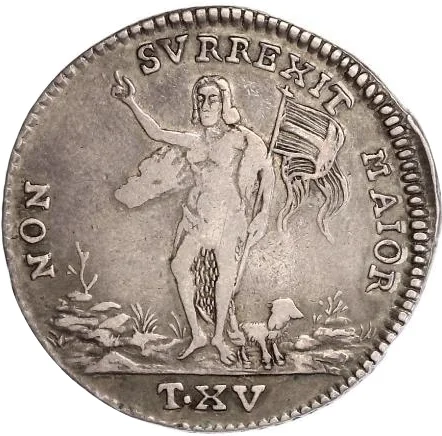
Reverse
Description:
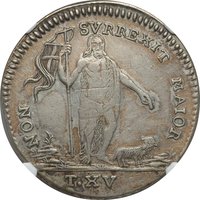
Lamb standing, banner in left foreleg.
Inscription:
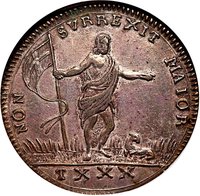
NON SVRREXIT MAIOR
T.XV
T.XV
Script: Latin
Edge
Mintings
| Year | Mint Mark | Mintage | Quality | Collection |
|---|---|---|---|---|
| 1757 | — | — | ||
| 1759 | — | — |
Historical background
In 1757, Malta's currency situation was complex and fragmented, reflecting its strategic position and the legacy of various ruling powers. The islands were officially under the sovereignty of the Knights of the Order of St. John, who minted their own distinctive coins. The primary unit was the Maltese scudo, divided into 12 tari, each of 20 grani or 240 piccioli. However, alongside this local system, a vast array of foreign coins circulated freely, including Spanish pieces of eight, Venetian sequins, Neapolitan ducats, and French louis d'or, brought by trade, corsairing, and the constant flow of sailors and merchants through the Grand Harbour.
This monetary pluralism created significant practical challenges. The value of foreign coins was not fixed, fluctuating with their silver or gold content and international trade rates, leading to confusion and frequent disputes in everyday transactions. The Knights attempted to regulate this by periodically issuing official tariff lists (bando) that set exchange rates for the most common foreign currencies against the Maltese scudo. These proclamations were essential for commerce but were often reactive, struggling to keep pace with market realities and the influx of worn or clipped coins, which further eroded trust in the circulating medium.
Ultimately, the currency landscape of 1757 Malta was one of managed disorder. The Knights' mint produced reliable local coinage, but it was insufficient to drive out foreign currencies, making the economy dependent on a precarious and multi-sourced monetary base. This system, while functional for a bustling maritime hub, was inherently unstable, placing a burden on merchants and the public, and highlighting the administrative difficulties of maintaining financial sovereignty in a strategically vital and internationally exposed island nation.
This monetary pluralism created significant practical challenges. The value of foreign coins was not fixed, fluctuating with their silver or gold content and international trade rates, leading to confusion and frequent disputes in everyday transactions. The Knights attempted to regulate this by periodically issuing official tariff lists (bando) that set exchange rates for the most common foreign currencies against the Maltese scudo. These proclamations were essential for commerce but were often reactive, struggling to keep pace with market realities and the influx of worn or clipped coins, which further eroded trust in the circulating medium.
Ultimately, the currency landscape of 1757 Malta was one of managed disorder. The Knights' mint produced reliable local coinage, but it was insufficient to drive out foreign currencies, making the economy dependent on a precarious and multi-sourced monetary base. This system, while functional for a bustling maritime hub, was inherently unstable, placing a burden on merchants and the public, and highlighting the administrative difficulties of maintaining financial sovereignty in a strategically vital and internationally exposed island nation.
✨ Legendary