

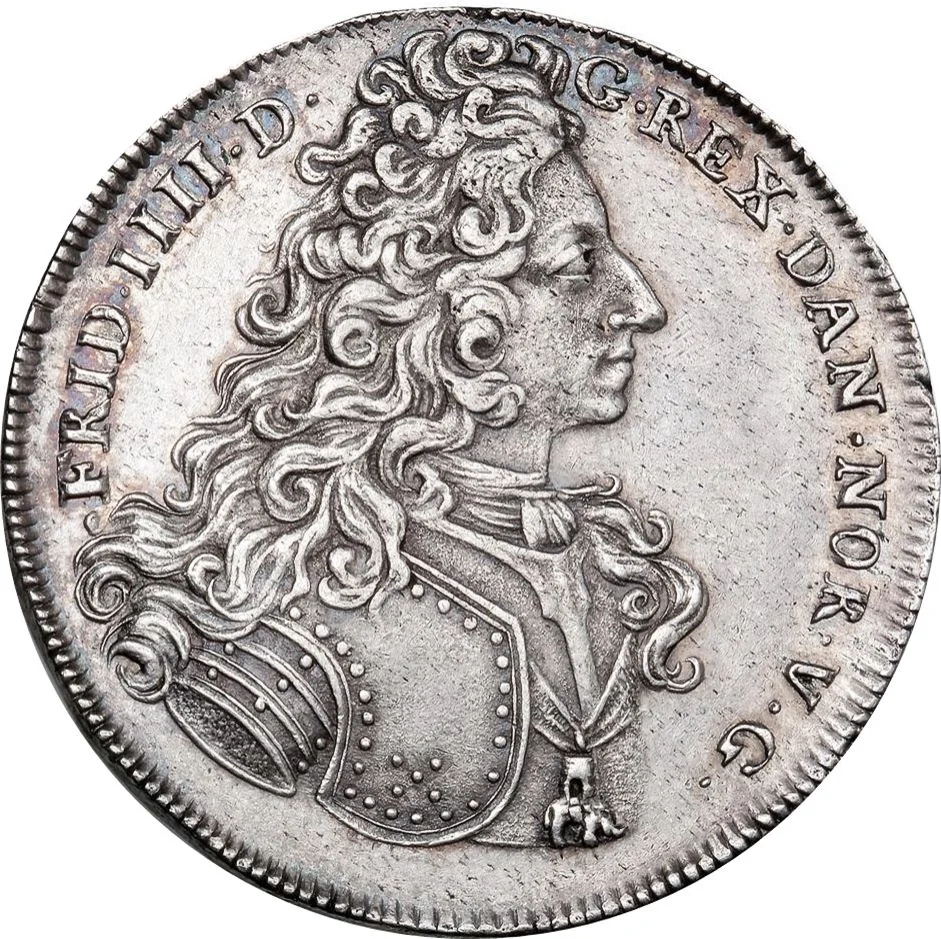

1 Rigsdaler Courant – ERR NorwayandNorway
Circulating commemorative coins
Commemoration: Frederik IV visit in Norway, 1704
Context
Material
References
KM: #Click to copy to clipboard479 (Denma
Numista: #82693
Value
Bullion value: $66.92
Obverse
Description:
Bust of Frederick IV in armor and the Order of the Elephant collar, facing right with a long curled wig.
Inscription:
FRID · IIII · D · G · REX · DAN · NOR · V · G .
Script: Latin
Reverse
Description:
Norwegian coat of arms: a crowned left-facing rampant lion holding a curved halberd.
Inscription:
🙦 MOD · TROSKAB · DAPPERHED · OG HVAD DER GIVER AERE
❀ DEN HEELE VERDEN KAND · BLANT NORSKE KLIPPER LÆRE
6 M
17 ♥ 04
❀ DEN HEELE VERDEN KAND · BLANT NORSKE KLIPPER LÆRE
6 M
17 ♥ 04
Script: Latin
Edge
Mints
| Name | Mark |
|---|---|
| Royal Danish Mint | ♥ |
Mintings
| Year | Mint Mark | Mintage | Quality | Collection |
|---|---|---|---|---|
| 1704 | ♥ | — |
Historical background
In 1704, Norway was part of the dual monarchy of Denmark-Norway, with its monetary system firmly controlled from Copenhagen. The official currency was the Danish rigsdaler, a silver-based coin, but the circulating medium was a complex and often chaotic mix. Alongside full-value rigsdaler coins, there were a plethora of lower-value skilling coins, many of which had been heavily debased (reduced in precious metal content) to finance Denmark-Norway's costly involvement in the Great Northern War (1700-1721). This created a two-tier system: "current money" (kurentmynt) of debased coins for everyday trade and "species money" (speciedaler) of full-value silver for large transactions and foreign trade, with fluctuating exchange rates between them.
The war's financial strain led to severe practical problems. The state's need for revenue resulted in chronic shortages of small change, hindering local commerce. Furthermore, the poor quality and widespread counterfeiting of the debased skilling coins eroded public trust. In remote Norwegian regions, traditional means of exchange like vadmel (coarse woolen cloth) and dried fish were still commonly used in barter, underscoring the insufficiency of the official coinage. This unstable environment placed a heavy burden on merchants and farmers, who faced uncertainty in the value of their payments and savings.
Consequently, the year 1704 fell within a period of significant monetary distress. While not marked by a single reform, it was a point of accumulating pressure within a deteriorating system. The ongoing debasement and currency confusion would eventually culminate in the major monetary reform of 1713, which introduced a new kurant system in an attempt to stabilize the currency, though with limited immediate success. Thus, Norway's currency situation in 1704 was defined by wartime fiscal policy, a fragmented circulating medium, and a growing crisis of confidence that reflected the broader economic strains of the kingdom.
The war's financial strain led to severe practical problems. The state's need for revenue resulted in chronic shortages of small change, hindering local commerce. Furthermore, the poor quality and widespread counterfeiting of the debased skilling coins eroded public trust. In remote Norwegian regions, traditional means of exchange like vadmel (coarse woolen cloth) and dried fish were still commonly used in barter, underscoring the insufficiency of the official coinage. This unstable environment placed a heavy burden on merchants and farmers, who faced uncertainty in the value of their payments and savings.
Consequently, the year 1704 fell within a period of significant monetary distress. While not marked by a single reform, it was a point of accumulating pressure within a deteriorating system. The ongoing debasement and currency confusion would eventually culminate in the major monetary reform of 1713, which introduced a new kurant system in an attempt to stabilize the currency, though with limited immediate success. Thus, Norway's currency situation in 1704 was defined by wartime fiscal policy, a fragmented circulating medium, and a growing crisis of confidence that reflected the broader economic strains of the kingdom.
✨ Legendary