

4 mark – Norway
Add to wishlist
Norway
Context
Years: 1725–1726
Issuer: Norway
Ruler: Frederick IV
Currency:
(1523—1746)
Subdivision: 4 mark = 1 Krone
Demonetized: Yes
Total mintage: 242,000
Material
References
KM: #
Numista: #82387
Value
Bullion value: $37.05
Obverse
Description:
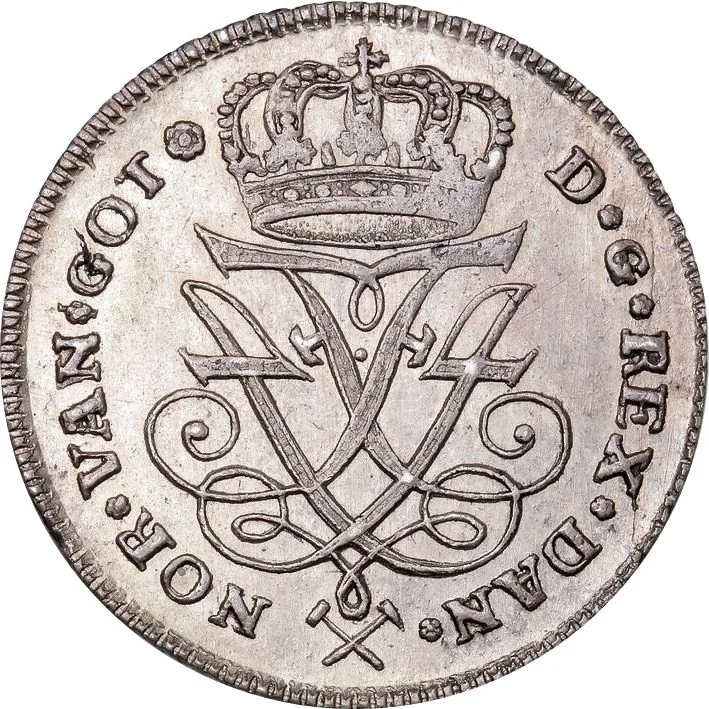
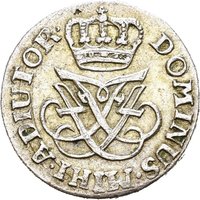
Crowned mirrored monogram of Frederik IV, encircled by inscription with mintmark below. Beaded edge.
Inscription:
D✿G✿REX✿DAN✿ ⚒ NOR✿VAN✿GOT🏵
Script: Latin
Reverse
Description:
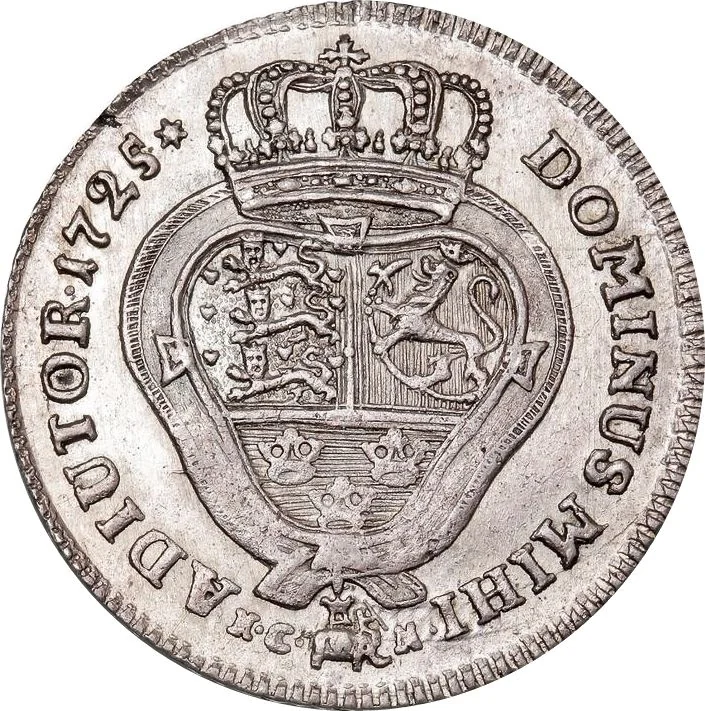
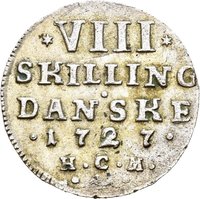
A crowned, three-part pear-shaped shield displays the arms of Denmark, Norway, and the Kalmar Union, encircled by a band with the Order of the Elephant pendant. An inscription surrounds it, with mintmaster initials divided by the elephant below. Beaded edge.
Inscription:
DOMINUS MIHI | ADIUTOR·1725✶
H·C· | M·
H·C· | M·
Script: Latin
Edge
Mints
| Name | Mark |
|---|---|
| Norwegian Mint | — |
Mintings
| Year | Mint Mark | Mintage | Quality | Collection |
|---|---|---|---|---|
| 1725 | — | 103,000 | ||
| 1726 | — | 139,000 |
Historical background
In 1725, Norway was part of the Dano-Norwegian dual monarchy, and its currency situation was complex and challenging. The primary circulating coin was the riksdaler specie, a large silver coin, but the system was not decimalized. It was subdivided into marks, skilling, and runstykkers (or penning), creating cumbersome calculations. More critically, the period was marked by a severe shortage of small-denomination coins needed for everyday transactions, which stifled local trade and caused significant hardship for the common population.
This scarcity was exacerbated by a broader monetary crisis. The state had repeatedly debased the coinage—reducing its silver content—to finance its involvement in the Great Northern War (1700-1721). This led to a classic "bad money drives out good" scenario (Gresham's Law), where older, full-value coins were hoarded or exported, leaving the inferior new coins in circulation. The result was a loss of public confidence in the currency, price inflation, and a disconnect between the official face value of coins and their actual metallic worth.
Consequently, the monetary system in 1725 was in a state of disarray and transition. Authorities in Copenhagen were aware of the problems and had begun efforts to reform the coinage. Just a few years later, in 1730, a major monetary reform would be enacted, introducing new, standardized silver coins in an attempt to restore stability. Therefore, the currency situation in 1725 can be characterized as the troubled tail end of a wartime financial policy, awaiting the corrective measures that would define the mid-18th century.
This scarcity was exacerbated by a broader monetary crisis. The state had repeatedly debased the coinage—reducing its silver content—to finance its involvement in the Great Northern War (1700-1721). This led to a classic "bad money drives out good" scenario (Gresham's Law), where older, full-value coins were hoarded or exported, leaving the inferior new coins in circulation. The result was a loss of public confidence in the currency, price inflation, and a disconnect between the official face value of coins and their actual metallic worth.
Consequently, the monetary system in 1725 was in a state of disarray and transition. Authorities in Copenhagen were aware of the problems and had begun efforts to reform the coinage. Just a few years later, in 1730, a major monetary reform would be enacted, introducing new, standardized silver coins in an attempt to restore stability. Therefore, the currency situation in 1725 can be characterized as the troubled tail end of a wartime financial policy, awaiting the corrective measures that would define the mid-18th century.
💎 Extremely Rare