

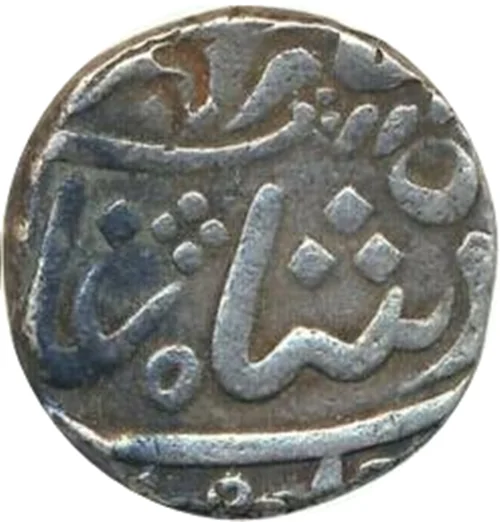
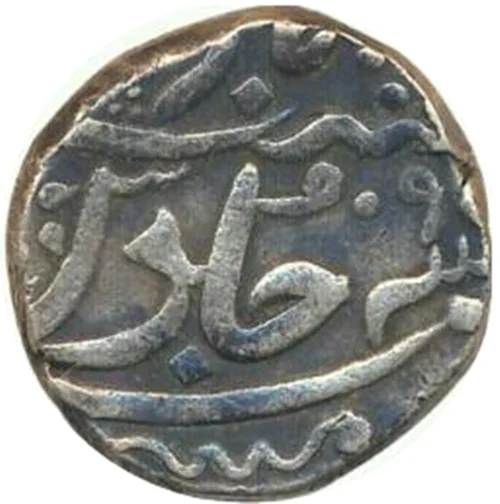
1 Rupee – Bombay Presidency
India
Context
Year: 1774
Islamic (Hijri) Year: 1188
Country: India 
Issuer: Bombay Presidency
Currency:
(1672—1835)
Demonetized: Yes
References
KM: #Click to copy to clipboard178
Numista: #79767
Value
Bullion value: $33.44
Obverse
Description:
Sikka mubarak, Alamgir.
Inscription:
١١٨٨
Reverse
Description:
Zarb Mumbai, Year 9 of Reign, Prosperity.
Inscription:
٩
Edge
Plain
Mintings
| Year | Mint Mark | Mintage | Quality | Collection |
|---|---|---|---|---|
| 1774 | — | — |
Historical background
In 1774, the currency situation within the Bombay Presidency was a complex and problematic web of competing systems, reflecting its position as a commercial hub amidst declining Mughal authority and rising British influence. The primary circulating medium was the silver rupee, but its value and purity were not uniform. The Presidency officially recognised the "Bombay rupee," a local imitation of the Surat rupee, but these coexisted with a multitude of other rupees from neighbouring regions like Surat, Anjengo, and those issued by various Maratha chieftains. This proliferation created chronic confusion in exchange rates, facilitated widespread counterfeiting, and posed a significant hindrance to trade and revenue collection.
The British administration faced severe difficulties due to this monetary chaos. The East India Company's own financial operations, including paying its troops and purchasing cotton and other goods for export, were complicated by the need for constant assay and discounting of coins. Furthermore, the Presidency suffered from a persistent shortage of specie (coin), exacerbated by the drain of silver to China for the tea trade and the cost of maintaining military campaigns against the Maratha Confederacy. This scarcity often forced the use of cumbersome and unreliable copper coins (pice) for smaller transactions and even led to the circulation of foreign coins like Spanish dollars.
Recognising that monetary disorder stifled commerce and governance, the Bombay Government took a significant step in 1774 by attempting to impose order. They passed a resolution to cry down (officially devalue) certain older and debased rupees, notably the "Anjengo rupee," and to establish a standard "Bombay rupee" as the sole legal tender for public payments. This was an early, though not immediately fully successful, move towards currency standardization. It highlighted the Company's evolving shift from a purely commercial entity to a territorial ruler seeking to impose a unified fiscal system, a process that would culminate in more comprehensive reforms in the following decades.
The British administration faced severe difficulties due to this monetary chaos. The East India Company's own financial operations, including paying its troops and purchasing cotton and other goods for export, were complicated by the need for constant assay and discounting of coins. Furthermore, the Presidency suffered from a persistent shortage of specie (coin), exacerbated by the drain of silver to China for the tea trade and the cost of maintaining military campaigns against the Maratha Confederacy. This scarcity often forced the use of cumbersome and unreliable copper coins (pice) for smaller transactions and even led to the circulation of foreign coins like Spanish dollars.
Recognising that monetary disorder stifled commerce and governance, the Bombay Government took a significant step in 1774 by attempting to impose order. They passed a resolution to cry down (officially devalue) certain older and debased rupees, notably the "Anjengo rupee," and to establish a standard "Bombay rupee" as the sole legal tender for public payments. This was an early, though not immediately fully successful, move towards currency standardization. It highlighted the Company's evolving shift from a purely commercial entity to a territorial ruler seeking to impose a unified fiscal system, a process that would culminate in more comprehensive reforms in the following decades.
✨ Legendary