

5 Kreuzer – Austrian Empire
Austria
Context
Years: 1788–1790
Country: Austria 
Issuer: Austrian Empire
Ruler: Joseph II
Currency:
(1754—1857)
Demonetized: Yes
Material
References
KM: #Click to copy to clipboard2061
Numista: #79546
Value
Bullion value: $8.10
Obverse
Description:
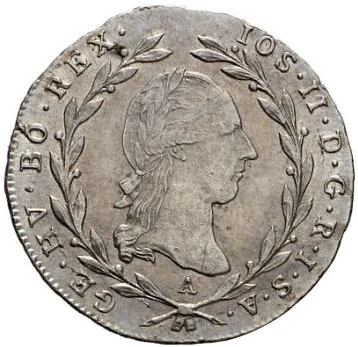
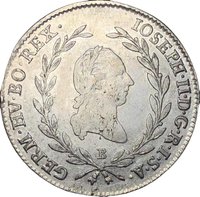
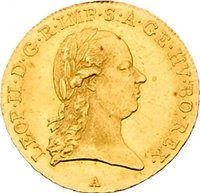
Joseph II portrait right in wreath, mint mark below. Legend: "Joseph II Dei Gratia Romanorum Imperator Semper Augustus Germaniae Hungariae Bohemiae Rex".
Inscription:
IOS II D G R I S A / GE HV BO REX
Script: Latin
Reverse
Description:
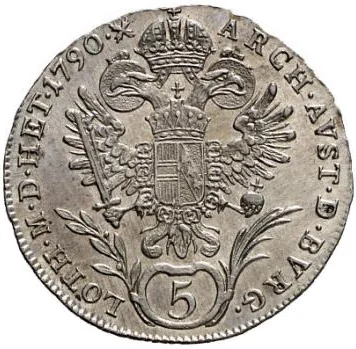
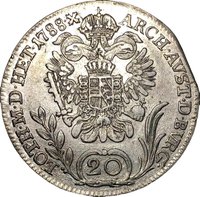
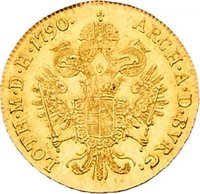
Imperial double-headed eagle with Austrian and Lorraine arms. Value in wreath-framed cartouche. Legend: "Archidux Austriae Dux Burgundiae Lotharingiae Magnus Dux Hetruriae".
Inscription:
ARCH AVST D BVRG / LOTH M D HET 1790 X
Script: Latin
Edge
Mints
| Name | Mark |
|---|---|
| Münze Österreich | A |
Historical background
In 1788, the Habsburg Monarchy, under Emperor Joseph II, was grappling with a severe and worsening currency crisis rooted in decades of deficit financing. To fund expansive military campaigns, most notably the costly War of the Austrian Succession and the Seven Years' War, the state had increasingly relied on debasing its coinage. The primary silver Conventionsthaler was steadily reduced in precious metal content, while billions of copper Kreuzers were minted to cover day-to-day expenses. This created a dysfunctional bimetallic system where the overvalued, debased silver coin drove full-weight silver out of circulation (Gresham's Law), leaving the economy flooded with unstable copper and paper money, causing widespread confusion and loss of public trust.
The immediate context of 1788 was the Empire's involvement in another expensive war, the Austro-Turkish War (1787-1791). This conflict placed further immense strain on state finances, forcing the government to issue even more Bankozettel—paper notes originally backed by the Vienna City Bank. While not yet legal tender, these notes began to circulate at a discount against silver, marking the early stages of inflationary pressure. The public, wary from past devaluations, increasingly hoarded sound money, exacerbating the shortage of reliable currency for commerce and tax collection.
Consequently, the Austrian economy in 1788 was characterized by monetary chaos, with multiple coinages (often outdated or foreign) circulating at fluctuating values, a growing shadow of paper money, and rising prices. This instability severely hampered trade, credit, and economic planning. The crisis would culminate just a few years later, in 1811, with a state bankruptcy (Finanzpatent), but in 1788 the foundational weaknesses were fully apparent, presenting a critical financial challenge that preoccupied Joseph II's government even as it fought a war on its southern frontier.
The immediate context of 1788 was the Empire's involvement in another expensive war, the Austro-Turkish War (1787-1791). This conflict placed further immense strain on state finances, forcing the government to issue even more Bankozettel—paper notes originally backed by the Vienna City Bank. While not yet legal tender, these notes began to circulate at a discount against silver, marking the early stages of inflationary pressure. The public, wary from past devaluations, increasingly hoarded sound money, exacerbating the shortage of reliable currency for commerce and tax collection.
Consequently, the Austrian economy in 1788 was characterized by monetary chaos, with multiple coinages (often outdated or foreign) circulating at fluctuating values, a growing shadow of paper money, and rising prices. This instability severely hampered trade, credit, and economic planning. The crisis would culminate just a few years later, in 1811, with a state bankruptcy (Finanzpatent), but in 1788 the foundational weaknesses were fully apparent, presenting a critical financial challenge that preoccupied Joseph II's government even as it fought a war on its southern frontier.
💎 Extremely Rare