

2 Leones – Sierra Leone
Circulating commemorative coins
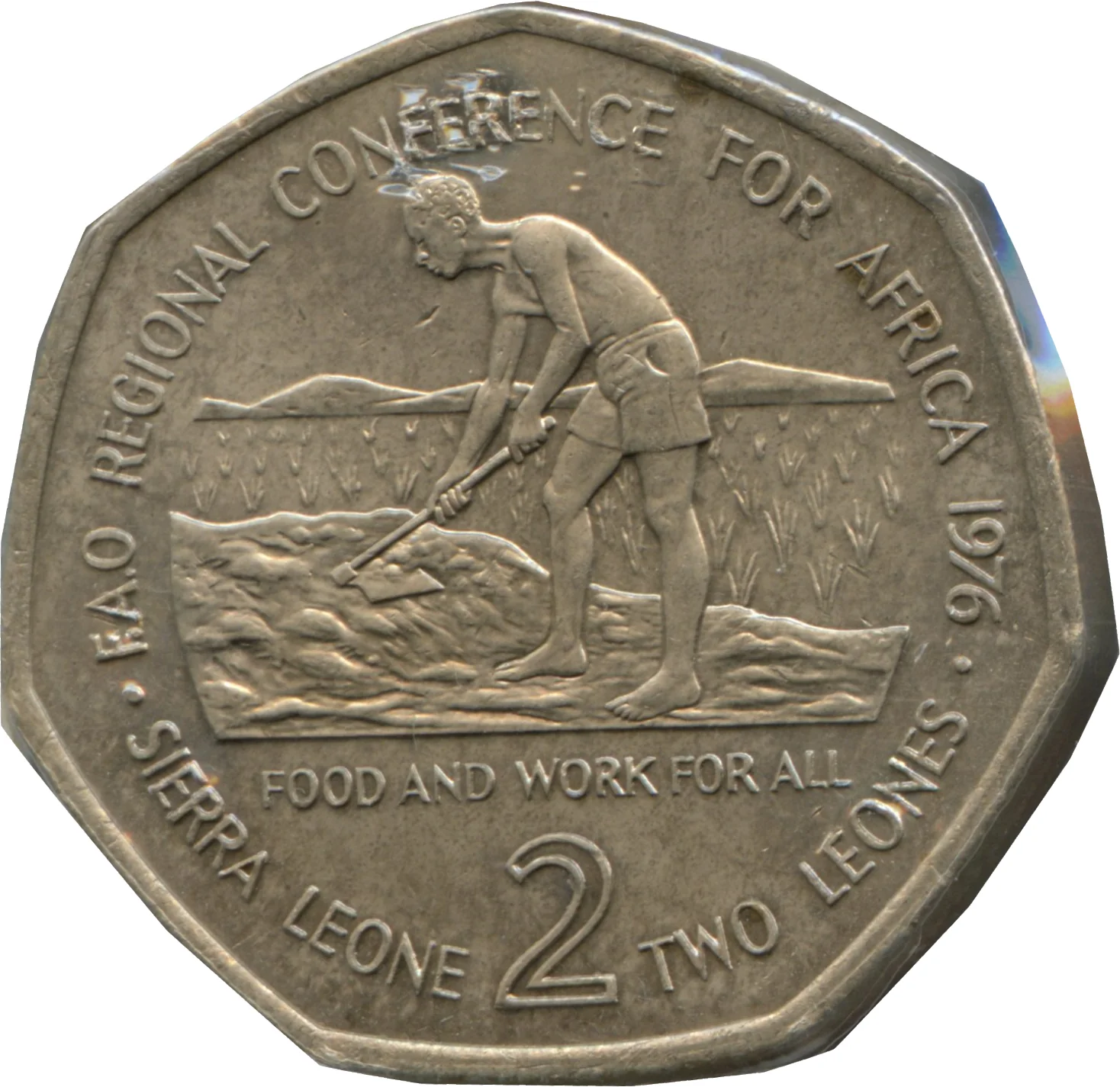
Commemoration: Regional Conference for Africa
Sierra Leone
Context
Year: 1976
Issuer: Sierra Leone 
Ruler: Siaka Stevens
Currency:
(1964—2023)
Demonetization: 1 January 2024
Total mintage: 20,000
Material
Diameter: 30 mm
Weight: 13.5 g
Thickness: 2.5 mm
Shape: Equilateral curve heptagon
Technique: Milled
Alignment: Medal alignment
flip
References
KM: #Click to copy to clipboard29
Numista: #12001
Value
Exchange value: 2 SLL
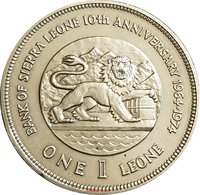
Obverse
Reverse
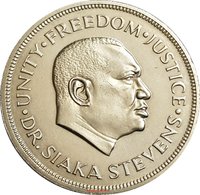
Description:
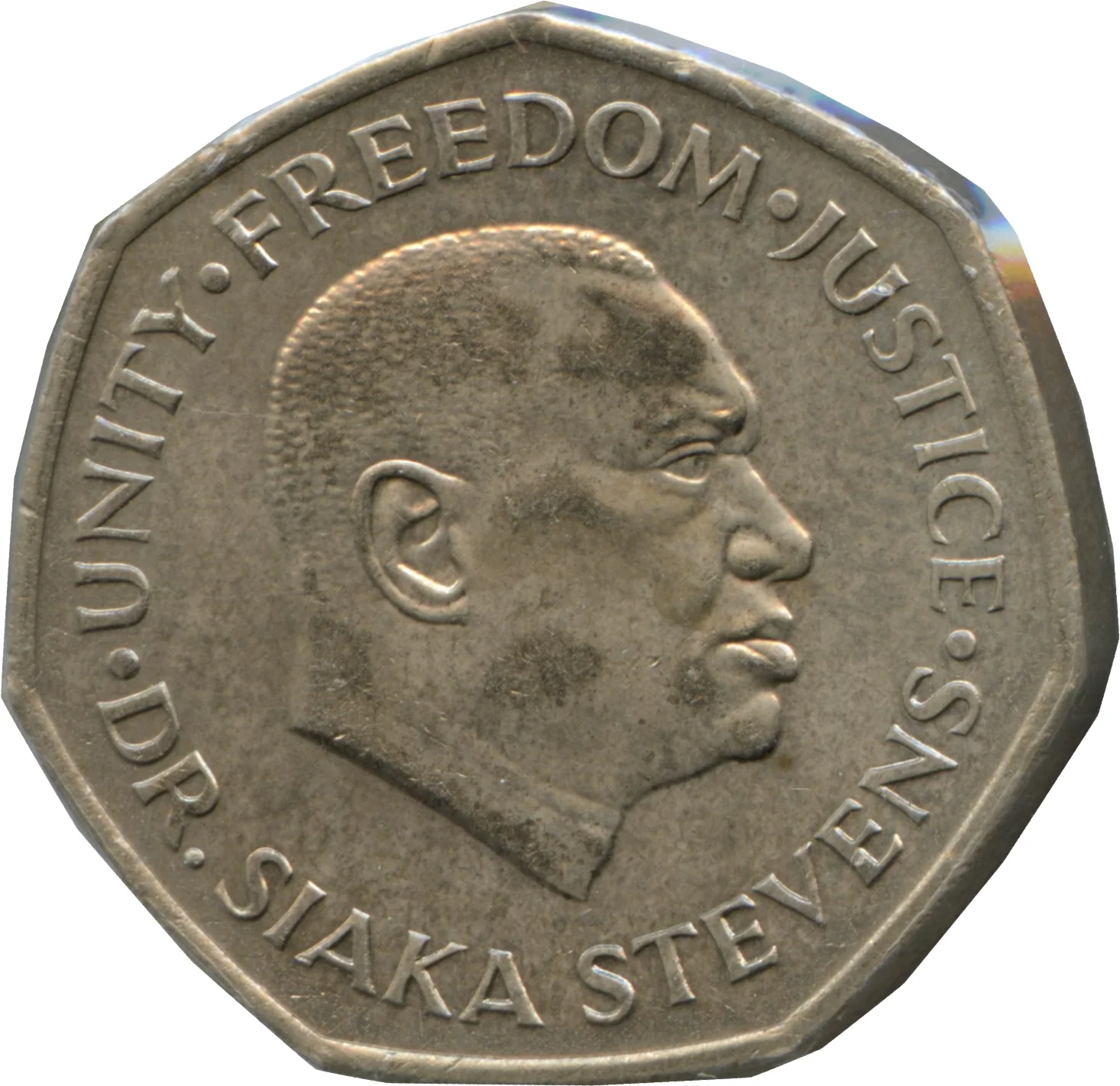
Dr. Siaka Stevens portrait
Inscription:
UNITY FREEDOM JUSTICE
DR SIAKA STEVENS
DR SIAKA STEVENS
Script: Latin
Edge
Plain
Categories
| Agriculture |
| Person> Politician |
| Organization> FAO |
Mints
| Name | Mark |
|---|---|
| Royal Mint | — |
Mintings
| Year | Mint Mark | Mintage | Quality | Collection |
|---|---|---|---|---|
| 1976 | — | 20,000 |
Historical background
In 1976, Sierra Leone's currency situation was characterized by the continued use of the Leone (SLL), which had been introduced in 1964 to replace the British West African pound. The currency was managed by the Bank of Sierra Leone, established in 1963, which held the responsibility for issuing notes and coins and managing the country's monetary policy. During this period, the Leone was still a relatively stable currency, but it operated within an economy heavily dependent on a single commodity: diamonds. This reliance made the country's financial health vulnerable to fluctuations in global diamond prices and exposed systemic issues with smuggling and revenue loss.
The broader economic context of the mid-1970s presented significant challenges. Sierra Leone, like many nations, was impacted by the 1973 oil crisis, which increased import costs and contributed to a growing trade deficit. While the country experienced a brief diamond boom in the early 1970s, by 1976 the benefits were unevenly distributed, and the economy showed signs of strain. Government spending was rising, often financed by borrowing from the central bank, which planted the seeds for future inflationary pressures. The Leone was officially pegged to a basket of currencies, but its effective value was under subtle pressure from these underlying economic weaknesses.
Furthermore, 1976 fell within the long political tenure of President Siaka Stevens (1971-1985), a period marked by increasing centralization of power and patronage networks. Economic management often prioritized political stability over fiscal discipline. While a full-blown currency crisis was not yet apparent in 1976, the foundational problems of a narrow export base, fiscal imbalances, and governance issues were firmly in place. These factors would later culminate in severe inflation and a dramatic devaluation of the Leone in the decades following, making 1976 a point on a trajectory of gradual monetary deterioration rather than a year of acute crisis itself.
The broader economic context of the mid-1970s presented significant challenges. Sierra Leone, like many nations, was impacted by the 1973 oil crisis, which increased import costs and contributed to a growing trade deficit. While the country experienced a brief diamond boom in the early 1970s, by 1976 the benefits were unevenly distributed, and the economy showed signs of strain. Government spending was rising, often financed by borrowing from the central bank, which planted the seeds for future inflationary pressures. The Leone was officially pegged to a basket of currencies, but its effective value was under subtle pressure from these underlying economic weaknesses.
Furthermore, 1976 fell within the long political tenure of President Siaka Stevens (1971-1985), a period marked by increasing centralization of power and patronage networks. Economic management often prioritized political stability over fiscal discipline. While a full-blown currency crisis was not yet apparent in 1976, the foundational problems of a narrow export base, fiscal imbalances, and governance issues were firmly in place. These factors would later culminate in severe inflation and a dramatic devaluation of the Leone in the decades following, making 1976 a point on a trajectory of gradual monetary deterioration rather than a year of acute crisis itself.
🌱 Fairly Common