

1 Schilling – Polish–Lithuanian Commonwealth
Poland
Context
Year: 1663
Country: Poland 
Issuer: Polish–Lithuanian Commonwealth
Ruler: John II Casimir Vasa
Currency:
(1573—1795)
Demonetized: Yes
Material
References
KM: #Click to copy to clipboard50
Numista: #119350
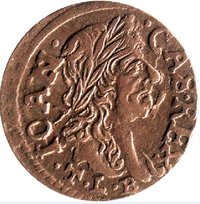
Obverse
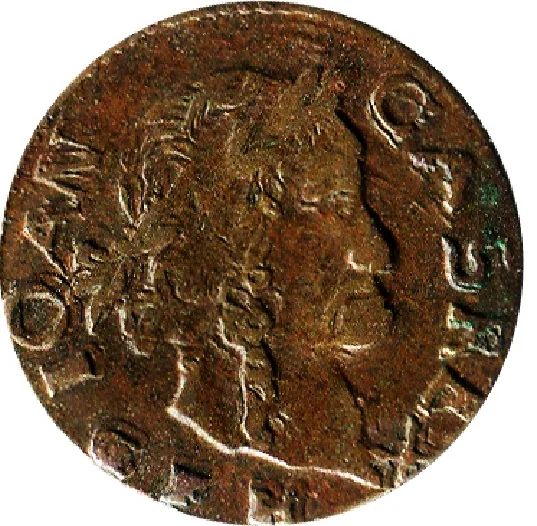
Inscription:
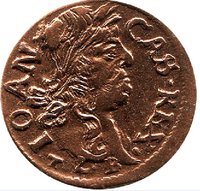
IOAN CAS REX G.F.H.
IOAN CAS REX G.H.F.
OAN CAS REX G.F.H.
IOAN CAS REX G.H.F.
OAN CAS REX G.F.H.
Script: Latin
Reverse
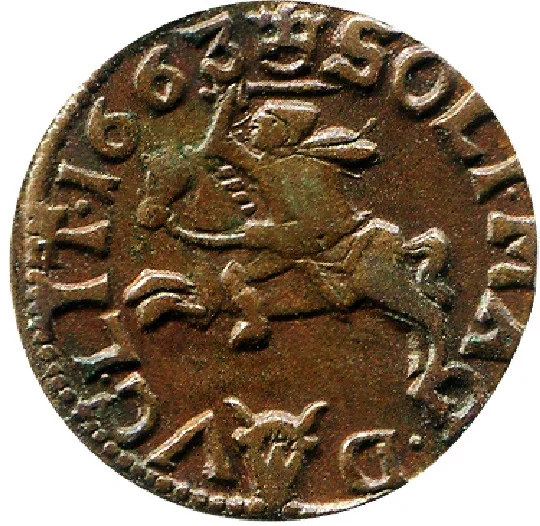
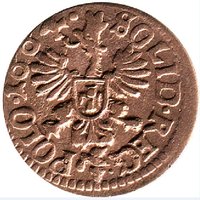
Inscription:
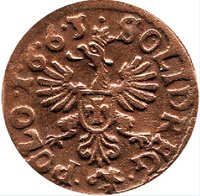
SOL MAG D (Wieniawa arms) UC LIT 1663 (crown)
SOL MAG -- D (Wieniawa arms) UC LIT 1663 (crown)
SOL MAG D (Wieniawa arms) VC LIT 1663 (crown)
SOL MAG D (Wieniawa arms) VC LIT (inverted 1)663 (crown)
SOLI MAG D (Wieniawa arms) UC LIT 1663 (crown)
SOLI MAG D (Wieniawa arms) VC LIT 1663 (crown)
SOLI MAG D (Wieniawa arms) UC LIT T663 (crown)
SOLI MAG (Wieniawa arms) DUC LIT 1663 (crown)
SOL MAG -- D (Wieniawa arms) UC LIT 1663 (crown)
SOL MAG D (Wieniawa arms) VC LIT 1663 (crown)
SOL MAG D (Wieniawa arms) VC LIT (inverted 1)663 (crown)
SOLI MAG D (Wieniawa arms) UC LIT 1663 (crown)
SOLI MAG D (Wieniawa arms) VC LIT 1663 (crown)
SOLI MAG D (Wieniawa arms) UC LIT T663 (crown)
SOLI MAG (Wieniawa arms) DUC LIT 1663 (crown)
Script: Latin
Edge
Mintings
| Year | Mint Mark | Mintage | Quality | Collection |
|---|---|---|---|---|
| 1663 | — | — |
Historical background
The currency situation in the Polish–Lithuanian Commonwealth in 1663 was one of severe monetary crisis and deliberate debasement, driven by the state's desperate financial needs. The Commonwealth was reeling from the devastating "Deluge," a period of mid-17th century wars with Sweden, Russia, and Cossacks, which had emptied the royal treasury. To finance ongoing military campaigns, particularly against Russia, King John II Casimir Vasa and his treasurer, Crown Podskarbi Andrzej Morsztyn, authorized the minting of a new, nominally high-value coin.
This coin, the tymf (named after its proposer, Andrzej Tymf), was a textbook example of bad money. Struck from low-quality silver bullion, its official nominal value was 30 groschen, but its intrinsic silver content was worth only about 12 groschen. The state mandated its acceptance at the inflated face value, forcing the public to effectively subsidize the crown through what was essentially a hidden tax. This practice led to Gresham's Law in action: "bad money drives out good," as people hoarded full-weight older coins like the solid ort and foreign thalers, and only used the debased tymfs for transactions.
The immediate consequence was rampant inflation, a collapse of trust in the state's currency, and economic chaos, particularly hurting fixed-income groups like the landless nobility and urban poor. The long-term damage was even more profound; the 1663 tymf debasement set a dangerous precedent for future reigns, institutionalizing currency manipulation as a fiscal tool and contributing to the weakening of the Commonwealth's economic foundations for decades to come.
This coin, the tymf (named after its proposer, Andrzej Tymf), was a textbook example of bad money. Struck from low-quality silver bullion, its official nominal value was 30 groschen, but its intrinsic silver content was worth only about 12 groschen. The state mandated its acceptance at the inflated face value, forcing the public to effectively subsidize the crown through what was essentially a hidden tax. This practice led to Gresham's Law in action: "bad money drives out good," as people hoarded full-weight older coins like the solid ort and foreign thalers, and only used the debased tymfs for transactions.
The immediate consequence was rampant inflation, a collapse of trust in the state's currency, and economic chaos, particularly hurting fixed-income groups like the landless nobility and urban poor. The long-term damage was even more profound; the 1663 tymf debasement set a dangerous precedent for future reigns, institutionalizing currency manipulation as a fiscal tool and contributing to the weakening of the Commonwealth's economic foundations for decades to come.
⭐ Somewhat Rare