

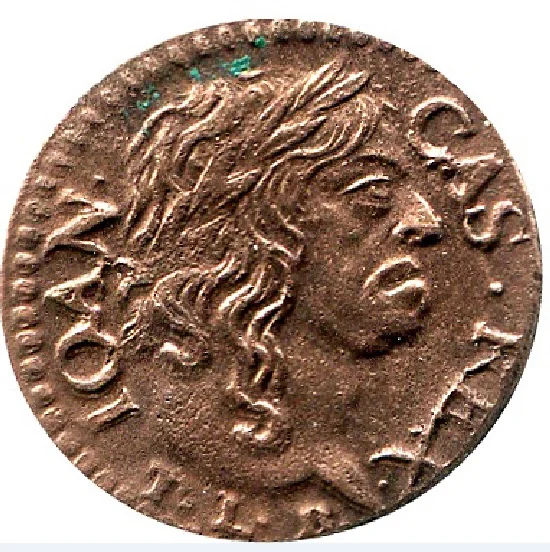
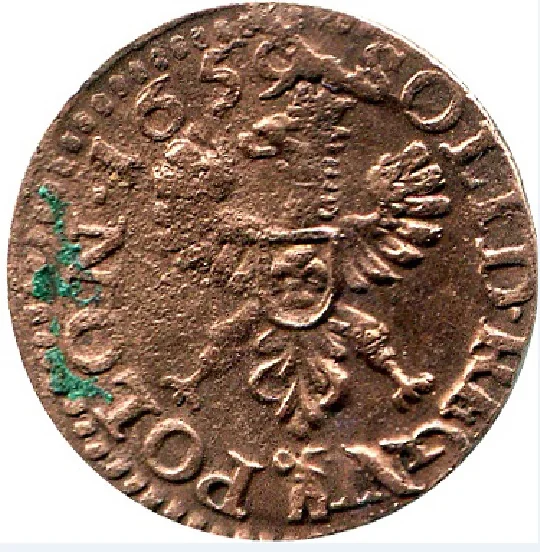
1 Schilling – Polish–Lithuanian Commonwealth
Poland
Context
Year: 1659
Country: Poland 
Issuer: Polish–Lithuanian Commonwealth
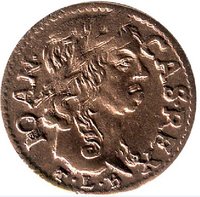
Ruler: John II Casimir Vasa
Currency:
(1573—1795)
Demonetized: Yes
Material
References
KM: #Click to copy to clipboard110
Numista: #119249
Obverse
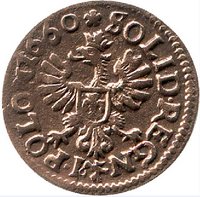
Reverse
Description:
Eagle: A powerful bird of prey.
Inscription:
SOLI REGN (_) POLON 1659
SOLI REGNI (_) POLON 1659
SOLID REGN (_) POLON 1659
SOLID REGN (_) POLON 1659 --
SOLID REGNI (_) POLON 1659
SOLID REGNI (_) POLON 1659 --
SOLID REGNI (_) POLONI 1659
SOLI REGNI (_) POLON 1659
SOLID REGN (_) POLON 1659
SOLID REGN (_) POLON 1659 --
SOLID REGNI (_) POLON 1659
SOLID REGNI (_) POLON 1659 --
SOLID REGNI (_) POLONI 1659
Script: Latin
Edge
Mintings
| Year | Mint Mark | Mintage | Quality | Collection |
|---|---|---|---|---|
| 1659 | — | — |
Historical background
By 1659, the Polish–Lithuanian Commonwealth was in the throes of a severe monetary and economic crisis, often called "The Deluge." This period, beginning in 1648, saw the Commonwealth ravaged by the Khmelnytsky Uprising, the Swedish invasion, and war with Russia. The relentless warfare devastated the economy, depopulated regions, and critically drained the state treasury. To finance its desperate military defense, the government, particularly under King John II Casimir, resorted to drastic currency debasement. The primary mint in Kraków and others began producing immense quantities of low-quality coinage, notably the boratynka (a copper shilling) and the tymf (a debased silver coin), which were declared to have an artificial, forced value far above their intrinsic metal worth.
This policy led to rampant inflation, a collapse of public trust in the currency, and economic chaos. Prices soared as merchants, recognizing the coins' poor metal content, demanded more of them for goods. The simultaneous circulation of older, full-value coins alongside the new debased ones triggered Gresham's Law, where "bad money drives out good." Hoarding of old silver coins became widespread, removing sound money from the economy and leaving only the depreciating currency in common use. The situation was exacerbated by counterfeit coins flooding the market and by the fact that foreign powers, especially Sweden, were also minting and flooding the Commonwealth with even worse counterfeit boratynki to further destabilize their enemy.
The monetary catastrophe of 1659 was not just an economic issue but a profound political one, highlighting the fatal weakness of the Commonwealth's decentralized system. The nobility in the Sejm (parliament), protective of their own interests, resisted necessary fiscal reforms and tax increases, forcing the crown to rely on destructive currency manipulation instead. This financial breakdown eroded the state's ability to pay its soldiers, leading to mutinies and further military weakness. Thus, the currency situation in 1659 was both a symptom and a cause of the Commonwealth's deepening crisis, undermining its stability and capacity to recover from the decade-long Deluge.
This policy led to rampant inflation, a collapse of public trust in the currency, and economic chaos. Prices soared as merchants, recognizing the coins' poor metal content, demanded more of them for goods. The simultaneous circulation of older, full-value coins alongside the new debased ones triggered Gresham's Law, where "bad money drives out good." Hoarding of old silver coins became widespread, removing sound money from the economy and leaving only the depreciating currency in common use. The situation was exacerbated by counterfeit coins flooding the market and by the fact that foreign powers, especially Sweden, were also minting and flooding the Commonwealth with even worse counterfeit boratynki to further destabilize their enemy.
The monetary catastrophe of 1659 was not just an economic issue but a profound political one, highlighting the fatal weakness of the Commonwealth's decentralized system. The nobility in the Sejm (parliament), protective of their own interests, resisted necessary fiscal reforms and tax increases, forcing the crown to rely on destructive currency manipulation instead. This financial breakdown eroded the state's ability to pay its soldiers, leading to mutinies and further military weakness. Thus, the currency situation in 1659 was both a symptom and a cause of the Commonwealth's deepening crisis, undermining its stability and capacity to recover from the decade-long Deluge.
💎 Very Rare