Logo Title
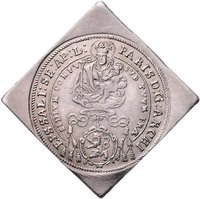
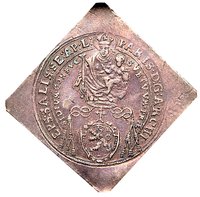
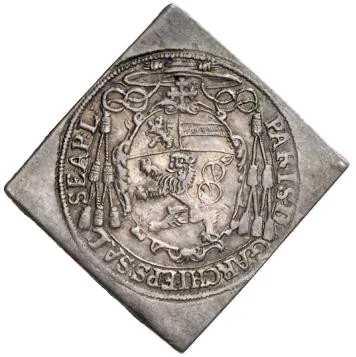
obverse
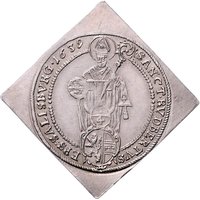
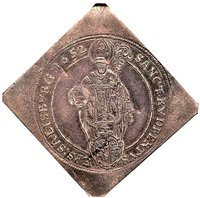
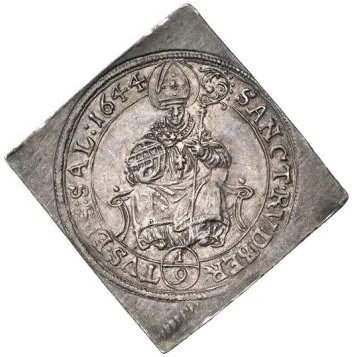
reverse
Numismatik Lanz Auctions

⅑ Thaler – Bishopric of Salzburg

Context
Years: 1633–1644
Currency:
Demonetized: Yes
Material
Weight: 3.16 g
Silver weight: 3.16 g
Shape: Klippe
Composition: Silver
Magnetic: No
Technique: Klippe
References
KM: #Click to copy to clipboard150
Numista: #78301
Value
Bullion value: $8.86

Obverse

Description:
Oval shield displaying the arms of Salzburg and its Archbishop beneath a cardinal’s hat, its tassels either inside or outside an inner circle. Legend around, beginning at 2 o’clock.
Inscription:
PARIS D G ARCHIEPS SAL S A L
Script: Latin

Reverse

Description:
St. Rupert seated with crozier and salt box. A circled fraction splits the legend.
Inscription:
SANCT RVDBE (1/9) RTVS EPS SAL 1644
Script: Latin

Edge

Mintings

YearMint MarkMintageQualityCollection
1633
1642
1643
1644

Historical background

In 1633, the Prince-Archbishopric of Salzburg, under the rule of Archbishop Paris Lodron, was deeply entangled in the economic and monetary turmoil of the Thirty Years' War. While the territory itself was not a primary battlefield, it faced severe financial strain from its political and military obligations. Salzburg was a member of the Catholic League, requiring substantial monetary contributions to support the Imperial and Bavarian forces. This relentless fiscal demand, coupled with disrupted trade and the general economic contraction of the era, placed immense pressure on the bishopric's treasury and its currency system.

The currency situation was characterized by a complex and debased coinage. Salzburg minted its own coins, such as the Salzburger Gulden, Kreuzer, and Pfennig, but these circulated alongside a plethora of foreign coins from neighboring German states and the Holy Roman Empire. The war had triggered a widespread "Kipper und Wipper" crisis across the Empire—a period of rampant currency debasement where authorities reduced the precious metal content in coins to fund their war efforts. While Archbishop Lodron was more restrained than some princes, the need for revenue inevitably led to the issuance of lighter, inferior coinage, causing inflation and a loss of public trust in the monetary system.

Consequently, the local economy in 1633 suffered from unstable exchange rates, rising prices for essential goods, and a preference for hoarding older, full-weight coins. Archbishop Lodron's primary focus was on financing the fortification of Salzburg (like the Hohensalzburg Fortress) and paying war contributions, rather than implementing comprehensive monetary reform. Therefore, the currency situation remained a symptom of the wider crisis: a fragile system of depreciating coinage struggling to sustain a sovereign entity amidst the overwhelming financial demands of a devastating continental war.
Legendary