

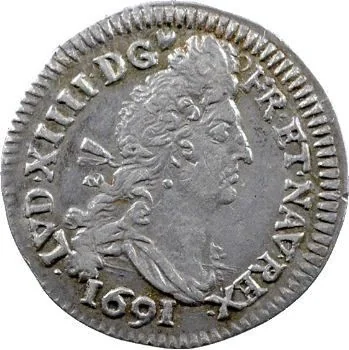
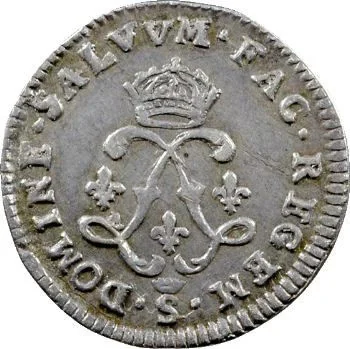
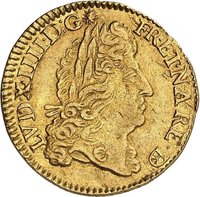
Obverse
Description:
Bust of Louis XIV right, draped and wigged; date below.
Inscription:
LVD. XIIII. D. G. FR. ET. NAV. REX.
1691
1691
Script: Latin
Engraver: Joseph Roëttiers
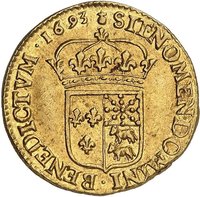
Reverse
Description:
Two facing Ls intertwined, three lilies (2 and 1), all beneath a crown.
Inscription:
.DOMINE. SALVVM. FAC. REGEM.
Script: Latin
Engraver: Joseph Roëttiers
Edge
Plain
Mints
| Name | Mark |
|---|---|
| Aix-en-Provence | & |
| Rennes | 9 |
| Monnaie de Paris | A |
| Metz | AA |
| Rouen | B |
| Caen | C |
| Besançon | CC entrelacés |
| Lyon | D |
| Tours | E |
| Poitiers | G |
| La Rochelle | H |
| Limoges | I |
| Bordeaux | K |
| Bayonne | L |
| Lille | L♔ |
| Toulouse | M |
| Metz | M♔ |
| Montpellier | N |
| Riom | O |
| Dijon | P |
| Reims | S |
| Troyes | S♔ |
| Troyes | V |
| Lille | W |
| Amiens | X |
| Bourges | Y |
Mintings
| Year | Mint Mark | Mintage | Quality | Collection |
|---|---|---|---|---|
| 1691 | & | — | ||
| 1691 | 9 | — | ||
| 1691 | A | 12,000,000 | ||
| 1691 | B | — | ||
| 1691 | D | — | ||
| 1691 | E | — | ||
| 1691 | G | 301,550 | ||
| 1691 | H | — | ||
| 1691 | M | — | ||
| 1691 | M♔ | — | ||
| 1691 | N | — | ||
| 1691 | O | — | ||
| 1691 | P | — | ||
| 1691 | S | — | ||
| 1691 | S♔ | — | ||
| 1691 | X | — | ||
| 1691 | Y | — | ||
| 1691 | I | — | ||
| 1691 | K | — | ||
| 1691 | L | — | ||
| 1691 | L♔ | — | ||
| 1692 | & | — | ||
| 1692 | 9 | 4,380,699 | ||
| 1692 | A | — | ||
| 1692 | B | — | ||
| 1692 | D | — | ||
| 1692 | N | — | ||
| 1692 | O | — | ||
| 1692 | P | — | ||
| 1692 | S | — | ||
| 1692 | S♔ | — | ||
| 1692 | V | — | ||
| 1692 | X | — | ||
| 1692 | Y | — | ||
| 1692 | E | — | ||
| 1692 | G | — | ||
| 1692 | H | — | ||
| 1692 | I | — | ||
| 1692 | J | — | ||
| 1692 | K | — | ||
| 1692 | L | — | ||
| 1692 | L♔ | — | ||
| 1692 | M | — | ||
| 1692 | M♔ | — | ||
| 1693 | & | — | ||
| 1693 | 9 | — | ||
| 1693 | A | — | ||
| 1693 | B | — | ||
| 1693 | D | — | ||
| 1693 | E | — | ||
| 1693 | G | — | ||
| 1693 | H | — | ||
| 1693 | I | — | ||
| 1693 | K | — | ||
| 1693 | M | — | ||
| 1693 | M♔ | — | ||
| 1693 | N | — | ||
| 1693 | O | — | ||
| 1693 | P | — | ||
| 1693 | S | — | ||
| 1693 | S♔ | — | ||
| 1693 | W | — | ||
| 1693 | X | — | ||
| 1693 | Y | — | ||
| 1694 | Y | — | ||
| 1694 | & | — | ||
| 1694 | 9 | — | ||
| 1694 | A | — | ||
| 1694 | AA | — | ||
| 1694 | B | — | ||
| 1694 | D | 769,916 | ||
| 1694 | E | — | ||
| 1694 | H | — | ||
| 1694 | L | — | ||
| 1694 | M | — | ||
| 1694 | N | — | ||
| 1694 | O | — | ||
| 1694 | S | — | ||
| 1694 | V | — | ||
| 1694 | W | — | ||
| 1695 | & | — | ||
| 1695 | 9 | — | ||
| 1695 | A | — | ||
| 1695 | AA | — | ||
| 1695 | CC | — | ||
| 1695 | D | — | ||
| 1695 | E | — | ||
| 1695 | G | — | ||
| 1695 | H | — | ||
| 1695 | L | — | ||
| 1695 | M | — | ||
| 1695 | N | — | ||
| 1695 | P | — | ||
| 1695 | Y | — | ||
| 1696 | I | — | ||
| 1696 | & | — | ||
| 1696 | 9 | 182,000 | ||
| 1696 | A | — | ||
| 1696 | AA | — | ||
| 1696 | C | — | ||
| 1696 | D | — | ||
| 1696 | K | — | ||
| 1696 | L | — | ||
| 1696 | M | — | ||
| 1696 | N | — | ||
| 1696 | W | — | ||
| 1697 | & | — | ||
| 1697 | C | — | ||
| 1697 | D | — | ||
| 1697 | E | — | ||
| 1697 | H | — | ||
| 1697 | K | — | ||
| 1697 | L♔ | 48,040 | ||
| 1697 | P | — | ||
| 1697 | T | — | ||
| 1698 | N | 11,238 | ||
| 1698 | D | — | ||
| 1698 | E | — | ||
| 1698 | H | — | ||
| 1699 | A | — | ||
| 1699 | D | — | ||
| 1699 | N | — | ||
| 1699 | Y | — | ||
| 1700 | & | — | ||
| 1700 | H | — |
Historical background
In 1691, France was in the midst of the Nine Years' War (1688-1697), a conflict against a powerful European coalition that placed immense strain on the royal treasury of Louis XIV. The Sun King's ambitions, coupled with the astronomical costs of maintaining a large standing army and funding military campaigns across multiple fronts, had drained the nation's finances. To meet these relentless expenses, the government, under the control of Finance Minister Louis Phélypeaux, Comte de Pontchartrain, had already resorted to a series of desperate fiscal measures, including selling offices, debasing coinage, and imposing new taxes, setting the stage for a severe monetary crisis.
The core of the currency situation was a deliberate and aggressive policy of coinage debasement. To generate immediate revenue, the royal mint repeatedly reduced the precious metal content (the titre) of gold and silver coins while increasing their face value (augmentation). This created a flood of new, inferior louis d'or and écus into the economy. The predictable result was Gresham's Law in action: "bad money drives out good." Older, full-weight coins were hoarded by the public or melted down for their higher bullion value, disappearing from circulation and further destabilizing the monetary system. Prices began to soar as the value of the currency in people's hands effectively plummeted.
This chaotic situation created profound economic distress and social tension. Merchants and peasants suffered from rampant inflation and unpredictable exchange rates, which disrupted trade and made everyday transactions fraught with uncertainty. The government's manipulations were widely understood as a form of hidden taxation and a breach of the royal promise stamped on each coin, eroding public trust. While the debasement provided short-term war funding, it severely damaged France's financial credibility and laid bare the fundamental weakness of an economy struggling to sustain the weight of Louis XIV's grand ambitions.
The core of the currency situation was a deliberate and aggressive policy of coinage debasement. To generate immediate revenue, the royal mint repeatedly reduced the precious metal content (the titre) of gold and silver coins while increasing their face value (augmentation). This created a flood of new, inferior louis d'or and écus into the economy. The predictable result was Gresham's Law in action: "bad money drives out good." Older, full-weight coins were hoarded by the public or melted down for their higher bullion value, disappearing from circulation and further destabilizing the monetary system. Prices began to soar as the value of the currency in people's hands effectively plummeted.
This chaotic situation created profound economic distress and social tension. Merchants and peasants suffered from rampant inflation and unpredictable exchange rates, which disrupted trade and made everyday transactions fraught with uncertainty. The government's manipulations were widely understood as a form of hidden taxation and a breach of the royal promise stamped on each coin, eroding public trust. While the debasement provided short-term war funding, it severely damaged France's financial credibility and laid bare the fundamental weakness of an economy struggling to sustain the weight of Louis XIV's grand ambitions.

🌱 Fairly Common