


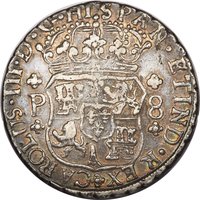
Obverse
Description:
Fernando VI bust, Carlos III legend.
Inscription:
CAROLUS • III • D • G • HISP • ET IND • REX
• 1761 •
• 1761 •
Script: Latin
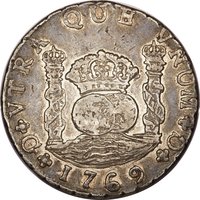
Reverse
Description:
Crowned arms encircled by chain and legend.
Inscription:
IN UTROQ FELIX AUSPICE DEO
8 S
G G
8 S
G G
Script: Latin
Edge
Categories
| Symbols> Coat of Arms |
| Person> Monarch |
Mints
| Name | Mark |
|---|---|
| Casa de Moneda de Guatemala | G |
Mintings
| Year | Mint Mark | Mintage | Quality | Collection |
|---|---|---|---|---|
| 1761 | G | — |
Historical background
In 1761, the currency situation in the Kingdom of Guatemala (a Spanish colony encompassing much of Central America) was characterized by a chronic and severe shortage of official coinage. The economy operated on a complex and often inefficient system where the primary unit of account was the peso, divided into 8 reales. However, physical Spanish silver coins, especially the smaller denominations like reales and half-reales essential for daily market transactions, were scarce. This scarcity was due to several factors: much of the silver from New World mines was shipped directly to Spain, local minting was prohibited (the nearest mint was in Mexico), and what coinage did circulate was often hoarded or exported to cover trade deficits with other regions.
To facilitate local trade, the populace and authorities relied heavily on commodity money and token currencies. The most widespread and officially recognized substitute was cacao beans, used for small purchases, a practice with deep pre-Hispanic roots. Additionally, reddish shell beads known as ziquites or cuentas coloradas circulated, particularly in regions like Nicaragua. For larger transactions, goods such as tobacco, sugar, and indigo might be used in barter. The Spanish administration also periodically authorized the use of local silver tokens or macuquinas (crudely cut cobs), but these were never sufficient to meet demand, leading to a messy and localized monetary environment.
This persistent shortage hindered commerce and tax collection, creating ongoing administrative headaches for the Captaincy-General. It reflected the broader mercantilist policies of the Spanish Empire, which prioritized the extraction of precious metals for the metropolis over the development of a robust, coin-based internal economy in its colonies. The situation would not be fundamentally addressed until the establishment of the Guatemala Mint (Casa de Moneda) in 1733, but even after its founding, production struggles meant that the currency scarcity described in 1761 remained a reality for decades.
To facilitate local trade, the populace and authorities relied heavily on commodity money and token currencies. The most widespread and officially recognized substitute was cacao beans, used for small purchases, a practice with deep pre-Hispanic roots. Additionally, reddish shell beads known as ziquites or cuentas coloradas circulated, particularly in regions like Nicaragua. For larger transactions, goods such as tobacco, sugar, and indigo might be used in barter. The Spanish administration also periodically authorized the use of local silver tokens or macuquinas (crudely cut cobs), but these were never sufficient to meet demand, leading to a messy and localized monetary environment.
This persistent shortage hindered commerce and tax collection, creating ongoing administrative headaches for the Captaincy-General. It reflected the broader mercantilist policies of the Spanish Empire, which prioritized the extraction of precious metals for the metropolis over the development of a robust, coin-based internal economy in its colonies. The situation would not be fundamentally addressed until the establishment of the Guatemala Mint (Casa de Moneda) in 1733, but even after its founding, production struggles meant that the currency scarcity described in 1761 remained a reality for decades.

✨ Legendary