


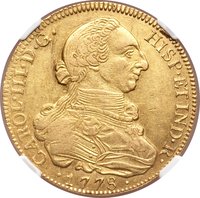
Obverse
Description:
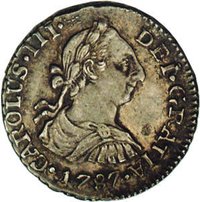
Bust right, legend around, date below.
Inscription:
CAROL • III • D • G • HISP • ET IND • R
• 1783 •
• 1783 •
Script: Latin
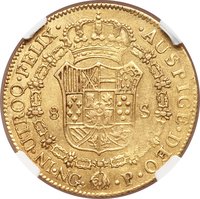
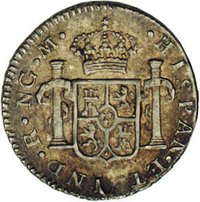
Reverse
Description:
Shield with crown, flanked by value, within chain and legend. Mint mark below.
Inscription:
IN • UTROQ • FELIX • A • D
2 S
• NG • • P •
2 S
• NG • • P •
Script: Latin
Edge
Categories
| Symbols> Coat of Arms |
| Person> Monarch |
Mints
| Name | Mark |
|---|---|
| Casa de Moneda de Guatemala | NG |
Historical background
In 1783, Guatemala, as the Captaincy General of Guatemala within the Spanish Empire, operated under a complex and strained monetary system. The official currency was the Spanish colonial real, with eight reales equaling one peso. However, the economy suffered from a severe and chronic shortage of physical coinage (specie). This scarcity was due to the mercantilist policies of the Spanish Crown, which extracted precious metals from the American colonies and restricted local minting. The primary source of coinage was from the larger viceroyalties to the south, particularly Peru and New Spain (Mexico), but this supply was irregular and insufficient for local needs.
The lack of official currency led to a widespread reliance on substitute and improvised forms of money. Cacao beans, used as currency in the pre-Columbian era, still circulated for small, everyday transactions, especially among the Indigenous population. More significantly, due to the scarcity of small-denomination coins, merchants and municipal authorities often issued tlacos or fichas—token-like credit notes made of lead, copper, or even leather. These were only valid within a specific merchant's shop or local town, creating a fragmented and unreliable monetary landscape. The Spanish Crown viewed these practices with suspicion but was powerless to stop them, as they were essential for the local economy to function.
This monetary instability occurred within a broader context of economic transition. The 1783 Treaty of Paris, which ended the American Revolutionary War, had reopened Atlantic trade routes, offering new, albeit limited, opportunities for the Kingdom of Guatemala's key exports like indigo and cochineal. However, the internal currency crisis hindered capital formation and complicated commerce. The situation would eventually prompt colonial authorities to advocate for the establishment of a local mint, a goal realized with the founding of the Guatemala Mint (Casa de Moneda) in 1733, though its output in the late 18th century remained inadequate to fully resolve the systemic shortage.
The lack of official currency led to a widespread reliance on substitute and improvised forms of money. Cacao beans, used as currency in the pre-Columbian era, still circulated for small, everyday transactions, especially among the Indigenous population. More significantly, due to the scarcity of small-denomination coins, merchants and municipal authorities often issued tlacos or fichas—token-like credit notes made of lead, copper, or even leather. These were only valid within a specific merchant's shop or local town, creating a fragmented and unreliable monetary landscape. The Spanish Crown viewed these practices with suspicion but was powerless to stop them, as they were essential for the local economy to function.
This monetary instability occurred within a broader context of economic transition. The 1783 Treaty of Paris, which ended the American Revolutionary War, had reopened Atlantic trade routes, offering new, albeit limited, opportunities for the Kingdom of Guatemala's key exports like indigo and cochineal. However, the internal currency crisis hindered capital formation and complicated commerce. The situation would eventually prompt colonial authorities to advocate for the establishment of a local mint, a goal realized with the founding of the Guatemala Mint (Casa de Moneda) in 1733, though its output in the late 18th century remained inadequate to fully resolve the systemic shortage.
✨ Legendary