

Obverse
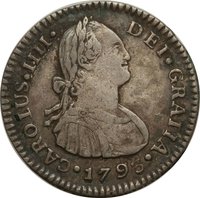
Description:
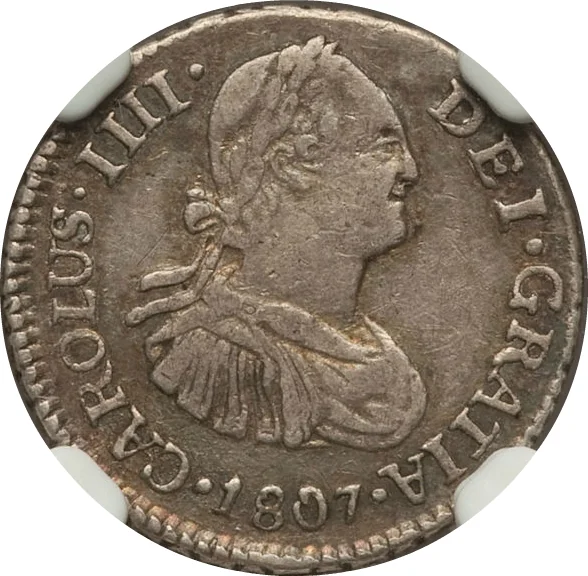
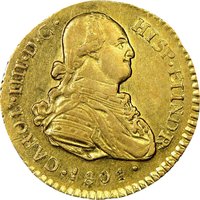
Bust right, legend around, date below.
Inscription:
CAROLUS • IIII • DEI • GRATIA
• 1807 •
• 1807 •
Script: Latin
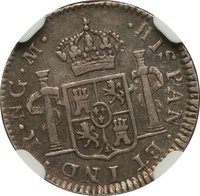
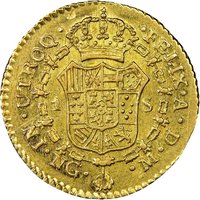
Reverse
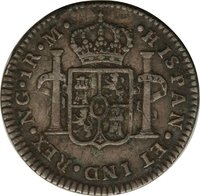
Description:
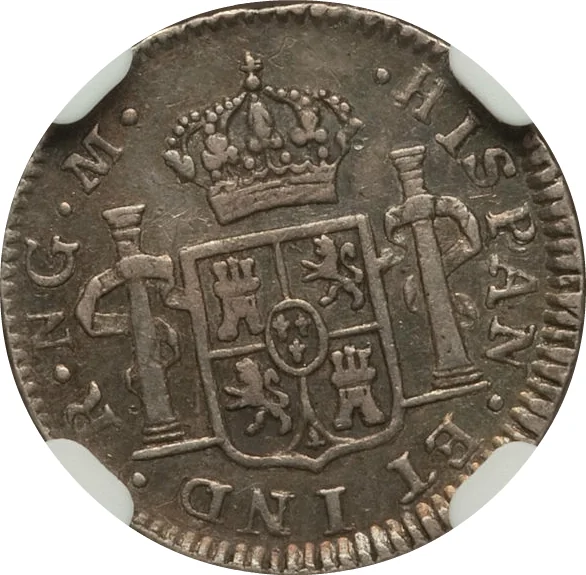
Shield with crowned arms between pillars, encircled by legend.
Inscription:
• HISPAN • ET IND • R • NG • M •
Script: Latin
Edge
Categories
| Symbols> Coat of Arms |
| Person> Monarch |
Mints
| Name | Mark |
|---|---|
| Casa de Moneda de Guatemala | NG |
Mintings
Historical background
In 1791, Guatemala was the heart of the Captaincy General of Guatemala, a Spanish colony encompassing much of Central America. The monetary system was a complex and often problematic reflection of its colonial status, operating under the principles of the Spanish imperial system. The official unit of account was the peso, divisible into 8 reales. However, the physical currency in circulation was a chaotic mix. This included Spanish-minted silver coins like pesos, reales, and half-reales, but also a significant volume of worn, clipped, and counterfeit coins that eroded public trust in everyday transactions.
A critical issue was the severe shortage of low-denomination coins, known as moneda menuda or sencilla, which were essential for market purchases and paying wages. This scarcity, a chronic problem in the Spanish Empire, crippled local commerce and led to the widespread use of substitute currencies. In Guatemala, cacao beans—a holdover from the pre-Columbian economy—were still legally recognized for small transactions in some local markets. More commonly, merchants and municipalities issued their own crude, unofficial lead or copper tokens to facilitate trade, creating a fragmented and unreliable monetary environment.
This situation existed within a restrictive mercantilist framework. Guatemala was legally bound to trade primarily with Spain, and its silver production, while not as vast as Peru or Mexico's, was required to flow to the royal coffers. The crown's periodic attempts to introduce regulated copper coinage to solve the small-change problem often failed due to public suspicion and poor management. Therefore, in 1791, Guatemala's currency situation was defined by an official silver standard strained by a lack of small coinage, a reliance on improvised and illegal substitutes, and the overarching control of a distant imperial power, all of which hindered economic efficiency and growth.
A critical issue was the severe shortage of low-denomination coins, known as moneda menuda or sencilla, which were essential for market purchases and paying wages. This scarcity, a chronic problem in the Spanish Empire, crippled local commerce and led to the widespread use of substitute currencies. In Guatemala, cacao beans—a holdover from the pre-Columbian economy—were still legally recognized for small transactions in some local markets. More commonly, merchants and municipalities issued their own crude, unofficial lead or copper tokens to facilitate trade, creating a fragmented and unreliable monetary environment.
This situation existed within a restrictive mercantilist framework. Guatemala was legally bound to trade primarily with Spain, and its silver production, while not as vast as Peru or Mexico's, was required to flow to the royal coffers. The crown's periodic attempts to introduce regulated copper coinage to solve the small-change problem often failed due to public suspicion and poor management. Therefore, in 1791, Guatemala's currency situation was defined by an official silver standard strained by a lack of small coinage, a reliance on improvised and illegal substitutes, and the overarching control of a distant imperial power, all of which hindered economic efficiency and growth.
💎 Extremely Rare