

1 Thaler – Hungary
Hungary

Obverse
Description:
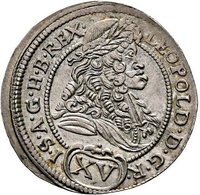
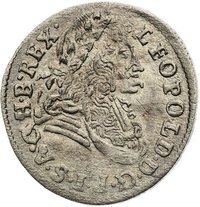
Laureate bust right, curly wig, breaking inner circle with Hungarian shield and Madonna and Child.
Inscription:
LEOPOLDUS · D · G · R · I · S · AV · GE · HV · B · REX
Reverse
Description:
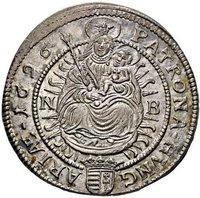
Imperial eagle in circle, crown above date, K B mintmark split by tail. U-shaped cartouche with crowned quadripartite shield (Árpád stripes/Bohemian lion). Central shield with uncrowned Austrian and Burgundian arms.
Inscription:
ARCHID · AV · DV · BV · MAR · MOR · CO · TY · 16 93
C H
C H
Edge
Plain
Mints
| Name | Mark |
|---|---|
| Bratislava | CH |
Mintings
| Year | Mint Mark | Mintage | Quality | Collection |
|---|---|---|---|---|
| 1697 | C | — |
Historical background
In 1697, the Kingdom of Hungary was in a state of profound economic and monetary disarray, a direct consequence of the nearly 150-year Ottoman occupation of its central regions and the ongoing War of the Holy League (1683-1699) to expel the Ottomans. The conflict had devastated the economy, depopulated vast areas, and fragmented the monetary system. The Habsburg government in Vienna, which controlled Royal Hungary, struggled to finance its military campaigns, leading to chronic debasement of the coinage. The primary circulating coins—the silver taler and the smaller copper denars—saw their precious metal content repeatedly reduced, causing severe inflation and a loss of public trust in the currency.
The monetary landscape was a chaotic patchwork. Alongside the officially debased Habsburg coins, older, fuller-weight thalers from earlier periods remained in circulation but were often hoarded. Furthermore, a multitude of foreign coins, including Turkish akçe, Polish and German thalers, and even Dutch ducats, circulated freely due to trade and the movement of armies, creating a complex and unreliable exchange environment. This situation was exacerbated by the activities of counterfeiters and clippers, who exploited the inconsistent coinage. The Habsburg authorities' attempts to impose fixed exchange rates between different coin types repeatedly failed, as market values fluctuated wildly based on metal content and availability.
This currency instability severely hampered economic recovery and daily commerce within the kingdom. It burdened the peasantry and townsfolk, who faced rising prices for basic goods, while also complicating the payment and supply of the imperial armies. The situation underscored the weak control of the central treasury and highlighted the broader challenge of integrating war-ravaged Hungary into the Habsburg fiscal system. The currency crisis of 1697 was, therefore, not merely a financial issue but a symptom of the immense task of reconstruction and integration that would follow the eventual conclusion of the war with the Ottoman Empire.
The monetary landscape was a chaotic patchwork. Alongside the officially debased Habsburg coins, older, fuller-weight thalers from earlier periods remained in circulation but were often hoarded. Furthermore, a multitude of foreign coins, including Turkish akçe, Polish and German thalers, and even Dutch ducats, circulated freely due to trade and the movement of armies, creating a complex and unreliable exchange environment. This situation was exacerbated by the activities of counterfeiters and clippers, who exploited the inconsistent coinage. The Habsburg authorities' attempts to impose fixed exchange rates between different coin types repeatedly failed, as market values fluctuated wildly based on metal content and availability.
This currency instability severely hampered economic recovery and daily commerce within the kingdom. It burdened the peasantry and townsfolk, who faced rising prices for basic goods, while also complicating the payment and supply of the imperial armies. The situation underscored the weak control of the central treasury and highlighted the broader challenge of integrating war-ravaged Hungary into the Habsburg fiscal system. The currency crisis of 1697 was, therefore, not merely a financial issue but a symptom of the immense task of reconstruction and integration that would follow the eventual conclusion of the war with the Ottoman Empire.
✨ Legendary