Logo Title
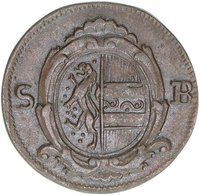
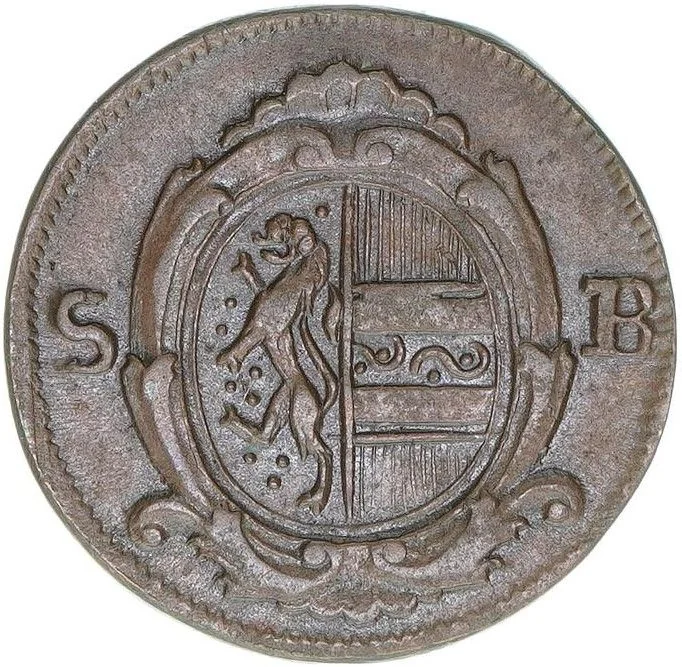
obverse
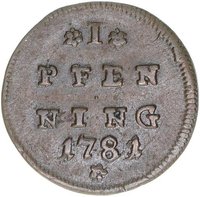
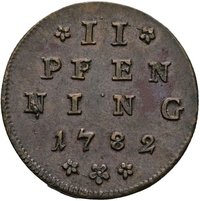
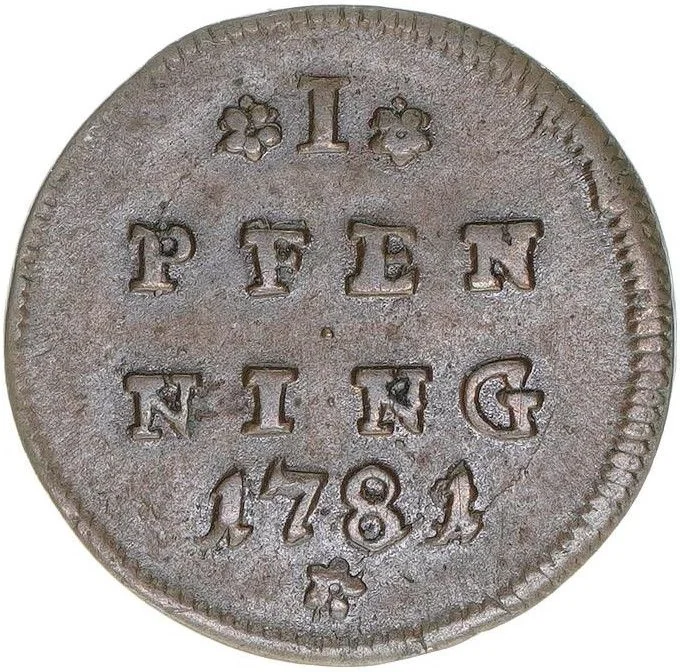
reverse
Numismatik Zöttl

1 Pfennig – Bishopric of Salzburg

Context
Years: 1778–1781
Currency:
Demonetized: Yes
Material
Diameter: 18 mm
Weight: 1.34 g
Shape: Round
Composition: Copper
Magnetic: No
Technique: Milled
Alignment: Medal alignment
Obverse
OBVERSE ↑
flip
Reverse
REVERSE ↑
References
KM: #Click to copy to clipboard441
Numista: #71904

Obverse

Description:
Salzburg arms: oval shield with "S B."
Inscription:
S B
Script: Latin

Reverse

Description:
Value and date in four lines.
A rosette beneath the date.
Inscription:
*I*

PFEN

NING

1781

*
Script: Latin

Edge
Mints

NameMark
Salzburg

Mintings

YearMint MarkMintageQualityCollection
1778
1779
1780
1781

Historical background

In 1778, the currency situation within the Prince-Archbishopric of Salzburg was complex and reflective of the fragmented monetary systems of the Holy Roman Empire. The principality did not have a fully independent minting authority for large silver coinage (like thalers) but instead operated within a broader regional framework. Salzburg primarily issued smaller denomination coins, such as kreuzers and pfennigs, for local use. However, the circulation was dominated by a mixture of foreign coins, particularly from the powerful neighbouring states of Bavaria and Austria, whose larger silver coins were essential for trade and state finance. This created a de facto multi-currency environment where the value and acceptance of money depended heavily on its metallic content and the issuing authority's credibility.

The system was fundamentally based on a silver standard, with values tied to the fine metal content of the coins. A key unit of account was the Conventionsgulden, a standardized silver gulden established by the 1753 Bavarian-Austrian monetary convention, which Salzburg and many other south German states adhered to. This treaty aimed to bring order by defining a common silver content for major coins, setting 1 Conventionsgulden equal to 2/3 of a Conventionsthaler. In daily life, however, people dealt in a confusing array of physical coins—local Salzburg kreuzers (with 60 kreuzers to a Conventionsgulden), Bavarian coins, Austrian coins, and even remnants of older issues, all requiring constant calculation and exchange.

This monetary patchwork posed significant challenges for trade, taxation, and public administration. The need to assay, exchange, and discount various coins created inefficiencies and opportunities for loss. For Archbishop Hieronymus von Colloredo, a reformer influenced by Enlightenment principles, the currency chaos was an administrative and economic nuisance. While no major monetary reform was enacted in 1778 specifically, the situation underscored the broader pressures for standardization and modernized state finance that would culminate in the principality's final years before its secularization and transfer to Austrian rule in the early 19th century.
💎 Extremely Rare