

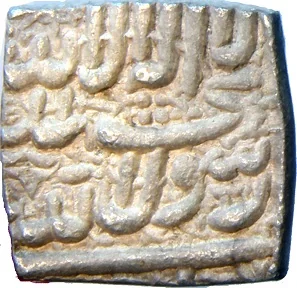
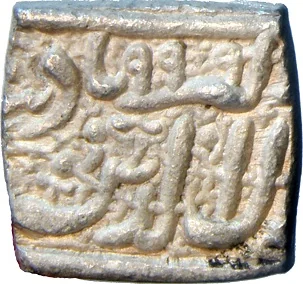
1 Rupee – Mughal Empire
India
Context
Years: 1580–1593
Country: India 
Issuer: Mughal Empire
Ruler: Akbar
Currency:
(1540—1842)
Demonetized: Yes
Material
References
KM: #Click to copy to clipboard82.7
Numista: #71530
Value
Bullion value: $33.15
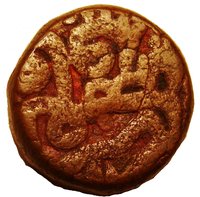
Obverse
Description:
One word.
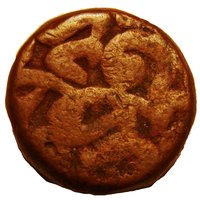
Reverse
Description:
Emperor's name and AH date
Inscription:
AH 999
Edge
Plain
Mintings
| Year | Mint Mark | Mintage | Quality | Collection |
|---|---|---|---|---|
| 1580 | — | — | ||
| 1581 | — | — | ||
| 1582 | — | — | ||
| 1586 | — | — | ||
| 1587 | — | — | ||
| 1588 | — | — | ||
| 1590 | — | — | ||
| 1591 | — | — | ||
| 1592 | — | — | ||
| 1593 | — | — |
Historical background
By 1580, the Mughal Empire under Emperor Akbar had established a sophisticated and centralized monetary system that was crucial for administering his vast territories and funding his ambitious projects. The foundation was the silver rupee, a high-purity coin that served as the primary unit of account and medium for large transactions, revenue collection, and state expenditure. It was complemented by the gold mohur, used for hoarding, ceremonial gifts, and high-value trade, and the copper dam, the everyday currency for the common people in bazaars and local markets. This trimetallic system, with officially fixed exchange rates (though market rates fluctuated), effectively monetized the economy and integrated diverse regions.
This stability was the result of Akbar's deliberate reforms following his consolidation of power. He standardized weight, design, and purity across a network of imperial mints (dar al-zarb), stamping the coins with Islamic inscriptions and the emperor's name to symbolize imperial authority and legitimacy. The system was underpinned by a reliable inflow of silver, primarily from the New World via European trade, which entered the economy through Gujarat's ports. Furthermore, Akbar's land revenue demand was assessed and collected in cash, which compelled agricultural production into the monetary economy and ensured a steady demand for the rupee.
However, the year 1580 itself was marked by a significant monetary disturbance: a major rebellion in the eastern provinces (Bihar and Bengal) that included disaffected imperial mintsmen. This revolt disrupted coin production and distribution, threatening the very symbol of imperial control. Akbar's swift and brutal suppression of the rebellion reaffirmed the state's monopoly over coinage. Consequently, the crisis of 1580 ultimately strengthened the system, leading to even tighter central control over mints and further solidifying the rupee's role as the stable pillar of the Mughal fiscal state for centuries to come.
This stability was the result of Akbar's deliberate reforms following his consolidation of power. He standardized weight, design, and purity across a network of imperial mints (dar al-zarb), stamping the coins with Islamic inscriptions and the emperor's name to symbolize imperial authority and legitimacy. The system was underpinned by a reliable inflow of silver, primarily from the New World via European trade, which entered the economy through Gujarat's ports. Furthermore, Akbar's land revenue demand was assessed and collected in cash, which compelled agricultural production into the monetary economy and ensured a steady demand for the rupee.
However, the year 1580 itself was marked by a significant monetary disturbance: a major rebellion in the eastern provinces (Bihar and Bengal) that included disaffected imperial mintsmen. This revolt disrupted coin production and distribution, threatening the very symbol of imperial control. Akbar's swift and brutal suppression of the rebellion reaffirmed the state's monopoly over coinage. Consequently, the crisis of 1580 ultimately strengthened the system, leading to even tighter central control over mints and further solidifying the rupee's role as the stable pillar of the Mughal fiscal state for centuries to come.
✨ Legendary