

1 Thaler – Anhalt-Bernburg-Schaumburg-Hoym
Germany
Context
Year: 1774
Country: Germany 
Issuer: Anhalt-Bernburg-Schaumburg-Hoym
Ruler: Charles Louis
Currency:
(1727—1812)
Demonetized: Yes
Material
References
KM: #Click to copy to clipboard2
Numista: #70555
Value
Bullion value: $64.37
Obverse
Description:
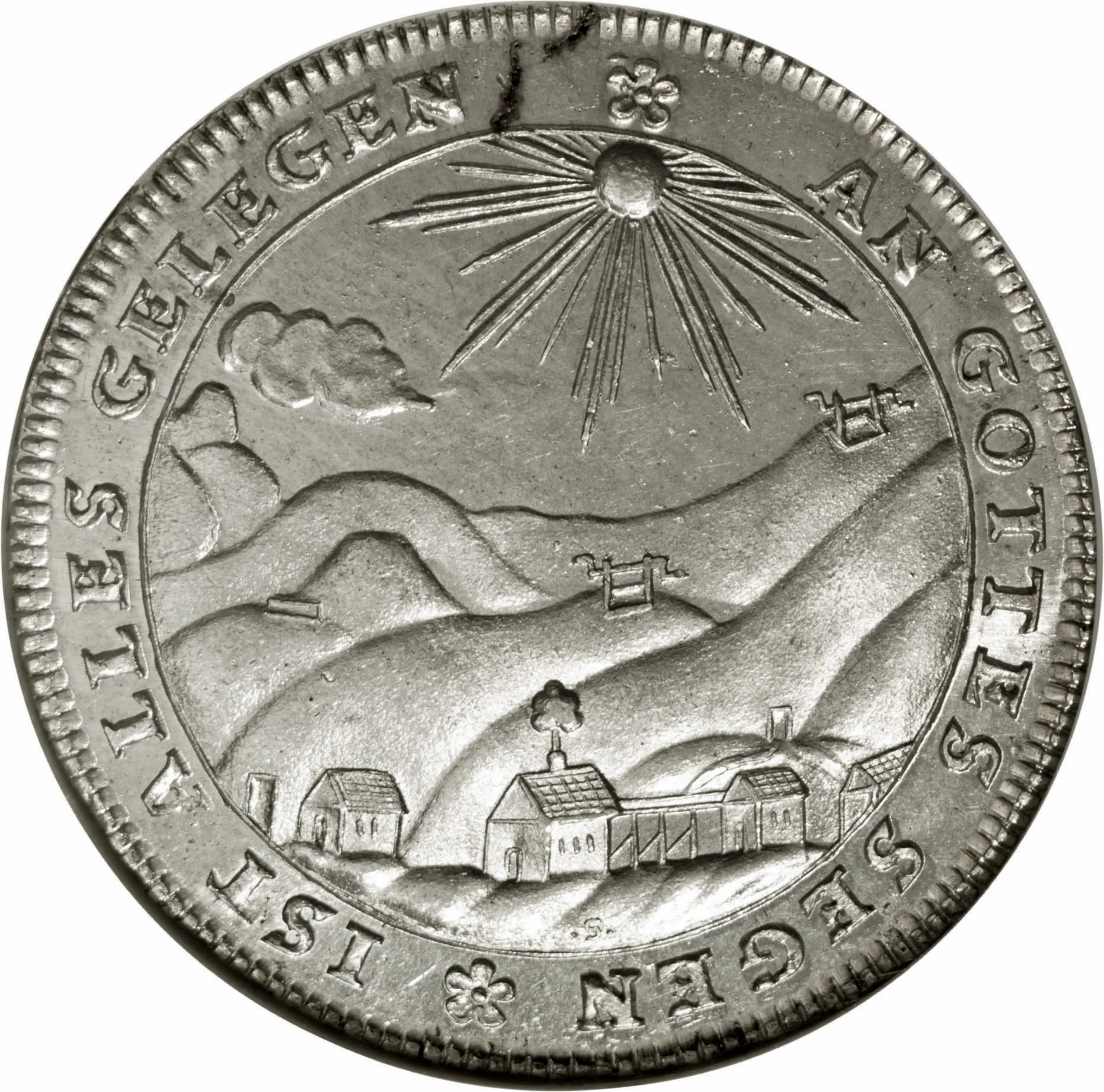
Sun over mining camp and hills.
Inscription:
AN GOTTES SEGEN * IST ALLES GELEGEN *
Script: Latin
Reverse
Description:
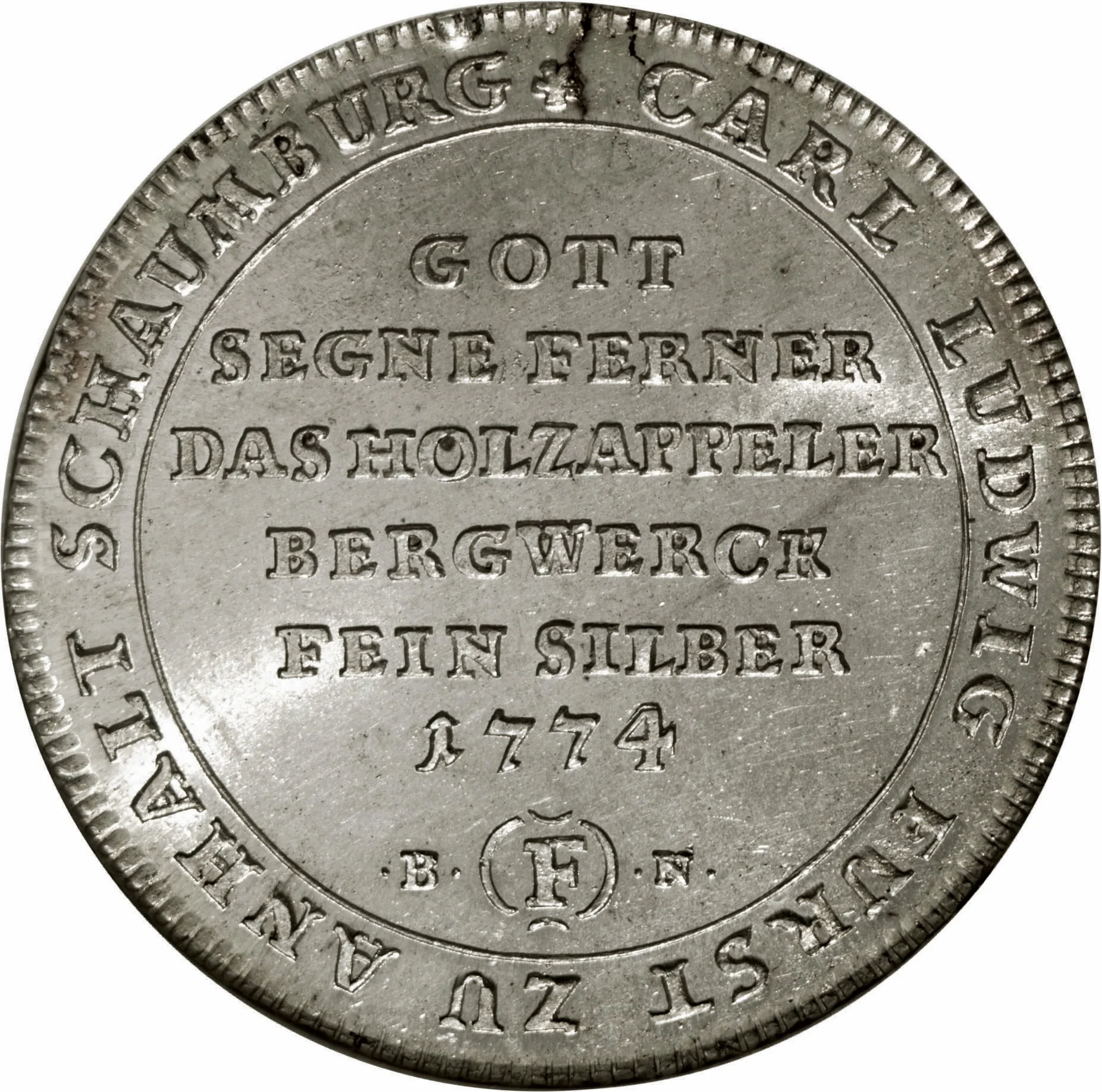
Inscription in seven lines with date and mintmaster initials inside inner circle, legend around.
Inscription:
CARL LUDWIG FURST ZU ANHALT SCHAUMBURG *
GOTT
SEGNE FERNER
DAS HOLZAPPELER
BERGWERCK
FEIN SILBER
1774
.B.(F).N.
GOTT
SEGNE FERNER
DAS HOLZAPPELER
BERGWERCK
FEIN SILBER
1774
.B.(F).N.
Script: Latin
Engravers: Philipp Christian Bunsen, Georg Neumeister
Edge
Mints
| Name | Mark |
|---|---|
| Frankfurt am Main | — |
Mintings
| Year | Mint Mark | Mintage | Quality | Collection |
|---|---|---|---|---|
| 1774 | — | — |
Historical background
In 1774, the currency situation in the small principality of Anhalt-Bernburg-Schaumburg-Hoym was complex and fragmented, reflecting its political reality. The territory was a recent creation, formed in 1727 from a partition of Anhalt-Bernburg, and was itself a minor part of the wider patchwork of German states within the Holy Roman Empire. As such, it lacked a strong, independent monetary system. The principality's economy relied heavily on the circulation of coins issued by larger and more influential neighboring states, particularly various Thalers from Prussia, Saxony, and Brunswick, alongside Reichstalers mandated by imperial law.
Prince Victor II, who ruled from 1727 to 1772, had issued some minor coinage (such as Gute Groschen and Kreuzer), but these were limited in scope and value. By 1774, under his successor Prince Friedrich, the monetary landscape was defined by this dependence on external currencies. The principality's own minting capacity was minimal, and any locally issued coins were primarily for small-scale domestic trade, while larger transactions were conducted in foreign Thalers. This created practical challenges for commerce, as merchants and officials had to constantly manage exchange rates between multiple coinage systems.
Consequently, the currency situation was one of passive integration into broader regional monetary networks rather than sovereign control. The principality was subject to the monetary policies and economic fluctuations of its powerful neighbors, with little ability to influence its own money supply or currency value. This monetary dependence was a direct symptom of Anhalt-Bernburg-Schaumburg-Hoym's political marginality, a common condition for many small German states in the 18th century before the Napoleonic reforms and later German unification imposed greater monetary order.
Prince Victor II, who ruled from 1727 to 1772, had issued some minor coinage (such as Gute Groschen and Kreuzer), but these were limited in scope and value. By 1774, under his successor Prince Friedrich, the monetary landscape was defined by this dependence on external currencies. The principality's own minting capacity was minimal, and any locally issued coins were primarily for small-scale domestic trade, while larger transactions were conducted in foreign Thalers. This created practical challenges for commerce, as merchants and officials had to constantly manage exchange rates between multiple coinage systems.
Consequently, the currency situation was one of passive integration into broader regional monetary networks rather than sovereign control. The principality was subject to the monetary policies and economic fluctuations of its powerful neighbors, with little ability to influence its own money supply or currency value. This monetary dependence was a direct symptom of Anhalt-Bernburg-Schaumburg-Hoym's political marginality, a common condition for many small German states in the 18th century before the Napoleonic reforms and later German unification imposed greater monetary order.
✨ Legendary