

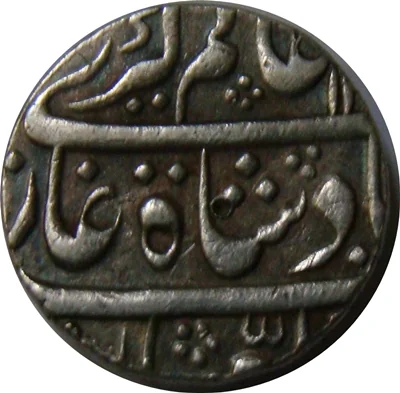
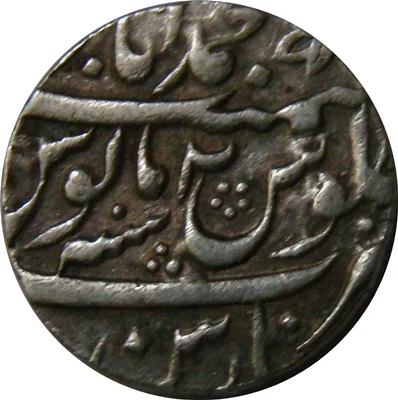
1 rupee – Awadh
Add to wishlist
India
Mints
| Name | Mark |
|---|---|
| Varanasi | — |
Mintings
| Year | Mint Mark | Mintage | Quality | Collection |
|---|---|---|---|---|
| 1755 | — | — | ||
| 1756 | — | — | ||
| 1757 | — | — | ||
| 1758 | — | — | ||
| 1759 | — | — |
Historical background
In 1755, the Nawabi of Awadh, under the rule of Nawab Safdar Jang, operated within a complex and evolving monetary system characteristic of late Mughal successor states. The primary currency was the silver rupee, which existed in a multitude of forms. The most prestigious was the Lucknow rupee, minted in the capital, but numerous other circulating rupees bore the names of older imperial mints (like Delhi or Murshidabad) or regional towns, each with slight variations in weight and purity. Alongside these, gold mohurs and copper dams facilitated larger transactions and small-scale trade, respectively. This system was not unified; it functioned as a bazaar economy where money-changers (sarrafs) were essential, assessing and exchanging coins based on their intrinsic metal value and reputation.
The currency situation was directly tied to political authority and economic pressure. As a nominally subordinate Suba of the decaying Mughal Empire, Awadh initially issued coins in the name of the Mughal Emperor Ahmad Shah Bahadur, affirming a fading political loyalty. However, the Nawab’s fiscal autonomy was growing, and minting was a key sovereign right and source of revenue (seigniorage). Furthermore, the economy was strained by the Nawab’s military obligations to the Mughal court and the looming presence of the Maratha Confederacy, which demanded heavy tribute (chauth). These vast payments, often extracted in silver, could lead to local liquidity shortages and heightened the importance of treasury management.
This period marked a transition. While the system was still fundamentally medieval, relying on hand-struck coins and bullion, the pressures of the mid-18th century were setting the stage for change. The need to finance armies and administration made currency debasement a constant temptation for rulers, gradually eroding public trust in specific coinages. The scene was thus one of layered complexity: a hybrid Mughal-local identity on coins, a fragile balance between political submission and autonomy, and an economy where the value of money literally depended on the weight and fineness of each piece of metal, expertly judged in the bustling sarrafs' quarters of Lucknow and Faizabad.
The currency situation was directly tied to political authority and economic pressure. As a nominally subordinate Suba of the decaying Mughal Empire, Awadh initially issued coins in the name of the Mughal Emperor Ahmad Shah Bahadur, affirming a fading political loyalty. However, the Nawab’s fiscal autonomy was growing, and minting was a key sovereign right and source of revenue (seigniorage). Furthermore, the economy was strained by the Nawab’s military obligations to the Mughal court and the looming presence of the Maratha Confederacy, which demanded heavy tribute (chauth). These vast payments, often extracted in silver, could lead to local liquidity shortages and heightened the importance of treasury management.
This period marked a transition. While the system was still fundamentally medieval, relying on hand-struck coins and bullion, the pressures of the mid-18th century were setting the stage for change. The need to finance armies and administration made currency debasement a constant temptation for rulers, gradually eroding public trust in specific coinages. The scene was thus one of layered complexity: a hybrid Mughal-local identity on coins, a fragile balance between political submission and autonomy, and an economy where the value of money literally depended on the weight and fineness of each piece of metal, expertly judged in the bustling sarrafs' quarters of Lucknow and Faizabad.
✨ Legendary