

25 kuna (Independence of Croatia) – Croatia
Add to wishlist
Circulating commemorative coins
Commemoration: 10th Anniversary of Independence of the Republic of Croatia
Croatia
Context
Material
Diameter: 32 mm
Weight: 12.75 g
Thickness: 2.2 mm
Shape: Dodecagonal
Technique: Milled
Alignment: Medal alignment
flip
References
KM: #
Numista: #11967
Value
Exchange value: 25 HRK
Obverse
Description:
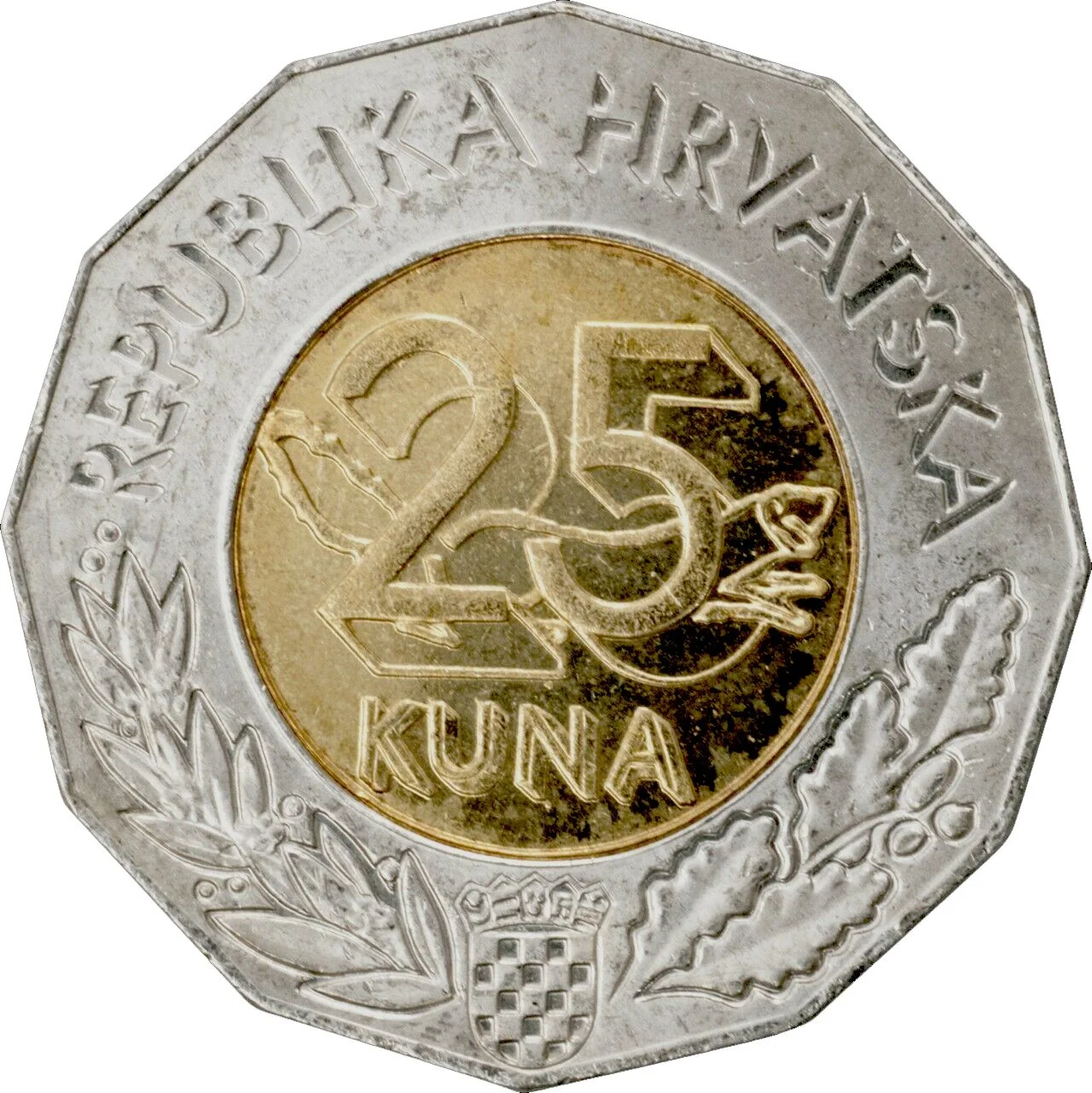
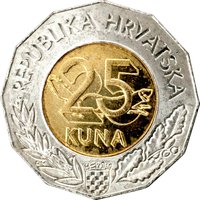
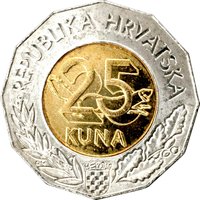
The brass center features the number "25" with a marten running right within its contours, and the word "KUNA" below. The outer ring displays the Croatian coat of arms flanked by laurel and oak branches, with "REPUBLIKA HRVATSKA" above.
Inscription:
REPUBLIKA HRVATSKA
25
KUNA
25
KUNA
Translation:
REPUBLIC OF CROATIA
25
KUNA
25
KUNA
Script: Latin
Language: Croatian
Engraver: Damir Mataušić
Reverse
Description:
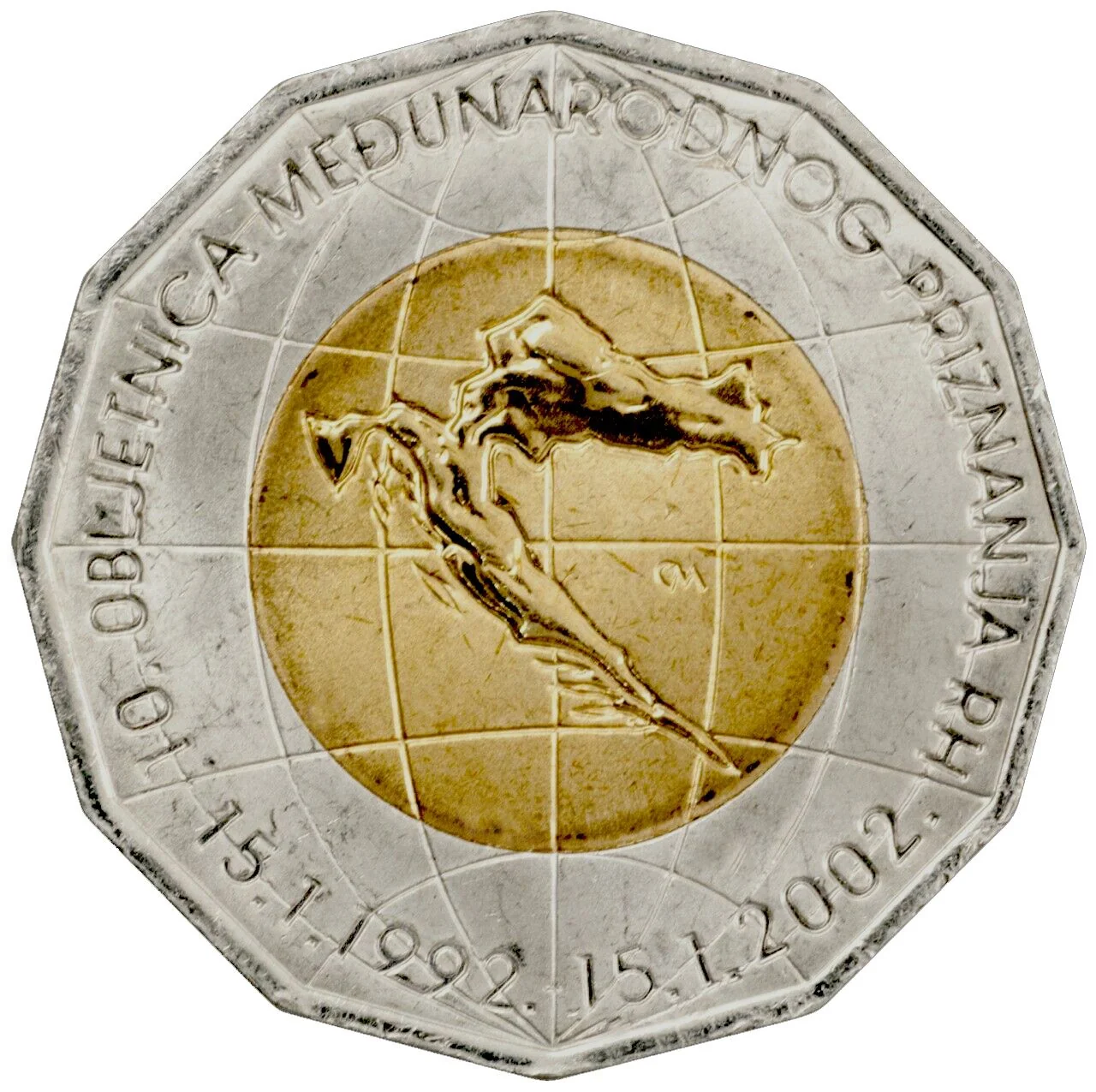
A brass ring centers a map of Croatia overlaid with lines symbolizing parallels and meridians, presenting Croatia as independent on the globe. Below are the dates "15.1.1992. - 15.1.2002." and the inscription "10. OBLJETNICA MEDUNARODNOG PRIZNANJA RH". The engraver's signature (DM) appears to the right of the map.
Inscription:
10. OBLJETNICA MEĐUNARODNOG PRIZNANJA RH
15.1.1992. - 15.1.2002.
DM
15.1.1992. - 15.1.2002.
DM
Translation:
10TH ANNIVERSARY OF INTERNATIONAL RECOGNITION OF THE REPUBLIC OF CROATIA
15.1.1992. - 15.1.2002.
KM
15.1.1992. - 15.1.2002.
KM
Script: Latin
Language: Croatian
Engraver: Damir Mataušić
Edge
Plain
Categories
| Map |
Mints
| Name | Mark |
|---|---|
| Croatian Mint | — |
Mintings
| Year | Mint Mark | Mintage | Quality | Collection |
|---|---|---|---|---|
| 2002 | — | 200,000 | ||
| 2002 | — | 1,000 | Proof |
Historical background
In 2002, Croatia was in a critical period of monetary transition, operating under a managed float exchange rate regime with the kuna (HRK) as its national currency, introduced in 1994 following hyperinflation. The primary focus of the Croatian National Bank (CNB) was ensuring macroeconomic stability, with a particular emphasis on maintaining low and stable inflation. To achieve this, the kuna was tightly managed against a currency basket, heavily weighted toward the euro (which had just entered physical circulation that January), reflecting Croatia's deep trade and financial ties with the Eurozone. This policy provided stability but required significant foreign exchange interventions by the CNB to manage volatility.
The broader economic context was shaped by post-war reconstruction, structural reforms, and a growing dependence on tourism and foreign debt. While the currency regime was successful in taming inflation, it came with trade-offs, including high euroization of the banking system where a majority of savings and loans were denominated in foreign currency, primarily euros. This created vulnerability for households and businesses to exchange rate fluctuations, despite the kuna's stability. Furthermore, the country's current account deficit was widening, fueled by strong import demand, raising concerns about long-term external sustainability.
Looking ahead, 2002 was a year of strategic positioning for deeper European integration. Croatia had signed a Stabilization and Association Agreement with the EU in 2001, formally setting it on the path to membership. Consequently, while not an immediate prospect, the long-term strategic goal of adopting the euro began to influence policy discussions. The existing de facto peg to the euro was seen as a preparatory step, aligning the economy with the Eurozone's stability criteria, though the immediate priority remained using the managed kuna to anchor the economy before any future membership in the Exchange Rate Mechanism (ERM II).
The broader economic context was shaped by post-war reconstruction, structural reforms, and a growing dependence on tourism and foreign debt. While the currency regime was successful in taming inflation, it came with trade-offs, including high euroization of the banking system where a majority of savings and loans were denominated in foreign currency, primarily euros. This created vulnerability for households and businesses to exchange rate fluctuations, despite the kuna's stability. Furthermore, the country's current account deficit was widening, fueled by strong import demand, raising concerns about long-term external sustainability.
Looking ahead, 2002 was a year of strategic positioning for deeper European integration. Croatia had signed a Stabilization and Association Agreement with the EU in 2001, formally setting it on the path to membership. Consequently, while not an immediate prospect, the long-term strategic goal of adopting the euro began to influence policy discussions. The existing de facto peg to the euro was seen as a preparatory step, aligning the economy with the Eurozone's stability criteria, though the immediate priority remained using the managed kuna to anchor the economy before any future membership in the Exchange Rate Mechanism (ERM II).
🌱 Common