

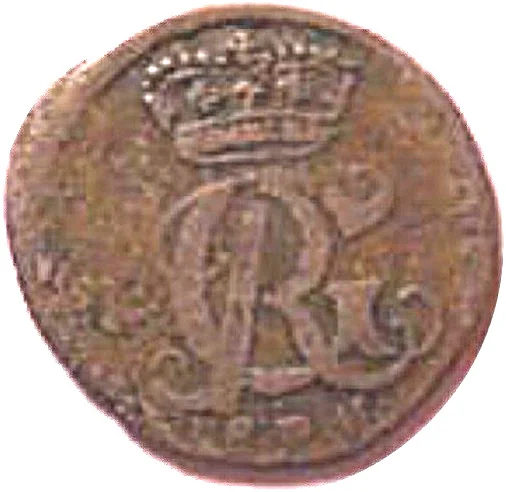
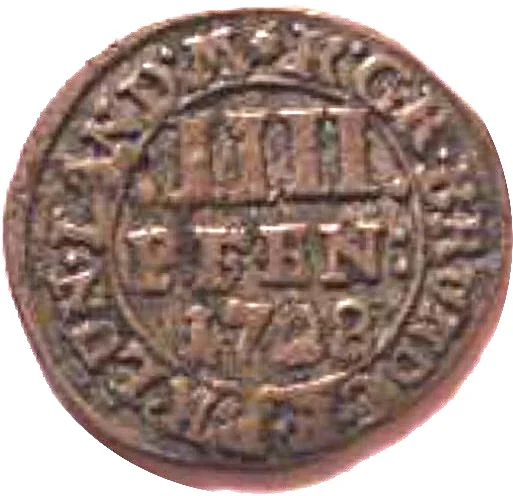
4 Pfennigs – Brunswick-Lüneburg-Calenberg-Hannover
Germany

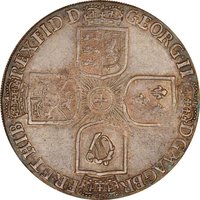
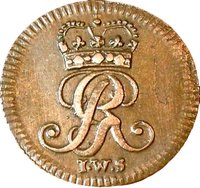
Obverse
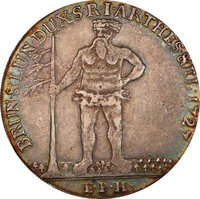
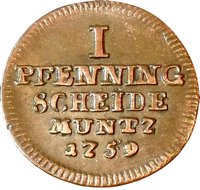
Reverse
Description:
3-line inscription encircling.
Inscription:
.IIII.
PFEN:
1728
*K'GR.BRUND.C.F.BR.LUN.LAND.M
PFEN:
1728
*K'GR.BRUND.C.F.BR.LUN.LAND.M
Script: Latin
Edge
Plain
Mints
| Name | Mark |
|---|---|
| Clausthal | — |
| Zellerfeld | — |
Mintings
| Year | Mint Mark | Mintage | Quality | Collection |
|---|---|---|---|---|
| 1728 | — | — | ||
| 1729 | — | — | ||
| 1731 | — | — | ||
| 1732 | — | — | ||
| 1733 | — | — | ||
| 1735 | — | — | ||
| 1738 | — | — | ||
| 1739 | — | — | ||
| 1744 | — | — | ||
| 1745 | — | — | ||
| 1746 | — | — | ||
| 1750 | — | — | ||
| 1752 | — | — | ||
| 1753 | — | — | ||
| 1754 | — | — | ||
| 1755 | — | — | ||
| 1756 | — | — | ||
| 1759 | — | — | ||
| 1760 | — | — |
Historical background
In 1728, the currency situation in the Duchy of Brunswick-Lüneburg, specifically the Principality of Calenberg (with its capital in Hanover), was characterized by significant instability and complexity, a legacy of the Great Northern War and regional fragmentation. The monetary system was a confusing patchwork, with multiple currencies in simultaneous circulation. These included the Reichsthaler (the theoretical imperial standard), the Conventionsthaler (a slightly different regional standard), and a plethora of lower-denomination Gute Groschen, Mariengroschen, and Pfennige from various German states. Furthermore, the widespread use of debased Kippermünzen (emergency coinage) from the war years had severely eroded public trust and disrupted commerce.
The root of the problem lay in the discrepancy between the official Kurantgeld (full-value specie) and the chronically depreciated Landesmünze (everyday small change). Duke George II Augustus, who was also the British King George II, governed the territory but was often absent, leaving administration to local officials. The state treasury struggled with debt, and the temptation to generate revenue through periodic Münzverrufungen (the recall and re-minting of coins at a worse standard) was a persistent destabilizing factor. This practice effectively taxed the populace through currency devaluation, creating uncertainty for merchants and hindering economic growth.
Consequently, 1728 fell within a period of ongoing monetary crisis rather than a year of definitive reform. While discussions about establishing a more stable and uniform currency were underway, influenced by broader Enlightenment ideas of cameralism and economic order, no major recoinage or standardization was enacted that year. The situation demanded a comprehensive monetary treaty or Münzfuß (coinage standard) to unify the system, a goal that would only be pursued more forcefully in the following decades, ultimately leading to Hanover's adoption of the Conventionsthaler standard as part of a broader regional stabilization effort.
The root of the problem lay in the discrepancy between the official Kurantgeld (full-value specie) and the chronically depreciated Landesmünze (everyday small change). Duke George II Augustus, who was also the British King George II, governed the territory but was often absent, leaving administration to local officials. The state treasury struggled with debt, and the temptation to generate revenue through periodic Münzverrufungen (the recall and re-minting of coins at a worse standard) was a persistent destabilizing factor. This practice effectively taxed the populace through currency devaluation, creating uncertainty for merchants and hindering economic growth.
Consequently, 1728 fell within a period of ongoing monetary crisis rather than a year of definitive reform. While discussions about establishing a more stable and uniform currency were underway, influenced by broader Enlightenment ideas of cameralism and economic order, no major recoinage or standardization was enacted that year. The situation demanded a comprehensive monetary treaty or Münzfuß (coinage standard) to unify the system, a goal that would only be pursued more forcefully in the following decades, ultimately leading to Hanover's adoption of the Conventionsthaler standard as part of a broader regional stabilization effort.
✨ Legendary