

2 Kune – Independent State of Croatia
Croatia
Context
Year: 1941
Country: Croatia 
Issuer: Independent State of Croatia
Demonetization: 9 July 1945
Total mintage: 1,750,000
Material
References
KM: #Click to copy to clipboard2
Numista: #11962
Obverse
Description:
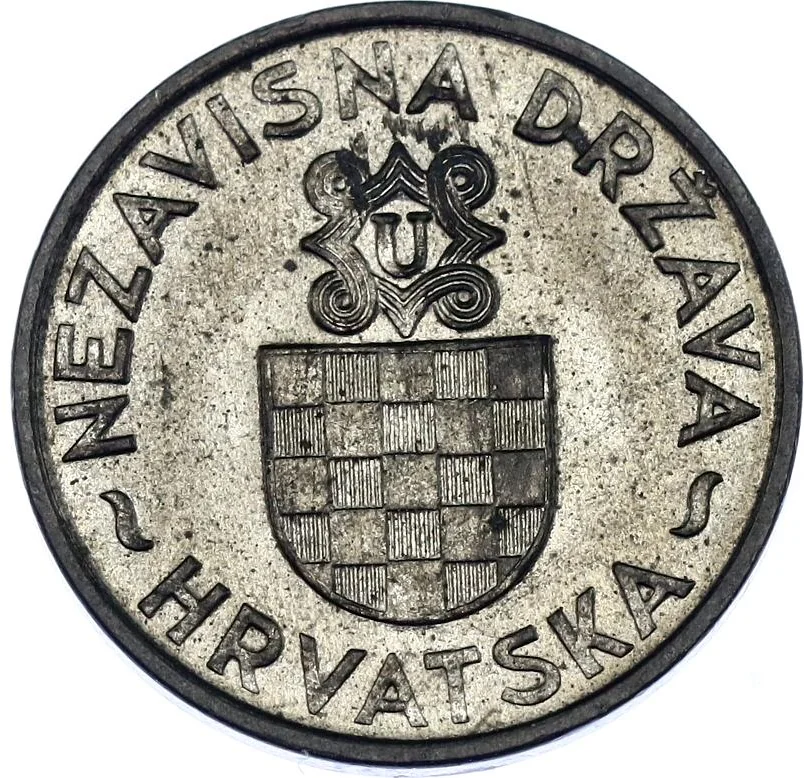
NEZAVISNA DRŽAVA is inscribed along the top edge and HRVATSKA along the bottom. The center features the old Croatian coat of arms surmounted by a letter U within a three-ribbon interlace.
Inscription:
~ NEZAVISNA DRŽAVA ~ HRVATSKA
U
U
Translation:
~ INDEPENDENT STATE ~ CROATIA
Script: Latin
Language: Croatian
Engraver: Ivo Kerdić
Reverse
Description:
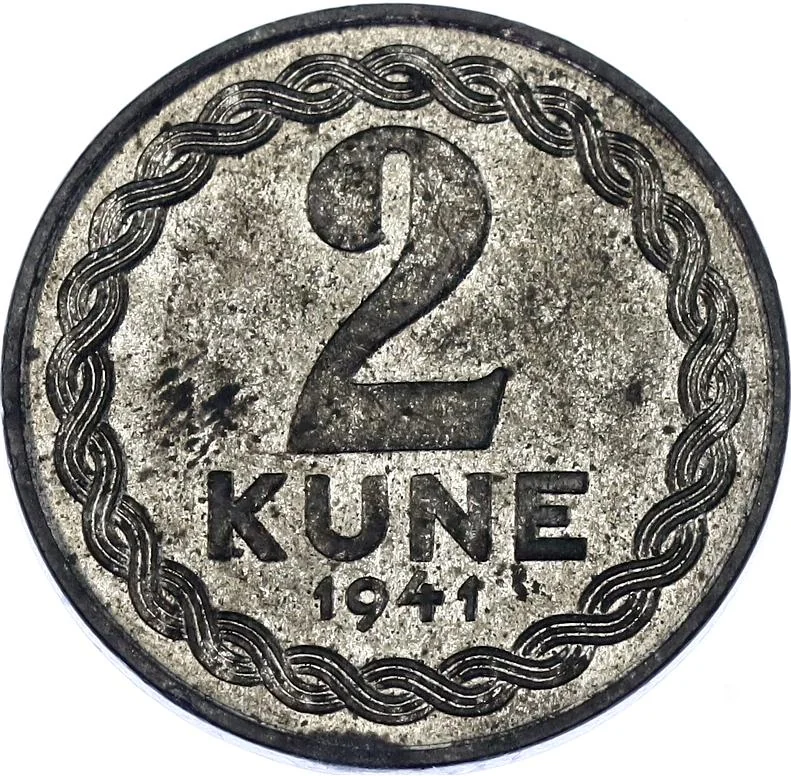
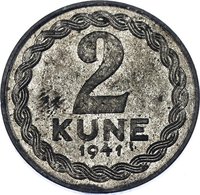
The coin's edge features a Christian braided pattern, with its central face value "2 KUNE" above the mint year 1941.
Inscription:
2
KUNE
1941
KUNE
1941
Translation:
KUNE
Script: Latin
Language: Albanian
Engraver: Ivo Kerdić
Edge
Plain
Categories
| Symbols> Coat of Arms |
Mints
| Name | Mark |
|---|---|
| Zagreb / Zágráb | — |
Mintings
| Year | Mint Mark | Mintage | Quality | Collection |
|---|---|---|---|---|
| 1941 | — | 1,750,000 | ||
| 1941 | — | — | Proof |
Historical background
The currency situation in the Independent State of Croatia (NDH) from its establishment in April 1941 was complex and unstable, directly reflecting the puppet state's contested sovereignty and wartime economy. The new regime immediately faced the challenge of replacing the former Yugoslav dinar, introducing the kuna as its official currency in July 1941. However, the kuna was not a strong, independent currency; it was pegged at par to the German Reichsmark and its circulation was limited, functioning more as a supplemental occupation script.
In practice, the monetary landscape was a chaotic mosaic of concurrent currencies, undermining the NDH's economic authority. Alongside the kuna, the German Reichsmark, the Italian lira, and even the old Yugoslav dinar remained in widespread use, especially in their respective zones of military and political influence. This fragmentation was a direct result of the NDH's division into German and Italian spheres of control, with each occupying power promoting its own currency for military procurement and local transactions, thereby stifling the kuna's legitimacy.
The period was characterized by severe inflation, which accelerated dramatically as the war turned against the Axis powers. The NDH government, engaged in extensive warfare and persecution, resorted to printing money to cover its deficits, leading to a rapid devaluation of the kuna. By 1945, the currency had become virtually worthless, mirroring the complete collapse of the state itself. Thus, the NDH's currency saga transitioned from a politically symbolic creation to an instrument of fiscal expediency, ending in the hyperinflation typical of a disintegrating wartime regime.
In practice, the monetary landscape was a chaotic mosaic of concurrent currencies, undermining the NDH's economic authority. Alongside the kuna, the German Reichsmark, the Italian lira, and even the old Yugoslav dinar remained in widespread use, especially in their respective zones of military and political influence. This fragmentation was a direct result of the NDH's division into German and Italian spheres of control, with each occupying power promoting its own currency for military procurement and local transactions, thereby stifling the kuna's legitimacy.
The period was characterized by severe inflation, which accelerated dramatically as the war turned against the Axis powers. The NDH government, engaged in extensive warfare and persecution, resorted to printing money to cover its deficits, leading to a rapid devaluation of the kuna. By 1945, the currency had become virtually worthless, mirroring the complete collapse of the state itself. Thus, the NDH's currency saga transitioned from a politically symbolic creation to an instrument of fiscal expediency, ending in the hyperinflation typical of a disintegrating wartime regime.
🌱 Common