

1 lipa (FAO history) – Croatia
Add to wishlist
Circulating commemorative coins
Commemoration: 50 years of FAO
Croatia
Obverse
Description:
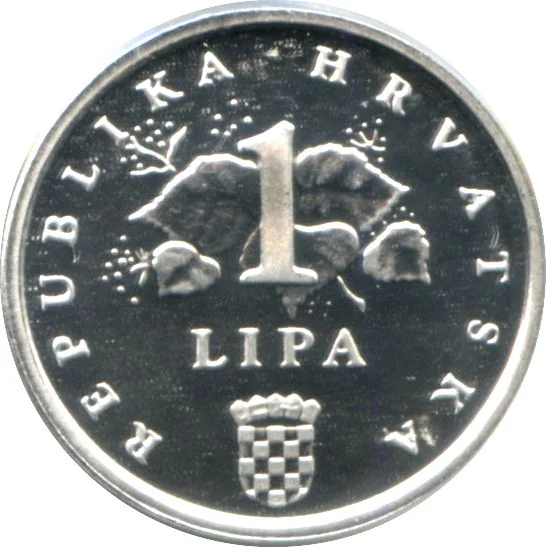
A stylized linden branch with inflorescence appears in the center, its leaves bearing the numeral 1 and the word "LIPA." Below the branch is the coat of arms of Croatia, around which the inscription "REPUBLIKA HRVATSKA" curves along the bottom edge.
Inscription:
REPUBLIKA HRVATSKA
1
LIPA
1
LIPA
Translation:
REPUBLIC OF CROATIA
1
LIPA
1
LIPA
Script: Latin
Language: Croatian
Engraver: Kuzma Kovačić
Reverse
Description:
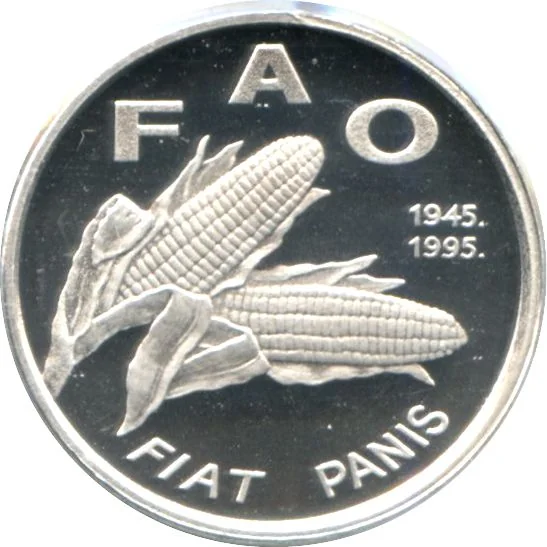
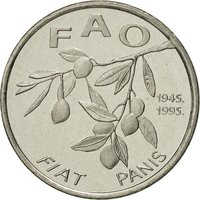
A stylized corn stalk with two ears is flanked by the inscription "FAO" above and "FIAT PANIS" below, with the years 1945 and 1995.
Inscription:
F A O
1945.
1995.
FIAT PANIS
1945.
1995.
FIAT PANIS
Translation:
F A O
1945.
1995.
Let there be bread.
1945.
1995.
Let there be bread.
Script: Latin
Engraver: Kuzma Kovačić
Edge
Plain
Categories
| Organization> FAO |
| Symbols> Coat of Arms |
Mints
| Name | Mark |
|---|---|
| Croatian Mint | — |
Mintings
| Year | Mint Mark | Mintage | Quality | Collection |
|---|---|---|---|---|
| 1995 | — | 1,000,000 | ||
| 1995 | — | 5,000 | Proof |
Historical background
In 1995, Croatia was in a complex monetary transition, operating under a dual-currency system while laying the groundwork for its future financial sovereignty. The official currency was the Croatian dinar (HRD), introduced in 1991 following independence from Yugoslavia to replace the Yugoslav dinar. However, due to hyperinflation experienced in the early 1990s and a lack of public confidence, the dinar was largely sidelined in everyday use. Instead, the Deutsche Mark (DEM) functioned as the de facto parallel currency for savings, major transactions, and as a psychological anchor of stability, reflecting the population's desire for a hard, trustworthy currency.
This period was one of active stabilization and preparation. The Croatian National Bank, under Governor Pero Jurković, had successfully tamed the hyperinflation of the early post-independence years through stringent monetary policy. The focus in 1995 was on maintaining that stability and building foreign currency reserves, a task complicated by the ongoing Homeland War, which would conclude with the Erdut Agreement in November. The government, led by the Croatian Democratic Union (HDZ), was simultaneously implementing broader economic reforms, often in consultation with the International Monetary Fund, to create conditions for a stronger, unified national currency.
Consequently, 1995 served as the final preparatory year before a pivotal monetary reform. The widespread use of the Deutsche Mark, combined with achieved macroeconomic stability, set the stage for the introduction of a new, strong national currency. This plan came to fruition just a few months later, in May 1996, when the kuna (HRK) replaced the Croatian dinar at a rate of 1 kuna = 1,000 dinars, and was firmly pegged to the Deutsche Mark. Thus, the situation in 1995 was characterized by a managed but unofficial deutschemarkization, providing a bridge to the kuna-based monetary system that would define Croatia's economy for decades.
This period was one of active stabilization and preparation. The Croatian National Bank, under Governor Pero Jurković, had successfully tamed the hyperinflation of the early post-independence years through stringent monetary policy. The focus in 1995 was on maintaining that stability and building foreign currency reserves, a task complicated by the ongoing Homeland War, which would conclude with the Erdut Agreement in November. The government, led by the Croatian Democratic Union (HDZ), was simultaneously implementing broader economic reforms, often in consultation with the International Monetary Fund, to create conditions for a stronger, unified national currency.
Consequently, 1995 served as the final preparatory year before a pivotal monetary reform. The widespread use of the Deutsche Mark, combined with achieved macroeconomic stability, set the stage for the introduction of a new, strong national currency. This plan came to fruition just a few months later, in May 1996, when the kuna (HRK) replaced the Croatian dinar at a rate of 1 kuna = 1,000 dinars, and was firmly pegged to the Deutsche Mark. Thus, the situation in 1995 was characterized by a managed but unofficial deutschemarkization, providing a bridge to the kuna-based monetary system that would define Croatia's economy for decades.
🌱 Common