

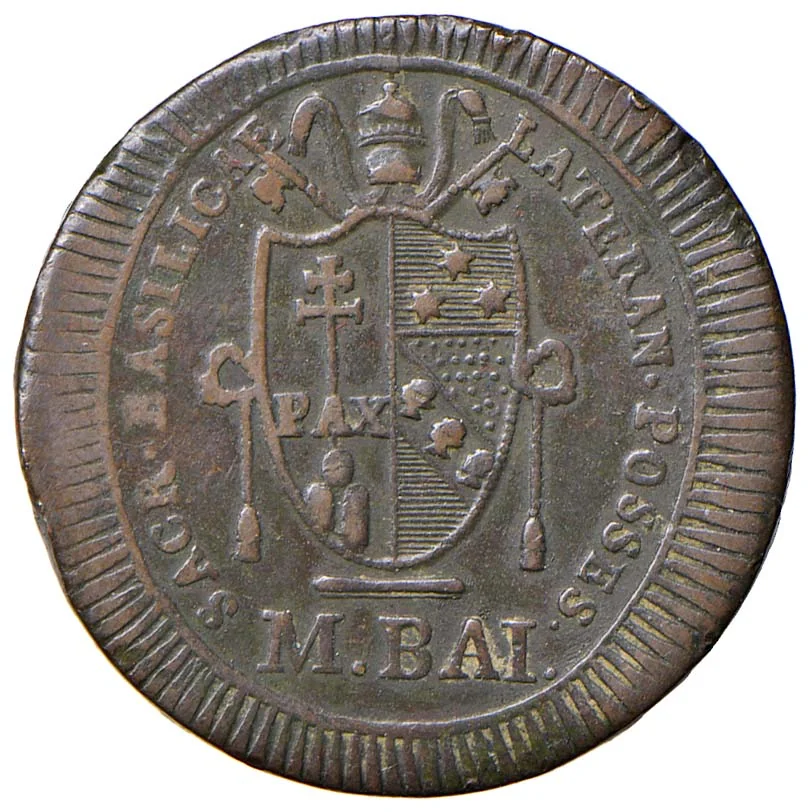
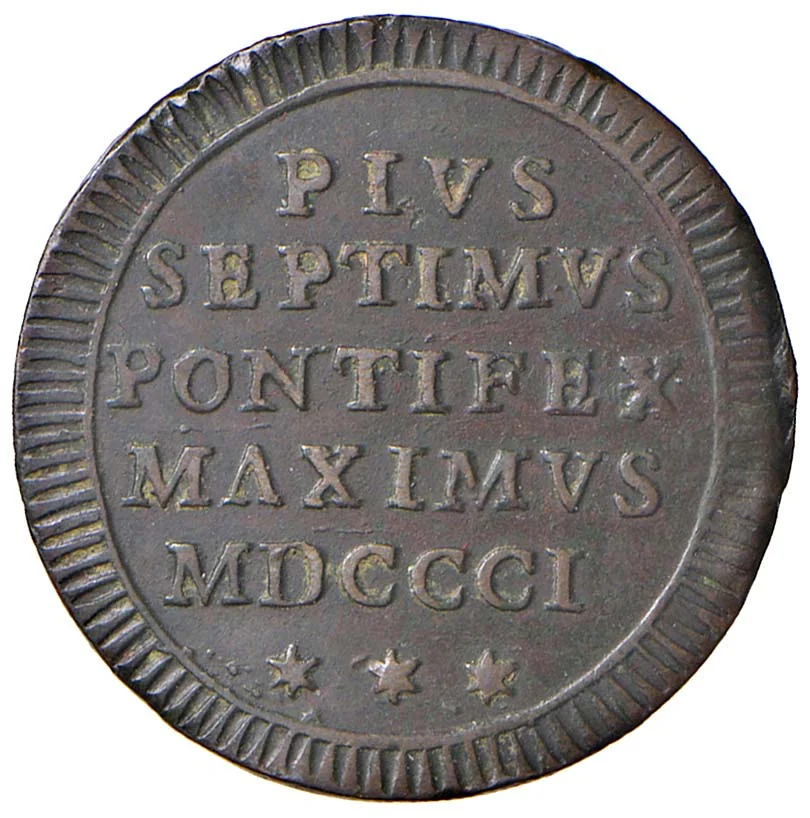
½ Baiocco – Papal States
Circulating commemorative coins
Commemoration: Taking possession of the Lateran, 24th November 1801
Vatican City
Context
Year: 1801
Country: Vatican City 
Issuer: Papal States
Ruler: Pius VII
Currency:
(1534—1835)
Demonetized: Yes
Material
References
KM: #Click to copy to clipboard1261
Numista: #119552
Obverse
Description:
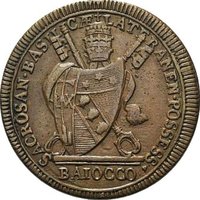
Papal arms above, value below.
Inscription:
SACR·BASILICAE· LATERAN·POSSESS
M.BAI.
M.BAI.
Script: Latin
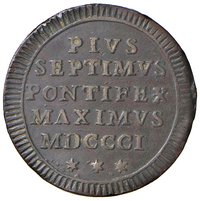
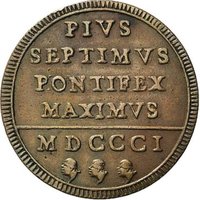
Reverse
Edge
Plain
Mints
| Name | Mark |
|---|---|
| Rome | — |
Mintings
| Year | Mint Mark | Mintage | Quality | Collection |
|---|---|---|---|---|
| 1801 | — | — |
Historical background
In 1801, the Papal States found itself in a complex and precarious monetary situation, deeply entangled with the political upheavals of the Napoleonic era. Following the French invasion of 1798-1799, which had established the short-lived Roman Republic, the restored papal government under Pope Pius VII faced a shattered economy. The French had looted the treasury, melted down precious metal for war funds, and introduced a chaotic mix of occupation currency, including the Roman scudo and the French franc, severely undermining public trust in the monetary system. The return to papal authority did not bring immediate stability, as the state grappled with a legacy of debt, depleted specie reserves, and a circulation of debased and foreign coins.
The core of the problem was the absence of a unified and authoritative currency. While the official unit of account remained the scudo, divided into 100 baiocchi, the actual coins in circulation were a heterogeneous mix. These included older papal issues of varying purity, coins from neighboring Italian states, French revolutionary currency, and even counterfeits. This fragmentation crippled commerce, as the value of coins was determined more by their metallic content and perceived legitimacy than by their face value, leading to confusion, arbitrage, and rampant inflation for everyday goods. The government's ability to mint new, high-quality coinage was constrained by both a lack of bullion and the ongoing political uncertainty.
Consequently, the early years of the 19th century were a period of ad-hoc management rather than systematic reform. The papal authorities focused on gradual recoinage to reassert sovereignty and stabilize the medium of exchange, but progress was slow. The situation remained fragile and directly tied to the broader European conflict; the Treaty of Lunéville (1801), which recognized French territorial gains, left the Papal States in a vulnerable position, financially and politically dependent on Napoleon's goodwill. This instability would culminate just a few years later with another French occupation in 1808, which would forcibly replace the papal monetary system entirely with the French franc, sweeping away the old order before a true restoration of a stable papal currency could be achieved.
The core of the problem was the absence of a unified and authoritative currency. While the official unit of account remained the scudo, divided into 100 baiocchi, the actual coins in circulation were a heterogeneous mix. These included older papal issues of varying purity, coins from neighboring Italian states, French revolutionary currency, and even counterfeits. This fragmentation crippled commerce, as the value of coins was determined more by their metallic content and perceived legitimacy than by their face value, leading to confusion, arbitrage, and rampant inflation for everyday goods. The government's ability to mint new, high-quality coinage was constrained by both a lack of bullion and the ongoing political uncertainty.
Consequently, the early years of the 19th century were a period of ad-hoc management rather than systematic reform. The papal authorities focused on gradual recoinage to reassert sovereignty and stabilize the medium of exchange, but progress was slow. The situation remained fragile and directly tied to the broader European conflict; the Treaty of Lunéville (1801), which recognized French territorial gains, left the Papal States in a vulnerable position, financially and politically dependent on Napoleon's goodwill. This instability would culminate just a few years later with another French occupation in 1808, which would forcibly replace the papal monetary system entirely with the French franc, sweeping away the old order before a true restoration of a stable papal currency could be achieved.
💎 Extremely Rare