

1 Thaler – Württemberg-Oels, Duchy and Prussian rule of
Germany
Context
Year: 1785
Country: Germany 
Ruler: Charles Christian Erdmann
Currency:
(since 1785)
Demonetized: Yes
References
KM: #Click to copy to clipboard87
Numista: #64599
Value
Bullion value: $61.29
Obverse
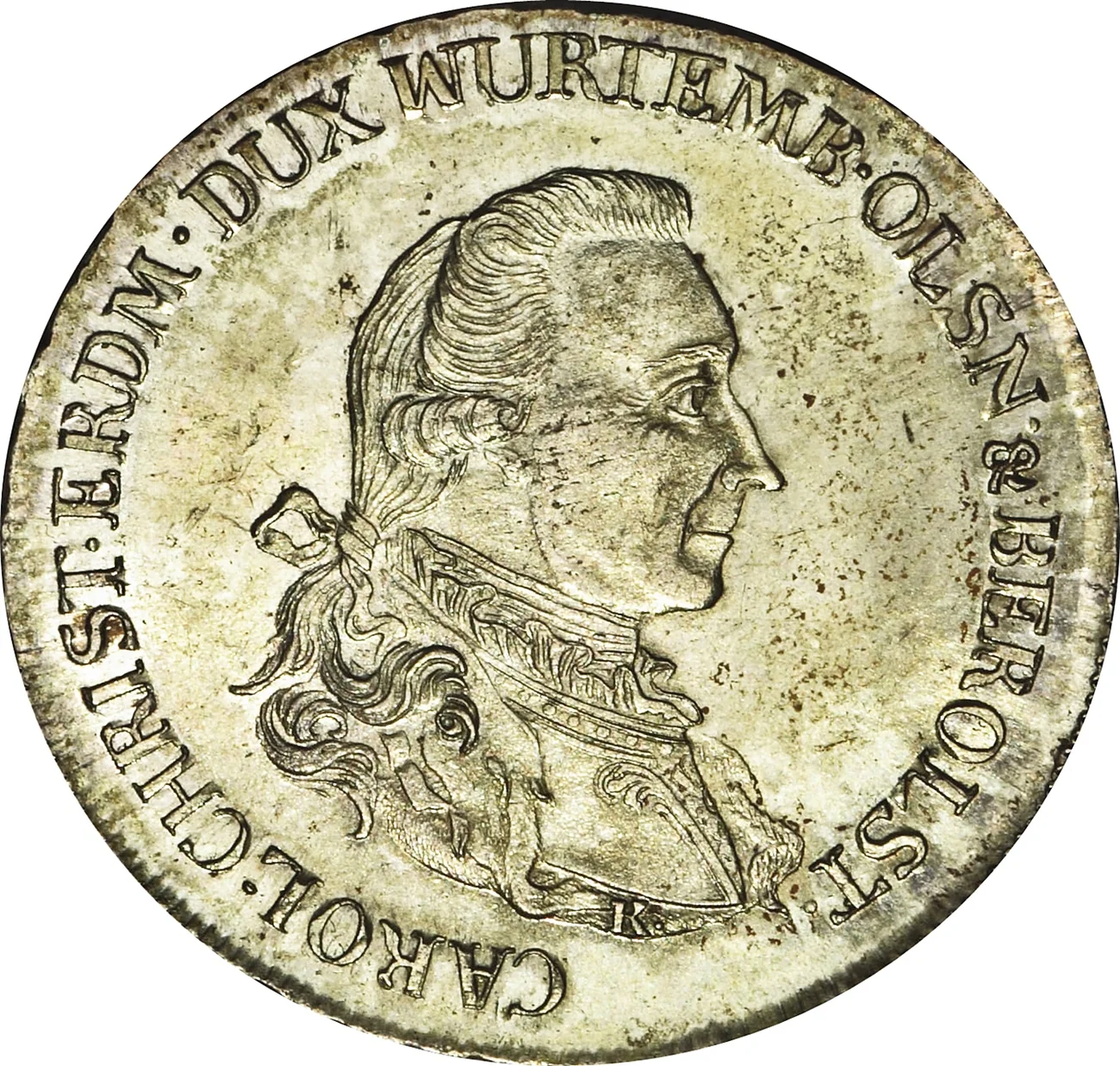
Description:
Bust right, K below.
Inscription:
CAROL.CHRIST.ERDM.DUX WURTEMB.OLSN.&BEROLST.
Script: Latin
Reverse
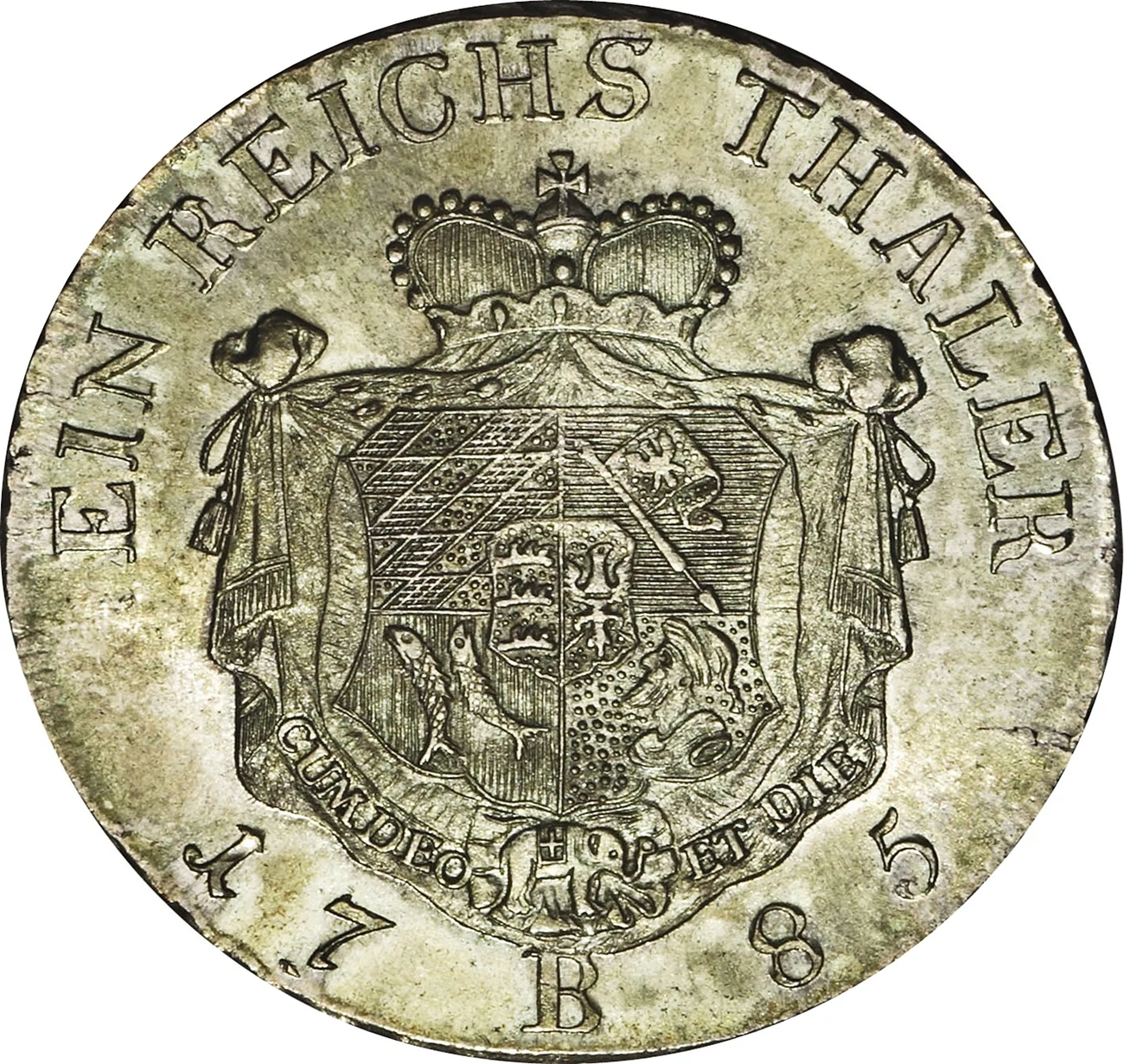
Description:
Arms crowned and mantled, dated below.
Inscription:
EIN REICHS THALER
17 / 85
CUM DEO / ET DIE
17 / 85
CUM DEO / ET DIE
Script: Latin
Edge
Mintings
| Year | Mint Mark | Mintage | Quality | Collection |
|---|---|---|---|---|
| 1785 | K//B | — |
Historical background
In 1785, the currency situation in Württemberg-Oels was complex, shaped by its dual political identity. The Duchy of Oels (Oleśnica) in Silesia was a Mediatized territory, meaning it was ruled by a branch of the House of Württemberg but lay within the sovereign borders of the Kingdom of Prussia. Consequently, while the Duke had certain administrative powers, monetary sovereignty rested entirely with the Prussian state. The official and mandatory currency was therefore Prussian, dominated by the Reichsthaler, which was divided into 24 Groschen, each of 12 Pfennige.
This Prussian system coexisted with the lingering memory and occasional practical use of older regional currencies, particularly the Austrian Conventionsthaler, a remnant from before Silesia became Prussian in 1742. Furthermore, the Württemberg-Oels dukes, like other German princes, occasionally issued limited Landmünzen (local coinage) for ceremonial purposes or small-scale local use. However, these coins had to align with the Prussian monetary standard and their circulation was secondary to the robust Prussian coinage, which facilitated trade and tax payments within the wider Prussian realm.
Thus, the monetary landscape was one of de jure uniformity under the efficient Prussian system, which provided stability and integration into the larger Prussian economy. De facto, it reflected a transitional historical layer, where older Austrian units were still understood by the population and minor ducal issues symbolized local autonomy, all underpinned by the firm authority of Frederick the Great's centralizing Prussian state.
This Prussian system coexisted with the lingering memory and occasional practical use of older regional currencies, particularly the Austrian Conventionsthaler, a remnant from before Silesia became Prussian in 1742. Furthermore, the Württemberg-Oels dukes, like other German princes, occasionally issued limited Landmünzen (local coinage) for ceremonial purposes or small-scale local use. However, these coins had to align with the Prussian monetary standard and their circulation was secondary to the robust Prussian coinage, which facilitated trade and tax payments within the wider Prussian realm.
Thus, the monetary landscape was one of de jure uniformity under the efficient Prussian system, which provided stability and integration into the larger Prussian economy. De facto, it reflected a transitional historical layer, where older Austrian units were still understood by the population and minor ducal issues symbolized local autonomy, all underpinned by the firm authority of Frederick the Great's centralizing Prussian state.
✨ Legendary