

2 skilling – Denmark
Add to wishlist
Denmark
Context
Material
Diameter: 19 mm
Weight: 1.23 g
Thickness: 0.5 mm
Shape: Irregular round
Alignment: Coin alignment
flip
References
KM: #
Numista: #62374
Obverse
Description:
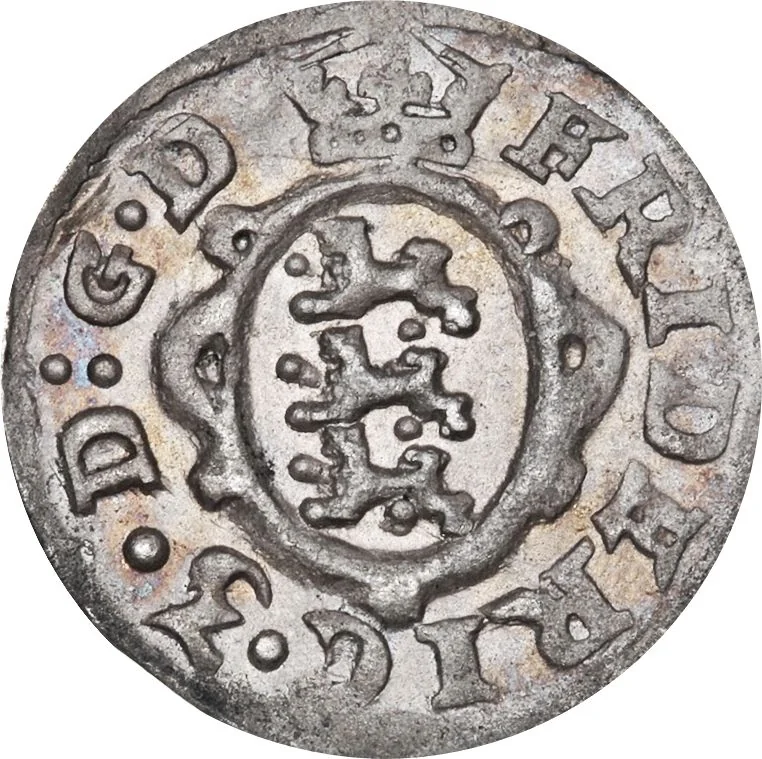
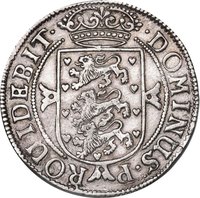
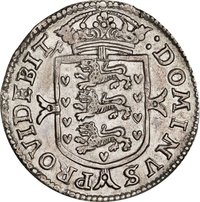
Shield with Danish arms, crowned. Circular legend.
Inscription:
FREDERIC.3.D:G.D
Script: Latin
Reverse
Description:
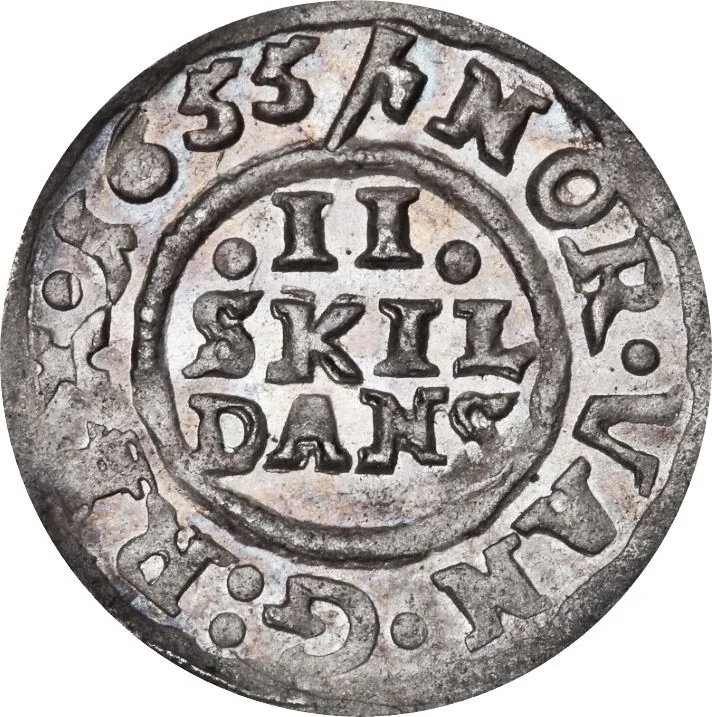
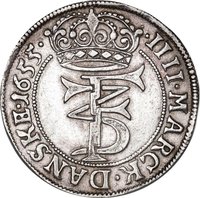
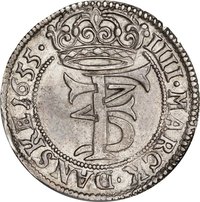
Three-line inscription in circle.
Outer legend with date and mintmark.
Outer legend with date and mintmark.
Inscription:
NOR.VAN.G.REX.1655
II
SKIL
DANS
II
SKIL
DANS
Script: Latin
Edge
Plain
Mints
| Name | Mark |
|---|---|
| Copenhagen | (h) |
Mintings
| Year | Mint Mark | Mintage | Quality | Collection |
|---|---|---|---|---|
| 1654 | h | — | ||
| 1655 | h | — |
Historical background
In 1654, Denmark operated under a bimetallic monetary system, a legacy of the 1625 Kurantordningen (Currency Regulation). This system officially valued silver coins (kurantmønter) in a fixed ratio to gold coins, but in practice, it was chronically unstable. The state's finances were severely strained following the devastating losses in the Thirty Years' War and the Torstenson War against Sweden, which had ended just a few years prior in 1645. To cover massive war debts and ongoing expenses, the Danish crown, under King Frederik III, repeatedly resorted to debasing the coinage—reducing the precious metal content in newly minted coins while mandating they hold the same face value. This created a widening gap between the intrinsic value of the coins and their nominal worth.
The result was monetary chaos and a classic case of Gresham's Law, where "bad money drives out good." Older, full-weight coins were hoarded, melted down, or exported, while the new, inferior coins flooded circulation, eroding public trust and causing inflation. The situation was further complicated by a parallel system of kreditmønter (credit money), which were accounting units used for large transactions and not physically minted. This created a complex and confusing multi-currency environment where the values of kurant, mark, and rigsdaler fluctuated against each other, hampering trade and economic stability.
This precarious currency situation formed a critical backdrop to the political crisis that would erupt in 1657. The state's financial weakness, rooted in the disordered monetary system, limited its options and contributed to the mounting tensions that led to the catastrophic Karl Gustav Wars (1657-1660) against Sweden. The war's aftermath and the subsequent introduction of absolute monarchy in 1660 would eventually force a comprehensive and authoritarian monetary reform, but in 1654, Denmark was mired in a period of significant financial fragility and monetary confusion.
The result was monetary chaos and a classic case of Gresham's Law, where "bad money drives out good." Older, full-weight coins were hoarded, melted down, or exported, while the new, inferior coins flooded circulation, eroding public trust and causing inflation. The situation was further complicated by a parallel system of kreditmønter (credit money), which were accounting units used for large transactions and not physically minted. This created a complex and confusing multi-currency environment where the values of kurant, mark, and rigsdaler fluctuated against each other, hampering trade and economic stability.
This precarious currency situation formed a critical backdrop to the political crisis that would erupt in 1657. The state's financial weakness, rooted in the disordered monetary system, limited its options and contributed to the mounting tensions that led to the catastrophic Karl Gustav Wars (1657-1660) against Sweden. The war's aftermath and the subsequent introduction of absolute monarchy in 1660 would eventually force a comprehensive and authoritarian monetary reform, but in 1654, Denmark was mired in a period of significant financial fragility and monetary confusion.
💎 Very Rare