

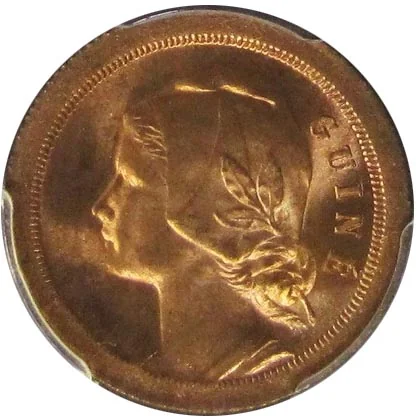
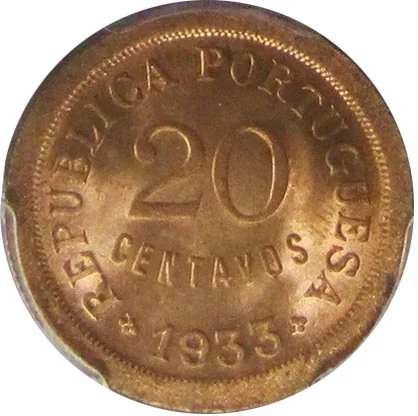
20 Centavos – Portuguese Guinea
Guinea-Bissau
Context
Year: 1933
Country: Guinea-Bissau 
Issuer: Portuguese Guinea
Period:
(1910—1951)
Currency:
(1914—1975)
Demonetized: Yes
Total mintage: 350,000
Material
References
KM: #Click to copy to clipboard3
Numista: #11941
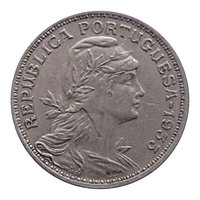
Obverse
Reverse
Description:
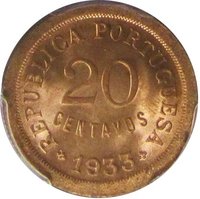
Center denomination, date below, encircling legend.
Inscription:
REPUBLICA PORTUGUESA
20 CENTAVOS
*1933*
20 CENTAVOS
*1933*
Translation:
Portuguese Republic
20 Centavos
*1933*
20 Centavos
*1933*
Script: Latin
Language: Portuguese
Edge
Reeded
Categories
| Symbol> Allegory |
| Symbol> Phrygian cap |
Mints
| Name | Mark |
|---|---|
| Imprensa Nacional - Casa da Moeda | — |
Mintings
| Year | Mint Mark | Mintage | Quality | Collection |
|---|---|---|---|---|
| 1933 | — | 350,000 |
Historical background
In 1933, the currency situation in Portuguese Guinea (present-day Guinea-Bissau) was firmly integrated into Portugal's colonial monetary system. The official currency was the Portuguese escudo, which had replaced the real in 1911 following the establishment of the Portuguese Republic. As a colony, Portuguese Guinea did not issue its own distinct banknotes or coins but used the metropolitan currency, facilitating trade and fiscal control from Lisbon. This integration meant that the colony's monetary policy and money supply were entirely dictated by the Banco de Portugal, with no local central banking authority.
The economy was predominantly based on agriculture, with peanuts being the primary cash crop for export. The use of hard currency was largely concentrated in the port capital of Bissau and among Portuguese administrators, traders, and a small urban commercial class. In the vast rural interior, a barter economy and informal credit systems remained widespread, with currency playing a secondary role to the exchange of goods and labor. Furthermore, limited banking infrastructure meant that physical escudo coins and notes were scarce outside of main commercial centers.
This monetary arrangement served Portugal's mercantilist interests, ensuring that export revenues were easily convertible and repatriated. However, it also underscored the colony's underdeveloped economic state and its role as an extractive periphery. The system provided monetary stability tied to the metropole but offered little flexibility to address local economic needs, a characteristic feature of Portugal's centralized and restrictive colonial administration under the Estado Novo regime, which was consolidated in 1933.
The economy was predominantly based on agriculture, with peanuts being the primary cash crop for export. The use of hard currency was largely concentrated in the port capital of Bissau and among Portuguese administrators, traders, and a small urban commercial class. In the vast rural interior, a barter economy and informal credit systems remained widespread, with currency playing a secondary role to the exchange of goods and labor. Furthermore, limited banking infrastructure meant that physical escudo coins and notes were scarce outside of main commercial centers.
This monetary arrangement served Portugal's mercantilist interests, ensuring that export revenues were easily convertible and repatriated. However, it also underscored the colony's underdeveloped economic state and its role as an extractive periphery. The system provided monetary stability tied to the metropole but offered little flexibility to address local economic needs, a characteristic feature of Portugal's centralized and restrictive colonial administration under the Estado Novo regime, which was consolidated in 1933.
🌱 Fairly Common