

50 riyals – Qatar
Add to wishlist
Non-circulating coins
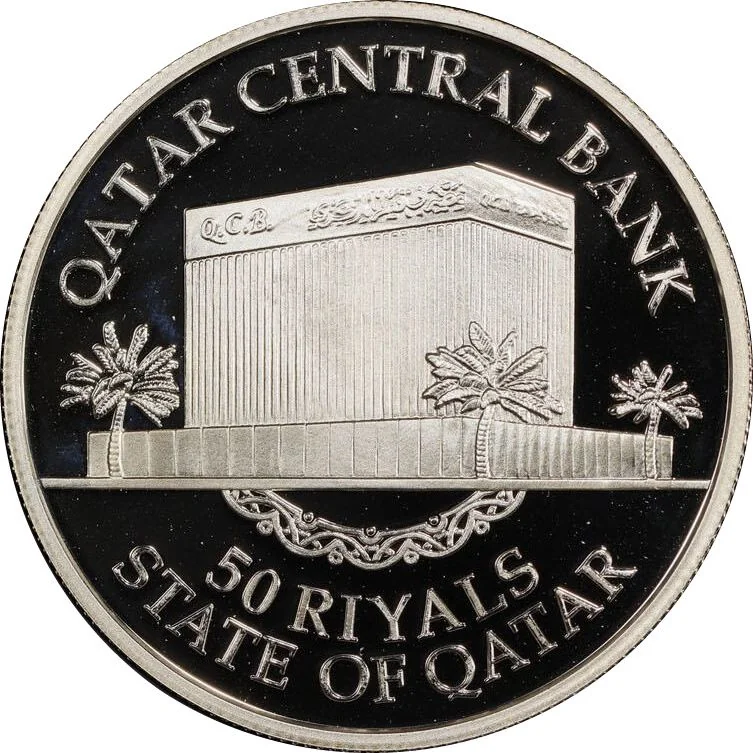
Commemoration: Qatar Central Bank
Qatar
Context
Year: 2006
Issuer: Qatar
Ruler: Hamad bin Khalifa Al Thani
Currency:
(since 1973)
Total mintage: 500
Material
References
Numista: #119370
Value
Exchange value: 50 QAR
Bullion value: $49.46
Obverse
Description:
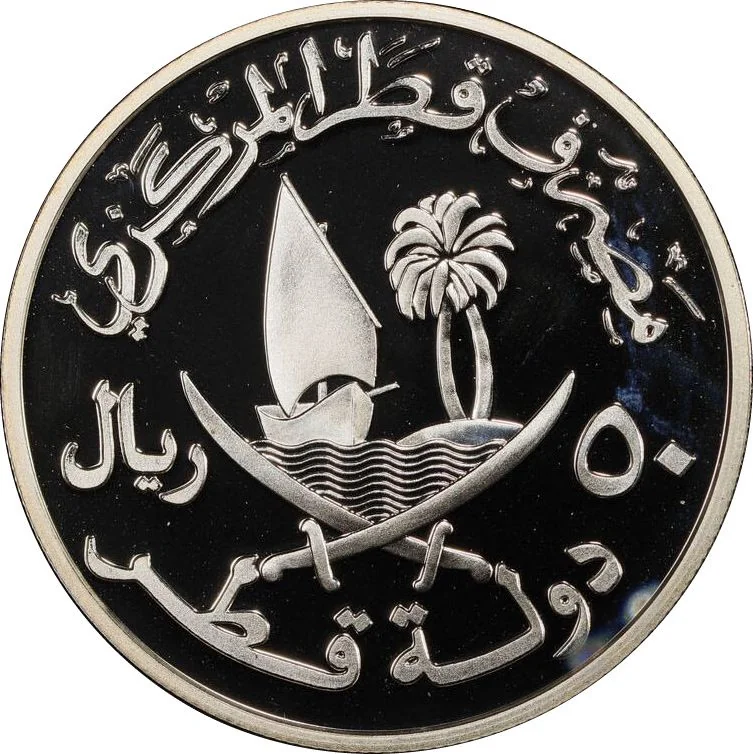
Qatar's emblem: two crossed scimitars flanking a dhow sailing past a palm-tree island. Value.
Inscription:
مَصرَف قَطَر المركَزي
٥٠ ريال
دولة قطر
٥٠ ريال
دولة قطر
Translation:
Qatar Central Bank
50 Riyals
State of Qatar
50 Riyals
State of Qatar
Language: Arabic
Reverse
Edge
Mints
| Name | Mark |
|---|---|
| Münze Österreich | — |
Mintings
| Year | Mint Mark | Mintage | Quality | Collection |
|---|---|---|---|---|
| 2006 | — | 500 | Proof |
Historical background
In 2006, Qatar's currency, the Qatari Riyal (QAR), was firmly pegged to the US Dollar at a fixed rate of 3.64 QAR per USD, a policy established in July 2001. This peg replaced a previous link to the Special Drawing Rights (SDR) basket and was a strategic decision to ensure monetary stability, attract foreign investment, and provide predictability for its dominant hydrocarbon exports, which were priced in dollars. The peg was managed by the Qatar Central Bank (QCB), which maintained substantial foreign exchange reserves to defend the fixed rate, a task made manageable by the nation's immense gas and oil revenues.
The period was characterized by a significant economic divergence, often described as a "policy trilemma." While the dollar peg provided stability, the US Federal Reserve was raising interest rates to combat inflation, forcing the QCB to follow suit to maintain the peg's credibility. This occurred even as Qatar's own economy was booming due to high energy prices, which typically would call for a different monetary policy. Consequently, rising local inflation—driven by a construction boom, population growth, and imported inflation—became a growing concern, as the peg limited the central bank's ability to use interest rates independently to cool the domestic economy.
Despite these underlying pressures, the currency regime itself faced no serious speculative attacks or volatility in 2006. The nation's vast financial reserves, consistent current account surpluses, and unwavering political commitment to the dollar anchor ensured the peg's stability. The debate among economists and within Qatari financial circles was not about immediate de-pegging, but rather about the long-term suitability of the arrangement given the inflationary side-effects and Qatar's rapidly growing economic linkages beyond the United States. The situation underscored a trade-off: the peg provided a bedrock of stability for development but at the cost of surrendering autonomous monetary policy.
The period was characterized by a significant economic divergence, often described as a "policy trilemma." While the dollar peg provided stability, the US Federal Reserve was raising interest rates to combat inflation, forcing the QCB to follow suit to maintain the peg's credibility. This occurred even as Qatar's own economy was booming due to high energy prices, which typically would call for a different monetary policy. Consequently, rising local inflation—driven by a construction boom, population growth, and imported inflation—became a growing concern, as the peg limited the central bank's ability to use interest rates independently to cool the domestic economy.
Despite these underlying pressures, the currency regime itself faced no serious speculative attacks or volatility in 2006. The nation's vast financial reserves, consistent current account surpluses, and unwavering political commitment to the dollar anchor ensured the peg's stability. The debate among economists and within Qatari financial circles was not about immediate de-pegging, but rather about the long-term suitability of the arrangement given the inflationary side-effects and Qatar's rapidly growing economic linkages beyond the United States. The situation underscored a trade-off: the peg provided a bedrock of stability for development but at the cost of surrendering autonomous monetary policy.

✨ Legendary