


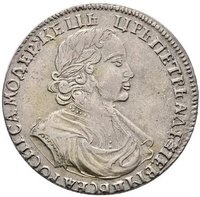
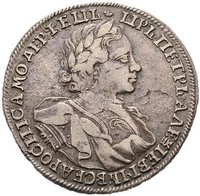
Obverse
Description:
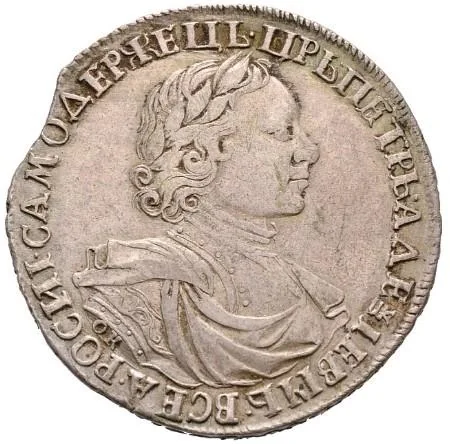
Peter I bust with encircling legend.
Inscription:
ЦРЬ·ПЕТРЬ·АЛЕѮИЕВIЧЬ·ВСЕѦ·РОСИI·САМОДЕРЖЕЦЬ
ОК
ОК
Script: Cyrillic
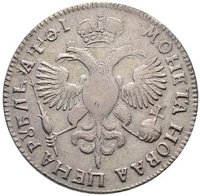
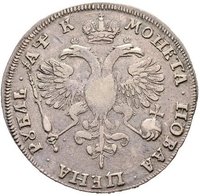
Reverse
Description:
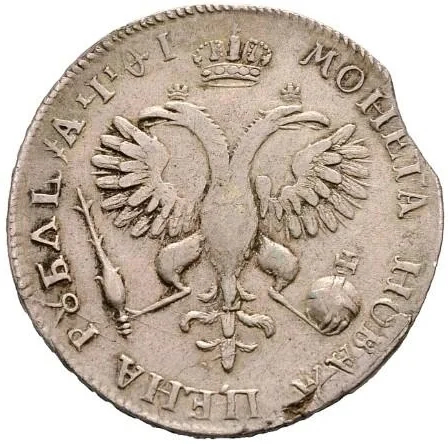
Double-headed eagle crowned, surrounded by legend.
Inscription:
МОНЕТА НОВАѦ ЦЕНА РƔБЛЬ ҂А ΨӨI
Script: Cyrillic
Edge
Smooth with lettering
Legend:
МОСКОВЬСКI УКАЗЬНЫ РУБЛЕВIКЪ МАНЕТНАГО ДВОРА 1719
Categories
| Symbol> Double-headed eagle |
Mints
| Name | Mark |
|---|---|
| Kadashevsky Mint | — |
Mintings
| Year | Mint Mark | Mintage | Quality | Collection |
|---|---|---|---|---|
| 1719 | OK | — |
Historical background
In 1719, the currency system of the Russian Empire was in a state of profound crisis, a direct consequence of Tsar Peter the Great's expensive military campaigns, particularly the Great Northern War (1700-1721). To finance his modernizing army and the construction of a new capital at St. Petersburg, Peter had resorted to a drastic measure: the systematic debasement of the silver coinage. Starting in 1711, the silver content of small denomination coins like kopeks was progressively reduced, effectively creating a forced state revenue through inflation. By 1719, this had led to a severe disparity between the face value of the debased silver coins and their intrinsic metal worth, causing widespread economic disruption, hoarding of older full-weight coins, and a deep loss of public trust in the currency.
Recognizing the unsustainable damage, 1719 marked a pivotal year as Peter and his officials began preparing for a major monetary reform. The state halted the minting of the debased low-silver kopeks and initiated plans for a comprehensive recoinage based on a new, stable monetary standard. The proposed system was designed to align Russia with European practices, introducing large-denomination silver rubles and copper coins for small change, with fixed metallic values. This period was one of transition and planning, where the chaotic consequences of the old policy were acutely felt, while the machinery for a new order was being assembled.
Therefore, the currency situation in 1719 was characterized by this tense duality. In daily life, merchants and peasants contended with a confusing and unstable mix of old and new coins of varying purity, which hampered trade and fostered uncertainty. Simultaneously, in government circles, it was a year of decisive shift toward stabilization. The reform, which would be fully implemented in the early 1720s, aimed not only to restore fiscal order but also to symbolize Russia's emergence as a modern, European-style empire under Peter's transformative rule.
Recognizing the unsustainable damage, 1719 marked a pivotal year as Peter and his officials began preparing for a major monetary reform. The state halted the minting of the debased low-silver kopeks and initiated plans for a comprehensive recoinage based on a new, stable monetary standard. The proposed system was designed to align Russia with European practices, introducing large-denomination silver rubles and copper coins for small change, with fixed metallic values. This period was one of transition and planning, where the chaotic consequences of the old policy were acutely felt, while the machinery for a new order was being assembled.
Therefore, the currency situation in 1719 was characterized by this tense duality. In daily life, merchants and peasants contended with a confusing and unstable mix of old and new coins of varying purity, which hampered trade and fostered uncertainty. Simultaneously, in government circles, it was a year of decisive shift toward stabilization. The reform, which would be fully implemented in the early 1720s, aimed not only to restore fiscal order but also to symbolize Russia's emergence as a modern, European-style empire under Peter's transformative rule.
✨ Legendary