

10 Francs (Francois Rude) – France
Circulating commemorative coins
Commemoration: 200th Anniversary of Francois Rude
France
Context
Material
Diameter: 26 mm
Weight: 10 g
Thickness: 2.5 mm
Shape: Round
Composition: Copper-aluminium-nickel
Technique: Milled
Alignment: Coin alignment
flip
References
KM: #Click to copy to clipboard954
Numista: #1193
Value
Exchange value: 10 FRF
Inflation-adjusted value: 24.17 FRF
Obverse
Description:
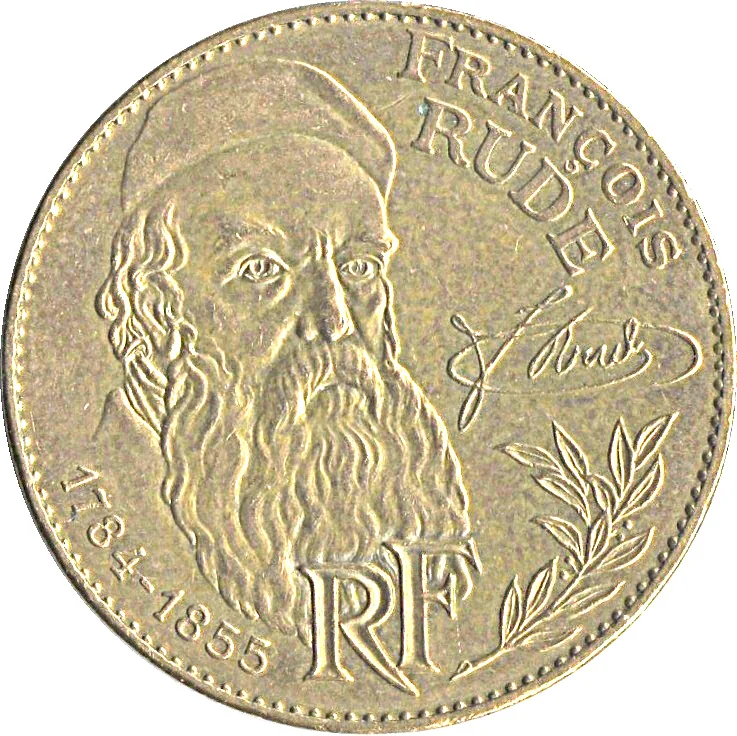
François Rude’s head, three-quarter view to the right.
Inscription:
FRANÇOIS
RUDE
RF
1784-1855
RUDE
RF
1784-1855
Translation:
François Rude, French Republic, 1784-1855
Script: Latin
Language: French
Engraver: Jean-Pierre Gendis
Reverse
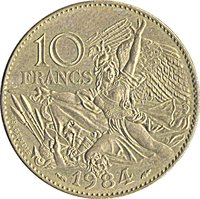
Description:
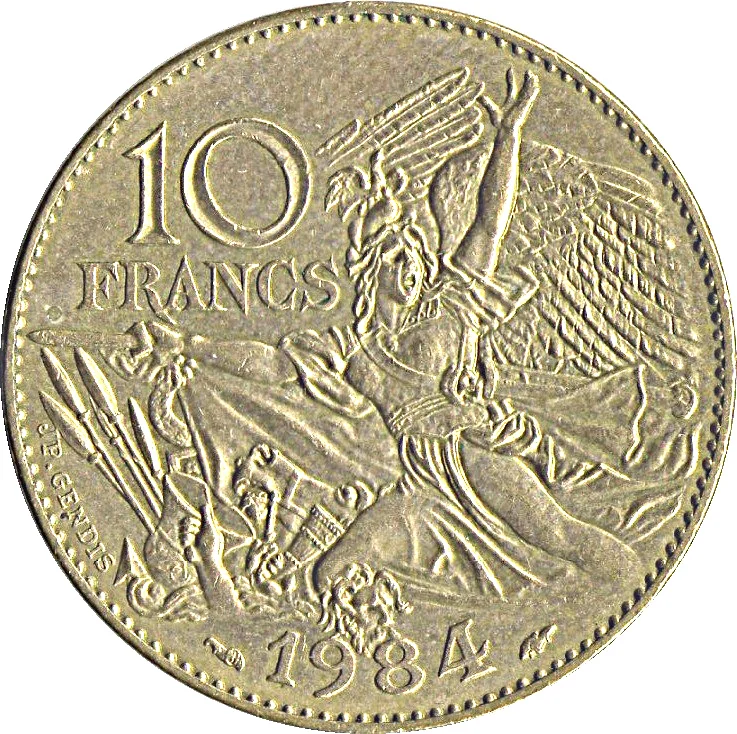
Marianne, the winged warrior leading the people. Fragment of François Rude's sculpture 'La Marseillaise' on the Arc de Triomphe.
Inscription:
10
FRANCS
1984
FRANCS
1984
Script: Latin
Engraver: Jean-Pierre Gendis
Designer: François Rude
Edge
Smooth with inscription
Legend:
LIBERTE EGALITE FRATERNITE
Translation:
Liberty Equality Fraternity
Language: French
Categories
| Art> Sculpture |
| Symbol> Phrygian cap |
Mints
| Name | Mark |
|---|---|
| Monnaie de Paris | — |
Mintings
| Year | Mint Mark | Mintage | Quality | Collection |
|---|---|---|---|---|
| 1984 | — | — |
Historical background
In 1984, France's currency situation was defined by its participation in the European Monetary System (EMS), established in 1979. The core of the EMS was the Exchange Rate Mechanism (ERM), which aimed to reduce exchange rate variability and achieve monetary stability in Europe by pegging national currencies, including the French franc, within fixed but adjustable bands against a basket currency called the European Currency Unit (ECU). For France, under President François Mitterrand's Socialist government, this meant a deliberate and often painful policy shift. After initial Keynesian reflation in 1981 led to capital flight and franc devaluations, the government made a decisive "tournant de la rigueur" (turn to austerity) in 1983, committing to the franc fort (strong franc) policy within the ERM to combat inflation and align with West Germany's Deutsche Mark, Europe's anchor currency.
This commitment came at a significant domestic economic cost. Maintaining the franc's parity required high interest rates, which stifled investment and contributed to rising unemployment, surpassing 10% in 1984. The strong currency policy also made French exports less competitive on the global market, exacerbating trade deficits. The tension was constant: the Banque de France was compelled to intervene frequently in foreign exchange markets and adjust interest rates to defend the franc's ERM band, prioritizing external stability over domestic growth. This period solidified the primacy of anti-inflationary policy and European integration as cornerstones of French economic strategy, even as it deepened a recession.
The 1984 currency stance was therefore a pivotal moment, locking France into a European discipline that would shape its future. It represented a strategic choice to anchor the country's monetary credibility to Germany and the EMS project, foreshadowing the later move towards a single currency. While socially painful in the short term, this stability framework was seen by its proponents as a necessary foundation for modernizing the French economy and ensuring its place at the heart of the European project, setting the stage for the eventual adoption of the euro.
This commitment came at a significant domestic economic cost. Maintaining the franc's parity required high interest rates, which stifled investment and contributed to rising unemployment, surpassing 10% in 1984. The strong currency policy also made French exports less competitive on the global market, exacerbating trade deficits. The tension was constant: the Banque de France was compelled to intervene frequently in foreign exchange markets and adjust interest rates to defend the franc's ERM band, prioritizing external stability over domestic growth. This period solidified the primacy of anti-inflationary policy and European integration as cornerstones of French economic strategy, even as it deepened a recession.
The 1984 currency stance was therefore a pivotal moment, locking France into a European discipline that would shape its future. It represented a strategic choice to anchor the country's monetary credibility to Germany and the EMS project, foreshadowing the later move towards a single currency. While socially painful in the short term, this stability framework was seen by its proponents as a necessary foundation for modernizing the French economy and ensuring its place at the heart of the European project, setting the stage for the eventual adoption of the euro.
🌱 Very Common