

Iran
Context
Year: 1771
Islamic (Hijri) Year: 1184
Issuer: Iran 
Currency:
(1501—1798)
Demonetization: 6 March 1779
Material
Diameter: 18 mm
Weight: 5.39 g
Gold weight: 5.39 g
Thickness: 2.1 mm
Shape: Irregular round
Composition: Gold
Magnetic: No
Alignment: Coin alignment
flip
References
KM: #Click to copy to clipboard531
Numista: #61867
Value
Bullion value: $899.20
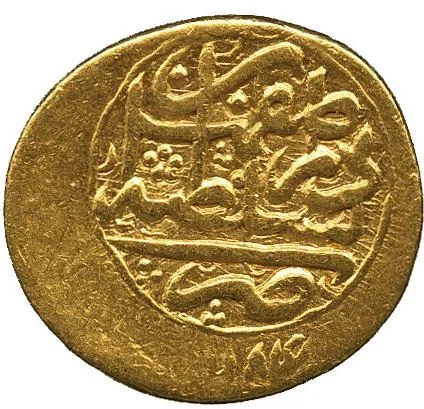
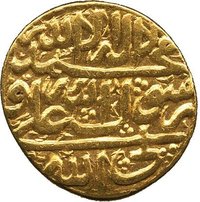
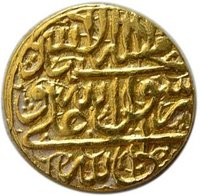
Obverse
Inscription:
ضرب دارالسلطنه اصفهان
۱۱۸۴
۱۱۸۴
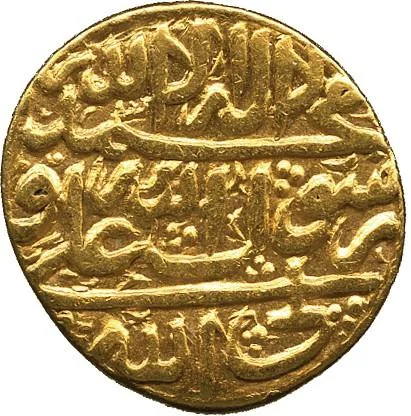
Reverse
Inscription:
لا اله الا الله
محمد رسول الله
علی ولی الله
محمد رسول الله
علی ولی الله
Edge
Plain
Mints
| Name | Mark |
|---|---|
| Isfahan | — |
Mintings
| Year | Mint Mark | Mintage | Quality | Collection |
|---|---|---|---|---|
| 1771 | — | — |
Historical background
In 1771, Iran was under the rule of the Zand dynasty, founded by Karim Khan Zand, who had established his capital in Shiraz. The period was one of relative stability and recovery following decades of civil war and fragmentation after the collapse of the Safavid Empire. Karim Khan, who notably refused the title of Shah and ruled as Vakil al-Raʿāyā (Representative of the People), focused on economic rehabilitation, justice, and fostering trade. This peaceful interlude allowed for a degree of monetary consistency, with the silver toman (a unit of account) and the rial (a coin) serving as the basis of the currency system, primarily minted in silver (abbasi) and copper (shahi) coins.
The currency situation, however, was complex and regionally varied. While Karim Khan’s central mint in Shiraz produced coins of reliable silver content to inspire confidence, the actual circulation was a mixture of new Zand coinage, older Safavid and Afsharid coins (from the reign of Nader Shah), and a plethora of foreign currencies. These included Ottoman, Russian, Dutch, and Indian rupees, which entered through robust trade in the Persian Gulf and overland routes. This multiplicity often led to complications in exchange rates and valuation in daily transactions, requiring money changers (sarraf) to play a crucial role in the bazaar economy.
Despite the centralized efforts, the monetary system faced underlying pressures. The state's silver reserves were limited, and the economy remained primarily agrarian with a modest precious metal base. Furthermore, while Karim Khan’s rule brought internal peace, Iran’s geopolitical position was precarious, surrounded by rivals like the Ottomans, the rising Qajar tribes in the north, and the Afghans. This external threat, coupled with the inherent fragility of a system reliant on diverse and ancient coinage, meant that the currency’s stability was ultimately tied to the strength and continuity of the ruler himself—a vulnerability that would become apparent following Karim Khan’s death in 1779, which plunged Iran back into a succession crisis and monetary disorder.
The currency situation, however, was complex and regionally varied. While Karim Khan’s central mint in Shiraz produced coins of reliable silver content to inspire confidence, the actual circulation was a mixture of new Zand coinage, older Safavid and Afsharid coins (from the reign of Nader Shah), and a plethora of foreign currencies. These included Ottoman, Russian, Dutch, and Indian rupees, which entered through robust trade in the Persian Gulf and overland routes. This multiplicity often led to complications in exchange rates and valuation in daily transactions, requiring money changers (sarraf) to play a crucial role in the bazaar economy.
Despite the centralized efforts, the monetary system faced underlying pressures. The state's silver reserves were limited, and the economy remained primarily agrarian with a modest precious metal base. Furthermore, while Karim Khan’s rule brought internal peace, Iran’s geopolitical position was precarious, surrounded by rivals like the Ottomans, the rising Qajar tribes in the north, and the Afghans. This external threat, coupled with the inherent fragility of a system reliant on diverse and ancient coinage, meant that the currency’s stability was ultimately tied to the strength and continuity of the ruler himself—a vulnerability that would become apparent following Karim Khan’s death in 1779, which plunged Iran back into a succession crisis and monetary disorder.
✨ Legendary