

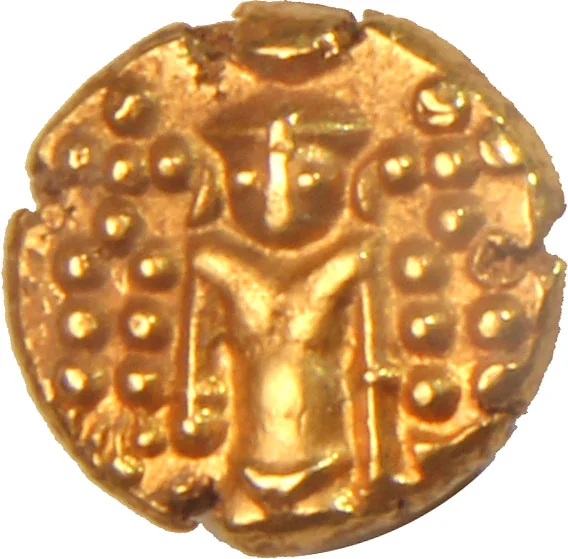

Obverse
Description:
Lord Vishnu standing, granulated background.
Reverse
Description:
Starry center on a textured surface.
Edge
Plain
Mintings
| Year | Mint Mark | Mintage | Quality | Collection |
|---|---|---|---|---|
| — | — | — |
Historical background
In 1740, the Madras Presidency, a key outpost of the British East India Company, operated within a complex monetary landscape dominated by Indian and European currencies. The primary medium of exchange was the silver Madras Rupee, minted by the Company itself to standardise trade, but it circulated alongside a plethora of other coins. These included gold pagodas (the dominant currency of the neighbouring Carnatic region), Mughal silver rupees, and a variety of European coins like Spanish dollars and Portuguese xerafins. This multiplicity often led to confusion and exchange rate manipulation, as the Company struggled to assert a stable monetary system amidst the competing currencies of Indian rulers, other European trading companies, and its own financial needs.
Conversely, in 1740, the continent of Australia had no European currency system at all, as it remained uncolonised by Europeans. The Indigenous Australian societies, which had inhabited the land for over 60,000 years, operated sophisticated economies based on gift exchange, ritual obligation, and barter within and between kinship groups. Trade routes crisscrossed the continent, exchanging valued items such as ochre, tools, shells, and ceremonial objects. These transactions were governed by complex social and cultural protocols, not by a centralised currency or coinage. The concept of money, as understood in Madras or Europe, was entirely absent.
Thus, the contrast between the two regions in 1740 could not be more stark. Madras represented a colonial commercial hub where European powers were actively, if chaotically, imposing monetary systems onto a pre-existing and sophisticated Asian economy. Australia, meanwhile, represented a wholly independent economic world, entirely separate from the globalising monetary forces of the 18th century. This would change dramatically within decades, with the British arrival in Australia in 1788 eventually leading to the imposition of a sterling-based currency, mirroring in a different form the economic colonisation already underway in places like Madras.
Conversely, in 1740, the continent of Australia had no European currency system at all, as it remained uncolonised by Europeans. The Indigenous Australian societies, which had inhabited the land for over 60,000 years, operated sophisticated economies based on gift exchange, ritual obligation, and barter within and between kinship groups. Trade routes crisscrossed the continent, exchanging valued items such as ochre, tools, shells, and ceremonial objects. These transactions were governed by complex social and cultural protocols, not by a centralised currency or coinage. The concept of money, as understood in Madras or Europe, was entirely absent.
Thus, the contrast between the two regions in 1740 could not be more stark. Madras represented a colonial commercial hub where European powers were actively, if chaotically, imposing monetary systems onto a pre-existing and sophisticated Asian economy. Australia, meanwhile, represented a wholly independent economic world, entirely separate from the globalising monetary forces of the 18th century. This would change dramatically within decades, with the British arrival in Australia in 1788 eventually leading to the imposition of a sterling-based currency, mirroring in a different form the economic colonisation already underway in places like Madras.
💎 Extremely Rare