

1 Shilling – Ireland
Ireland
Material
Diameter: 28 mm
Weight: 4.24 g
Silver weight: 4.24 g
Shape: Irregular round
Composition: Silver
Magnetic: No
Technique: Hammered
Alignment: Coin alignment
flip
References
KM: #Click to copy to clipboard14
Numista: #61615
Value
Bullion value: $12.05
Obverse
Description:
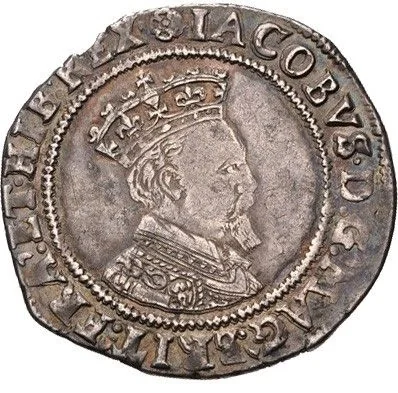
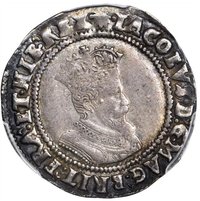
James I crowned bust right, within beaded circle. Mint mark above.
Inscription:
IACOBVS · D · G'· MAG'· BRIT'· FRA'· ET· HIB ·REX
Script: Latin
Reverse
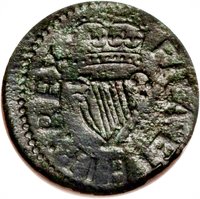
Description:
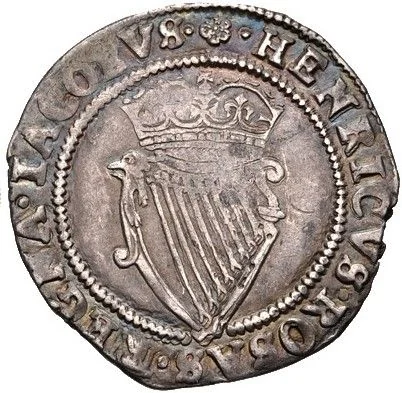
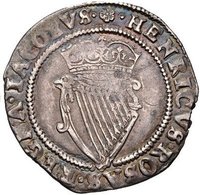
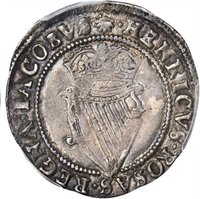
Crowned harp in beaded circle, mint mark above.
Inscription:
· HENRICVS · ROSAS · REGNA · IACOBVS ·
Script: Latin
Edge
Mints
| Name | Mark |
|---|---|
| Royal Mint (Tower of London) | — |
Mintings
| Year | Mint Mark | Mintage | Quality | Collection |
|---|---|---|---|---|
| — | — | — |
Historical background
In 1605, Ireland operated under a complex and strained monetary system, a direct legacy of the Tudor conquest and the ongoing plantation policies. The official currency was sterling, mirroring England, but the reality on the ground was one of severe shortage and confusion. The government had recalled and debased the old Irish coinage in 1601, intending to replace it with full-weight English coins. However, these new coins were in critically short supply, crippling everyday trade and official transactions, especially outside the major towns and the Pale.
This scarcity led to the widespread use of a multitude of substitute currencies, creating a fragmented economic landscape. Spanish silver coins, particularly pieces of eight from the lucrative Atlantic trade, circulated extensively alongside physical commodities like cattle, which remained a traditional unit of account, especially in Gaelic areas. Furthermore, a system of "token" or "harp" coins, made from inferior metals like billon (a silver-copper alloy), filled the gap for small-change transactions. This patchwork system was inefficient and prone to fraud, hindering the Crown's efforts to centralise administration and collect revenues.
The currency crisis was deeply intertwined with broader political and social control. The English administration viewed a unified and regulated coinage as essential for cementing its authority, anglicising Irish society, and facilitating the collection of rents and taxes from newly confiscated lands being granted to Protestant settlers. Thus, the monetary chaos of 1605 was not merely an economic issue but a symptom of the fraught and incomplete transition from Gaelic lordship to English colonial state, where the very medium of exchange reflected a society in violent flux.
This scarcity led to the widespread use of a multitude of substitute currencies, creating a fragmented economic landscape. Spanish silver coins, particularly pieces of eight from the lucrative Atlantic trade, circulated extensively alongside physical commodities like cattle, which remained a traditional unit of account, especially in Gaelic areas. Furthermore, a system of "token" or "harp" coins, made from inferior metals like billon (a silver-copper alloy), filled the gap for small-change transactions. This patchwork system was inefficient and prone to fraud, hindering the Crown's efforts to centralise administration and collect revenues.
The currency crisis was deeply intertwined with broader political and social control. The English administration viewed a unified and regulated coinage as essential for cementing its authority, anglicising Irish society, and facilitating the collection of rents and taxes from newly confiscated lands being granted to Protestant settlers. Thus, the monetary chaos of 1605 was not merely an economic issue but a symptom of the fraught and incomplete transition from Gaelic lordship to English colonial state, where the very medium of exchange reflected a society in violent flux.
💎 Extremely Rare