

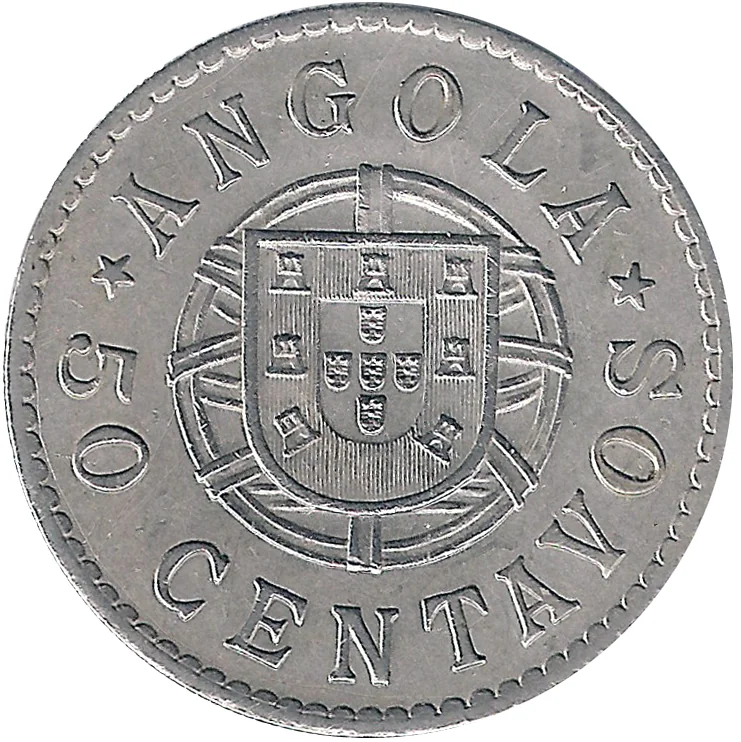
50 centavos – Angola
Add to wishlist
Angola
Context
Years: 1922–1923
Issuer: Angola
Period:
(1910—1951)
Currency:
(1914—1928)
Demonetized: Yes
Total mintage: 12,000,000
Material
Diameter: 31.1 mm
Weight: 10.5 g
Thickness: 1.9 mm
Shape: Round
Composition: Copper-nickel
Technique: Milled
Alignment: Medal alignment
flip
References
KM: #
Numista: #11916
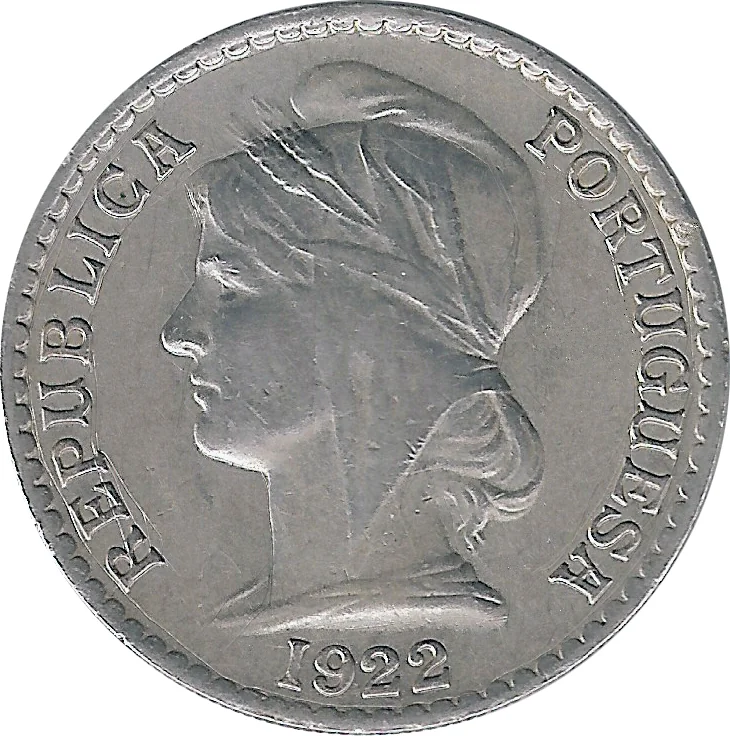
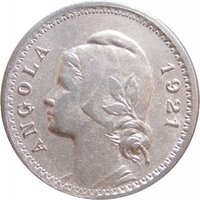
Obverse
Description:
Left, date below
Inscription:
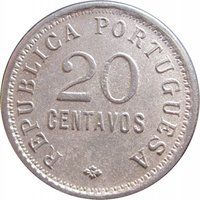
REPUBLICA PORTUGUESA
1922
1922
Translation:
PORTUGUESE REPUBLIC
1922
1922
Script: Latin
Language: Portuguese
Reverse
Edge
Milled
Categories
| Symbol> Allegory |
| Symbols> Coat of Arms |
| Symbol> Phrygian cap |
Mints
| Name | Mark |
|---|---|
| Kings Norton Metal Company | KN |
Mintings
| Year | Mint Mark | Mintage | Quality | Collection |
|---|---|---|---|---|
| 1922 | — | 6,000,000 | ||
| 1923 | — | 4,780,000 | ||
| 1923 | KN | 1,220,000 |
Historical background
In 1922, Angola's currency situation was defined by its status as a Portuguese colony, operating within the broader monetary framework of the Portuguese Empire. The official currency was the Angolan real, which had been introduced in the 19th century. However, this system was fragmented and often unstable. The value of the real was not robust, and a significant volume of transactions, especially in rural and interior regions, was still conducted via barter or using traditional means of exchange like cloth and shells, reflecting the limited penetration of a formal monetary economy across the vast territory.
The year 1922 fell within a period of significant monetary transition. Portugal itself had adopted the gold standard in 1854 but faced chronic fiscal difficulties, which directly impacted its colonies. In Angola, the circulating currency was a mixture of Portuguese coins and locally issued paper notes, but confidence in this paper money was frequently low. A major shift was imminent; in 1926, just a few years later, the Angolan escudo would be introduced, replacing the real at a rate of 1 escudo to 1,000 réis. The conditions of 1922 can thus be seen as the prelude to this reform, characterized by an outdated and cumbersome unit of account (the real) in need of modernization.
Economically, the currency instability mirrored and exacerbated the colony's developmental challenges. Angola's economy was heavily geared towards raw material exports, primarily coffee, diamonds, and later cotton, with trade and financial control firmly in Portuguese hands. The weak and inconsistent currency complicated commercial transactions, hindered investment, and created an environment where foreign currencies, particularly the British pound and South African pound in southern regions, often held more trust for larger transactions. Therefore, the monetary landscape of 1922 was one of colonial dependency, internal inconsistency, and mounting pressure for a standardized system to better facilitate the extractive colonial economy.
The year 1922 fell within a period of significant monetary transition. Portugal itself had adopted the gold standard in 1854 but faced chronic fiscal difficulties, which directly impacted its colonies. In Angola, the circulating currency was a mixture of Portuguese coins and locally issued paper notes, but confidence in this paper money was frequently low. A major shift was imminent; in 1926, just a few years later, the Angolan escudo would be introduced, replacing the real at a rate of 1 escudo to 1,000 réis. The conditions of 1922 can thus be seen as the prelude to this reform, characterized by an outdated and cumbersome unit of account (the real) in need of modernization.
Economically, the currency instability mirrored and exacerbated the colony's developmental challenges. Angola's economy was heavily geared towards raw material exports, primarily coffee, diamonds, and later cotton, with trade and financial control firmly in Portuguese hands. The weak and inconsistent currency complicated commercial transactions, hindered investment, and created an environment where foreign currencies, particularly the British pound and South African pound in southern regions, often held more trust for larger transactions. Therefore, the monetary landscape of 1922 was one of colonial dependency, internal inconsistency, and mounting pressure for a standardized system to better facilitate the extractive colonial economy.
🌱 Fairly Common