


Obverse
Description:
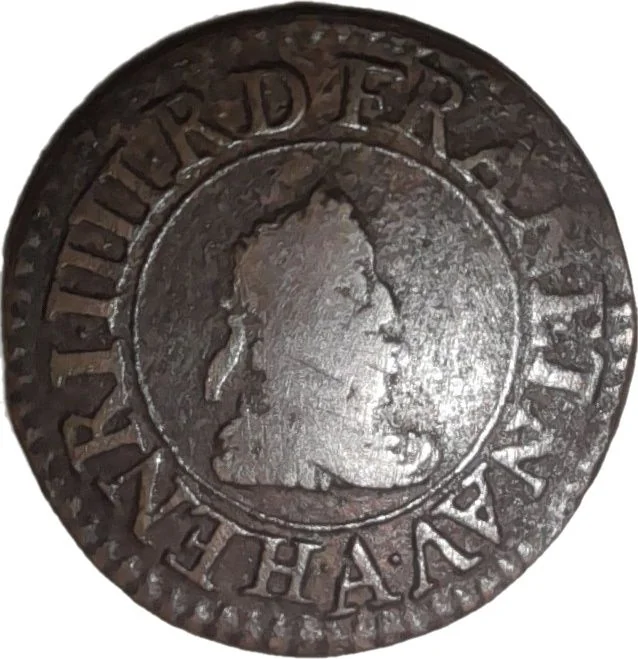
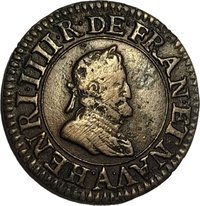
Laureate, bearded bust in cuirass and drapery. Flan edge legend begins at 6 o'clock.
Inscription:
HENRI.IIII.R.D.FRAN.ET.NAV.A. (a)
HENRI.IIII.R.DE.FRAN.ET.NAV.A. (b)
HENRI.IIII.R.DE.FRAN.ET.NAV.A. (b)
Script: Latin
Reverse
Description:
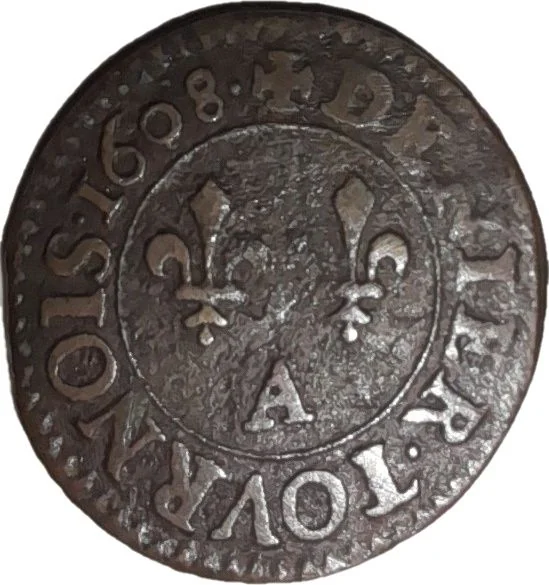
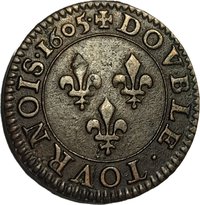
From 12 o'clock: 10mm circle, two lilies, an "A".
Inscription:
+ DENIER.TOVRNOIS.1605. (1)
+ DENIER.TOVRNOIS.1605 (2)
+ DENIER.TOVRNOIS 1605 (3)
+ DENIER.TOVR.NOIS 1604 (4)
+ DENIER.TOVR.NOIS.1604 (5)
+ DENIER.TOVRNOIS.1605 (2)
+ DENIER.TOVRNOIS 1605 (3)
+ DENIER.TOVR.NOIS 1604 (4)
+ DENIER.TOVR.NOIS.1604 (5)
Script: Latin
Edge
Mints
| Name | Mark |
|---|---|
| Monnaie de Paris | A |
Mintings
Historical background
In 1598, France’s currency situation was chaotic and deeply destabilized by decades of the French Wars of Religion (1562-1598). The conflict had drained the royal treasury, forcing successive monarchs to repeatedly debase the coinage—reducing the precious metal content in coins like the livre tournois, écu, and franc—to fund military campaigns. This practice led to severe inflation, a loss of public confidence in the currency, and a bewildering variety of coins of uncertain value in circulation, both domestic and foreign. The monetary system was on the verge of collapse, crippling trade and exacerbating the economic misery of a war-weary population.
The pivotal event of 1598 was the Edict of Nantes in April, which granted rights to Huguenots and effectively ended the civil wars. While primarily a religious settlement, it created the essential precondition for monetary and economic recovery by establishing peace. King Henry IV, advised by his brilliant finance minister, the Duke of Sully, could now turn his full attention to restoring the kingdom’s fiscal health. A stable and trustworthy currency was understood to be the foundation for reviving agriculture, commerce, and royal authority.
Therefore, the period immediately following 1598 set the stage for sweeping monetary reform. Sully embarked on a program to restore confidence by gradually calling in debased coins and reissuing currency with a higher and fixed precious metal content. His efforts, which took several years to implement fully, aimed to stabilize the livre tournois as a unit of account and ensure the coins in hand held reliable intrinsic value. The peace of 1598 thus marked the end of an era of monetary chaos and the beginning of a deliberate, though challenging, process of restoring sound money to France.
The pivotal event of 1598 was the Edict of Nantes in April, which granted rights to Huguenots and effectively ended the civil wars. While primarily a religious settlement, it created the essential precondition for monetary and economic recovery by establishing peace. King Henry IV, advised by his brilliant finance minister, the Duke of Sully, could now turn his full attention to restoring the kingdom’s fiscal health. A stable and trustworthy currency was understood to be the foundation for reviving agriculture, commerce, and royal authority.
Therefore, the period immediately following 1598 set the stage for sweeping monetary reform. Sully embarked on a program to restore confidence by gradually calling in debased coins and reissuing currency with a higher and fixed precious metal content. His efforts, which took several years to implement fully, aimed to stabilize the livre tournois as a unit of account and ensure the coins in hand held reliable intrinsic value. The peace of 1598 thus marked the end of an era of monetary chaos and the beginning of a deliberate, though challenging, process of restoring sound money to France.
⭐ Rare