

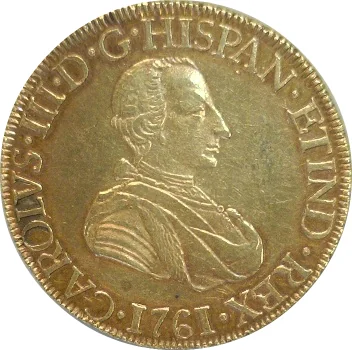
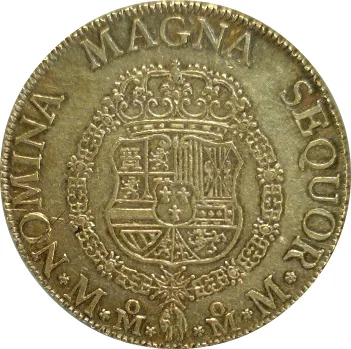
8 Escudos – New Spain
Mexico
Context
Year: 1761
Country: Mexico 
Issuer: New Spain
Ruler: Charles III
Currency:
(1535—1897)
Demonetized: Yes
Material
References
KM: #Click to copy to clipboard154
Numista: #57663
Value
Bullion value: $4133.91
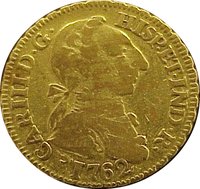
Obverse
Description:
Armored profile right
Inscription:
CAROLVS•III•D•G•HISPAN•ETIND•REX
•1761•
•1761•
Script: Latin
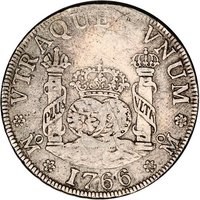
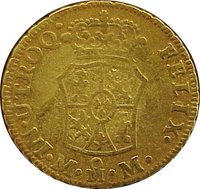
Reverse
Edge
Mintings
| Year | Mint Mark | Mintage | Quality | Collection |
|---|---|---|---|---|
| 1761 | MM | — |
Historical background
In 1761, the currency system of New Spain was a complex and often unstable amalgamation of silver coins, gold, and unofficial mediums of exchange, all underpinned by the colony's immense silver production. The backbone of the economy was the silver real and the famous "piece of eight" (8 reales), minted primarily at the Mexico City Mint. These coins, prized for their consistent silver content, circulated globally. However, chronic shortages of small-denomination coins for daily transactions led to widespread use of tlacos (token coins issued by merchants) and pilones (credit tokens), creating a fragmented and locally variable monetary environment.
This internal fragility was exacerbated by Spain's mercantilist policies, which systematically drained silver from New Spain to finance the Crown's European wars and the Manila Galleon trade. Large quantities of silver pesos were shipped to Spain or sent across the Pacific to Asia, creating a persistent scarcity of specie within the colony itself. Furthermore, the monetary system was on the cusp of a significant reform. King Charles III, who ascended the Spanish throne in 1759, would soon initiate Bourbon reforms that included a major currency overhaul, leading to the introduction of new, machine-struck coins with portrait busts in the 1770s.
Therefore, the currency situation in 1761 represented the final years of an older, strained system. It was characterized by a paradox: New Spain was the heart of the world's silver supply, yet its own economy suffered from coin shortages, relied on unreliable substitute currencies, and bore the heavy burden of funding the Spanish Empire. This tension between local need and imperial demand created economic inefficiencies and social grievances that would continue to define the viceroyalty in the decades leading up to its independence.
This internal fragility was exacerbated by Spain's mercantilist policies, which systematically drained silver from New Spain to finance the Crown's European wars and the Manila Galleon trade. Large quantities of silver pesos were shipped to Spain or sent across the Pacific to Asia, creating a persistent scarcity of specie within the colony itself. Furthermore, the monetary system was on the cusp of a significant reform. King Charles III, who ascended the Spanish throne in 1759, would soon initiate Bourbon reforms that included a major currency overhaul, leading to the introduction of new, machine-struck coins with portrait busts in the 1770s.
Therefore, the currency situation in 1761 represented the final years of an older, strained system. It was characterized by a paradox: New Spain was the heart of the world's silver supply, yet its own economy suffered from coin shortages, relied on unreliable substitute currencies, and bore the heavy burden of funding the Spanish Empire. This tension between local need and imperial demand created economic inefficiencies and social grievances that would continue to define the viceroyalty in the decades leading up to its independence.
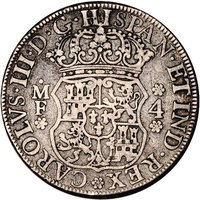
✨ Legendary