

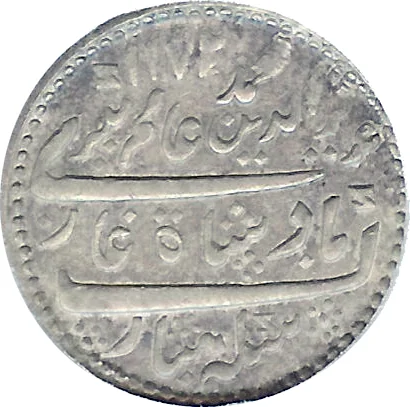
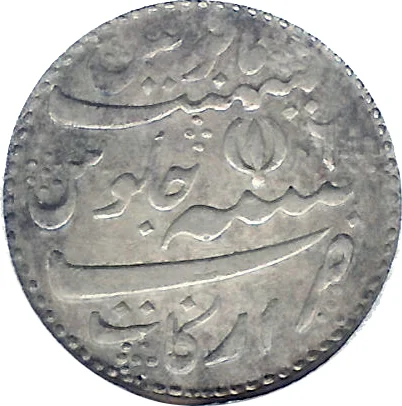
½ Rupee – Madras Presidency
India
Context
Year: 1812
Country: India 
Issuer: Madras Presidency
Currency:
(1691—1835)
Demonetized: Yes
Total mintage: 3,392,021
Material
References
KM: #Click to copy to clipboard402
Numista: #56721
Value
Bullion value: $16.69
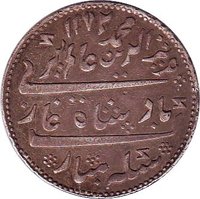
Obverse
Description:
Persian legend: "1172 Sikka Mubarak, Badshah ghazi Aziz-ud-din Muhammad, Alamgir" within a toothed border.
Inscription:
١١۷٢
محمد عالم كير
عزيز الدين
باد شاه غازي
سكه مبارك
محمد عالم كير
عزيز الدين
باد شاه غازي
سكه مبارك
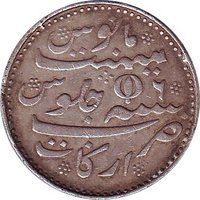
Reverse
Description:
Zarb Arcat, 6th year of prosperous reign.
Inscription:
ممنت مانوس
سنه ٦ جلوس
ضرب اركات
سنه ٦ جلوس
ضرب اركات
Edge
Indented Cord Milling (grained left)
Mintings
| Year | Mint Mark | Mintage | Quality | Collection |
|---|---|---|---|---|
| 1812 | — | 3,392,021 | ||
| 1812 | — | — |
Historical background
In 1812, the currency situation in the Madras Presidency was a complex and chaotic system, characterised by a severe shortage of specie (coin) and a proliferation of unreliable paper money. The presidency was still recovering from the financial strain of the Fourth Anglo-Mysore War (1798-99) and the ongoing Carnatic Wars, which had drained the East India Company's treasury. The primary silver coin, the Arcot rupee, circulated alongside a multitude of other older and debased Mughal and regional coins, leading to confusing exchange rates and widespread forgery. This instability severely hampered trade and the Company's own revenue collection.
The most acute problem was the over-issuance of "currency notes" or paper bills by the Madras Government. First issued in 1807 to alleviate the coin shortage, these notes were not effectively backed by silver reserves and had rapidly depreciated. By 1812, they were trading at a steep discount of about 30% against silver rupees, causing public distrust and financial losses. The system was on the verge of collapse, as the government itself often refused to accept its own notes for tax payments, further undermining their value and creating a crisis of confidence.
Recognising the untenable situation, the Madras Government was actively seeking a solution. Discussions were underway to demonetise the depreciated paper and reintroduce a stable, silver-based coinage. This led to the pivotal Coinage Act of 1812, which aimed to sweep away the old chaotic system. The Act planned for a new, uniform silver rupee (which would become the Madras Fanam) and laid the groundwork for calling in and cancelling the discredited paper currency, setting the stage for a more standardised monetary system in the following years.
The most acute problem was the over-issuance of "currency notes" or paper bills by the Madras Government. First issued in 1807 to alleviate the coin shortage, these notes were not effectively backed by silver reserves and had rapidly depreciated. By 1812, they were trading at a steep discount of about 30% against silver rupees, causing public distrust and financial losses. The system was on the verge of collapse, as the government itself often refused to accept its own notes for tax payments, further undermining their value and creating a crisis of confidence.
Recognising the untenable situation, the Madras Government was actively seeking a solution. Discussions were underway to demonetise the depreciated paper and reintroduce a stable, silver-based coinage. This led to the pivotal Coinage Act of 1812, which aimed to sweep away the old chaotic system. The Act planned for a new, uniform silver rupee (which would become the Madras Fanam) and laid the groundwork for calling in and cancelling the discredited paper currency, setting the stage for a more standardised monetary system in the following years.
💎 Extremely Rare