

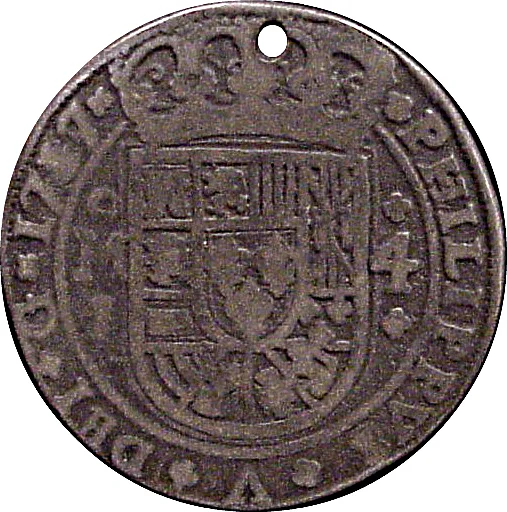
Obverse
Description:
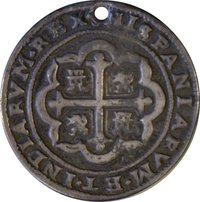
Felipe V's royal coat of arms, encircled by legend and date.
Inscription:
PHILIPVS V DEI G
Script: Latin
Reverse
Description:
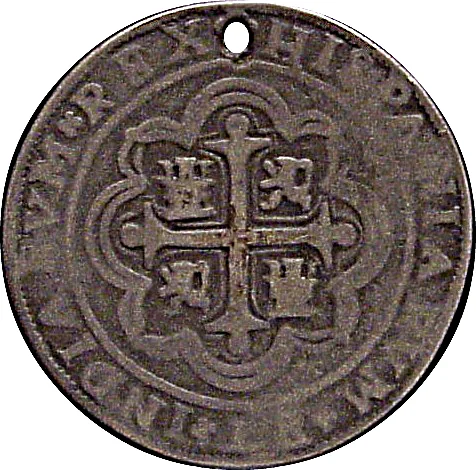
Spain's coat of arms.
Script: Latin
Edge
Mintings
| Year | Mint Mark | Mintage | Quality | Collection |
|---|---|---|---|---|
| 1716 | Mo | — | ||
| 1719 | Mo | — | ||
| 1721 | Mo | — | ||
| 1722 | Mo | — | ||
| 1723 | Mo | — |
Historical background
In 1716, the currency system of New Spain, the wealthiest viceroyalty of the Spanish Empire, was characterized by a chronic shortage of official coinage and the widespread circulation of substitute and debased money. The primary unit was the silver peso or "piece of eight," minted at the Mexico City mint, one of the most prolific in the world. However, the vast territorial expanse, booming economic activity, and the constant outflow of silver to Spain and the Orient meant that these high-quality coins were often scarce in daily provincial commerce. This scarcity was exacerbated by hoarding and the practice of clipping or shaving precious metal from the edges of coins.
To facilitate local trade, a variety of substitute currencies filled the void. The most common was tlacos, small tokens or promissory notes issued by merchants, hacienda owners, and even churches, redeemable only at their place of origin. These created fragmented and unreliable monetary zones. Furthermore, a massive quantity of debased and counterfeit coins, especially low-denomination reales, circulated freely. These were often crude, hammer-struck "cobs" or later, illicitly minted coins, whose silver content was unreliable. This chaotic environment led to frequent disputes over exchange rates and values, hindering commerce and tax collection.
The Spanish Crown was aware of these problems and had initiated a major monetary reform just a few years prior. Beginning in 1709, the Mexico City mint started producing new, machine-struck coins with milled edges to prevent clipping—the famous columnario or "pillar dollars." By 1716, these newer, more uniform coins were in production and represented the official standard. However, the process of replacing the old mixed currency in circulation across such a vast territory was slow. Thus, 1716 represents a transitional year, where the modernizing vision of the Bourbon monarchy coexisted with the entrenched, chaotic monetary reality of a cash-starved colonial economy.
To facilitate local trade, a variety of substitute currencies filled the void. The most common was tlacos, small tokens or promissory notes issued by merchants, hacienda owners, and even churches, redeemable only at their place of origin. These created fragmented and unreliable monetary zones. Furthermore, a massive quantity of debased and counterfeit coins, especially low-denomination reales, circulated freely. These were often crude, hammer-struck "cobs" or later, illicitly minted coins, whose silver content was unreliable. This chaotic environment led to frequent disputes over exchange rates and values, hindering commerce and tax collection.
The Spanish Crown was aware of these problems and had initiated a major monetary reform just a few years prior. Beginning in 1709, the Mexico City mint started producing new, machine-struck coins with milled edges to prevent clipping—the famous columnario or "pillar dollars." By 1716, these newer, more uniform coins were in production and represented the official standard. However, the process of replacing the old mixed currency in circulation across such a vast territory was slow. Thus, 1716 represents a transitional year, where the modernizing vision of the Bourbon monarchy coexisted with the entrenched, chaotic monetary reality of a cash-starved colonial economy.
✨ Legendary