Logo Title
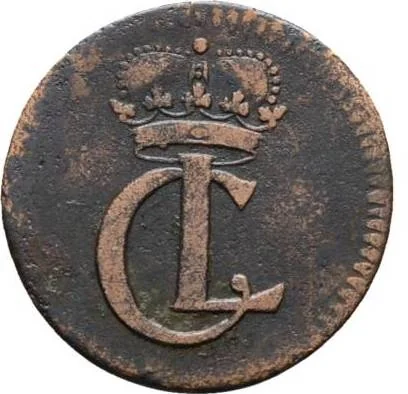
obverse
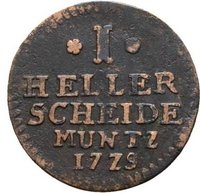
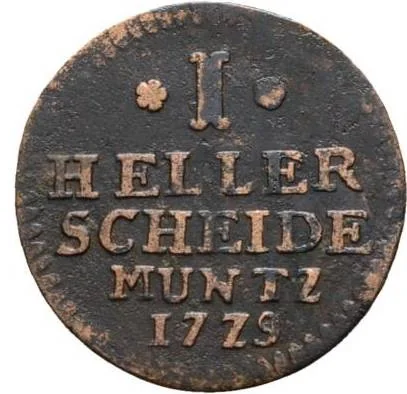
reverse
MANFRED OLDING Münzenhandlung

1 Heller – Landgraviate of Hesse-Cassel

Context
Years: 1725–1730
Ruler: Charles I
Currency:
Demonetized: Yes
Material
Diameter: 19.5 mm
Weight: 2.35 g
Thickness: 1.15 mm
Shape: Round
Composition: Copper
Magnetic: No
Alignment: Medal alignment
Obverse
OBVERSE ↑
flip
Reverse
REVERSE ↑
References
KM: #Click to copy to clipboard393
Numista: #53319

Obverse

Description:
Crowned central monogram.
Inscription:
CL
Script: Latin

Reverse

Description:
Center inscription: denomination and date.
Inscription:
* I *

HELLER

SCHEIDE

MUNTZ

1729
Script: Latin

Edge

Plain

Mints

NameMark
Kassel

Mintings

YearMint MarkMintageQualityCollection
1725
1726
1727
1728
1729
1730

Historical background

In 1725, the currency situation in the Landgraviate of Hesse-Cassel was one of relative stability and strength, a legacy of the prudent fiscal policies of Landgrave Charles I (r. 1670-1730). His reign had been marked by a deliberate recovery from the financial devastation of the Thirty Years' War, achieved through mercantilist economic policies and the infamous practice of hiring out Hessian soldiers to foreign powers, most notably to Great Britain. The substantial "subsidies" received for these troops provided a steady influx of silver, particularly Reichsthalers, which allowed the landgraviate to mint its own high-quality, full-weight coinage and build considerable state reserves.

The primary circulating coin was the Hessian Taler, which was part of the wider Holy Roman Empire's monetary system based on the Reichsthaler. It was a large silver coin that enjoyed a strong reputation for its reliable silver content, facilitating both domestic trade and commerce with neighboring German states. The system was subdivided into Gute Groschen, Mariengroschen, and Pfennigs, creating a complex but functional hierarchy of denominations. This internal stability was, however, juxtaposed with the constant challenge of navigating a fragmented imperial monetary landscape, where dozens of neighboring territories issued coins of varying quality.

Despite this overall strength, underlying pressures were present. The economy remained heavily reliant on military subsidies, creating a vulnerability to shifts in European alliances. Furthermore, the practice of Kipper- und Wipperzeit (clipping and debasement) that had plagued the Empire earlier in the century served as a cautionary tale. Landgrave Charles's administration was therefore vigilant in maintaining the purity of the coinage to preserve public trust and the state's creditworthiness. Thus, in 1725, Hesse-Cassel's currency was a pillar of its growing regional influence, representing a hard-earned stability that was carefully, and sometimes ruthlessly, managed.
💎 Very Rare