

4 Kreuzers – Landgraviate of Hesse-Darmstadt
Context
Years: 1748–1759
Issuer: Landgraviate of Hesse-Darmstadt
Ruler: Louis VIII
Currency:
(1568—1805)
Demonetized: Yes
References
KM: #Click to copy to clipboard184
Numista: #51892
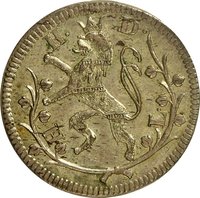
Obverse
Description:
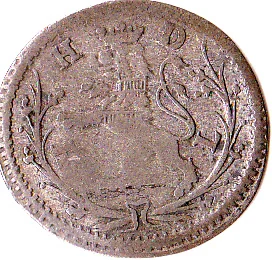
Crowned lion facing left.
Inscription:
H D
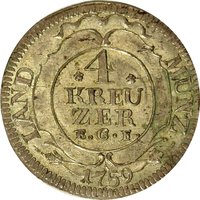
Reverse
Description:
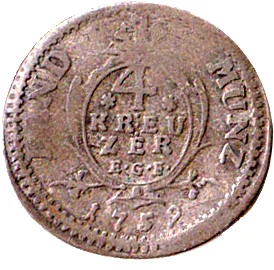
Baroque frame, dated.
Inscription:
LAND MÜNZ
4
KREU
ZER
1759
4
KREU
ZER
1759
Edge
Mints
| Name | Mark |
|---|---|
| Darmstadt | — |
Mintings
| Year | Mint Mark | Mintage | Quality | Collection |
|---|---|---|---|---|
| 1748 | — | — | ||
| 1750 | — | — | ||
| 1759 | — | — | ||
| 1759 | EGF | — |
Historical background
In 1748, the currency situation in the Landgraviate of Hesse-Darmstadt was characterized by complexity and fragmentation, a common challenge across the Holy Roman Empire. The landgraviate did not have a monopoly on coinage; multiple authorities within its borders, including the landgrave himself, the nobility, and ecclesiastical institutions, held the right to mint coins (Münzrecht). This resulted in a circulation of numerous different coins of varying standards, weights, and metallic content, alongside a flood of foreign currencies from neighboring states. The primary accounting unit was the Gulden (florin), divided into 15 Batzen or 60 Kreuzer, but the actual value of coins in circulation often deviated from their official face value, leading to chronic confusion in trade and public finance.
The economic strain of the recent War of the Austrian Succession (1740-1748) exacerbated these monetary problems. Like many German territories, Hesse-Darmstadt likely resorted to debasement—reducing the precious metal content in coins—to finance military expenditures. This practice eroded public trust in the currency, drove older, higher-value coins out of circulation (Gresham's Law), and contributed to inflation. The year 1748, marking the war's end with the Treaty of Aix-la-Chapelle, presented Landgrave Ludwig VIII with the urgent task of stabilizing the monetary system to facilitate post-war recovery and economic stability.
Consequently, the period around 1748 was one of transition toward attempted reform. The landgraviate would have been actively engaged in efforts to negotiate and implement imperial currency regulations (Reichsmünzordnungen), which aimed to standardize coinage across the Empire. While a comprehensive, unilateral reform in Hesse-Darmstadt was still a future development, the post-war imperative to restore order to the coinage was clear. The situation demanded actions to curb debasement, regulate the multitude of circulating species, and align the local Gulden more reliably with the Empire's monetary framework, laying groundwork for more definitive reforms later in the century.
The economic strain of the recent War of the Austrian Succession (1740-1748) exacerbated these monetary problems. Like many German territories, Hesse-Darmstadt likely resorted to debasement—reducing the precious metal content in coins—to finance military expenditures. This practice eroded public trust in the currency, drove older, higher-value coins out of circulation (Gresham's Law), and contributed to inflation. The year 1748, marking the war's end with the Treaty of Aix-la-Chapelle, presented Landgrave Ludwig VIII with the urgent task of stabilizing the monetary system to facilitate post-war recovery and economic stability.
Consequently, the period around 1748 was one of transition toward attempted reform. The landgraviate would have been actively engaged in efforts to negotiate and implement imperial currency regulations (Reichsmünzordnungen), which aimed to standardize coinage across the Empire. While a comprehensive, unilateral reform in Hesse-Darmstadt was still a future development, the post-war imperative to restore order to the coinage was clear. The situation demanded actions to curb debasement, regulate the multitude of circulating species, and align the local Gulden more reliably with the Empire's monetary framework, laying groundwork for more definitive reforms later in the century.
💎 Extremely Rare