

1 tanga – Portuguese India
Add to wishlist
India
Context
Material
Diameter: 14 mm
Weight: 1.1 g
Silver Weight:: 1.10 g
Shape: Irregular round
Composition: Silver
Magnetic: No
Technique: Hammered
References
KM: #
Numista: #50929
Value
Bullion value: $2.76
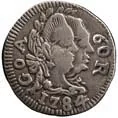
Obverse
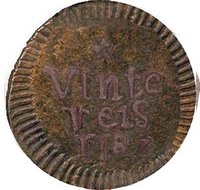
Description:
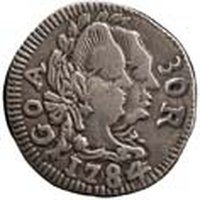
King & Queen busts flank date, lettering below.
Inscription:
GOA__60 R
1874
1874
Script: Latin
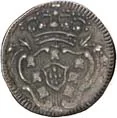
Reverse
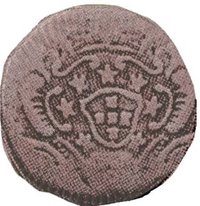
Description:
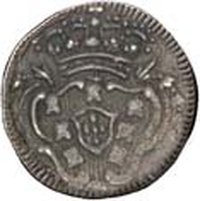
Heraldic emblem
Edge
Mints
| Name | Mark |
|---|---|
| Goa | — |
Mintings
| Year | Mint Mark | Mintage | Quality | Collection |
|---|---|---|---|---|
| 1784 | GOA | — | ||
| 1785 | GOA | — |
Historical background
In 1784, the currency situation in Portuguese India was a complex and fragmented system, reflecting both its local economic realities and its declining position within the broader Portuguese empire. The primary official unit was the Portuguese Indian Rupia (Rupia da Índia Portuguesa), a silver coin that served as the standard for larger transactions. However, the monetary landscape was dominated by a proliferation of foreign and historic coins that circulated freely due to centuries of intense regional trade. Chief among these were the gold Mohan and the silver Xerafim (which was valued at one-third of a Rupia), alongside a multitude of other coins like Tangas, Reis (the official Portuguese unit, used mainly for accounting), and crucially, coins from neighbouring powers, especially the British Indian Rupee.
This monetary pluralism created significant challenges. The lack of a uniform, state-controlled currency led to constant difficulties in exchange rates, valuation, and revenue collection. The value of coins was often determined by their intrinsic metal content and weight rather than a stable face value, leading to fluctuations and arbitrage. Furthermore, the Portuguese administration in Goa struggled with chronic financial weakness, unable to mint sufficient quantities of its own currency to establish dominance. This effectively ceded monetary sovereignty to market forces and more economically dynamic neighbours, undermining both local economic planning and the symbolic authority of the Portuguese crown.
The situation was symptomatic of Portugal's wider 18th-century struggles. While other European powers in India, like the British, were consolidating their economic and territorial control, Portuguese India was a diminished remnant of its former glory, reliant on trade and remittances. The chaotic currency system of 1784 thus mirrored an administration that was reactive rather than proactive, managing a legacy of circulation rather than imposing a modern, unified monetary system. It would take the reforms of the late 18th and early 19th centuries, particularly under the Marquis of Pombal's influence and later the Rupia Britânica's growing dominance, to begin a slow process of standardization.
This monetary pluralism created significant challenges. The lack of a uniform, state-controlled currency led to constant difficulties in exchange rates, valuation, and revenue collection. The value of coins was often determined by their intrinsic metal content and weight rather than a stable face value, leading to fluctuations and arbitrage. Furthermore, the Portuguese administration in Goa struggled with chronic financial weakness, unable to mint sufficient quantities of its own currency to establish dominance. This effectively ceded monetary sovereignty to market forces and more economically dynamic neighbours, undermining both local economic planning and the symbolic authority of the Portuguese crown.
The situation was symptomatic of Portugal's wider 18th-century struggles. While other European powers in India, like the British, were consolidating their economic and territorial control, Portuguese India was a diminished remnant of its former glory, reliant on trade and remittances. The chaotic currency system of 1784 thus mirrored an administration that was reactive rather than proactive, managing a legacy of circulation rather than imposing a modern, unified monetary system. It would take the reforms of the late 18th and early 19th centuries, particularly under the Marquis of Pombal's influence and later the Rupia Britânica's growing dominance, to begin a slow process of standardization.
✨ Legendary