

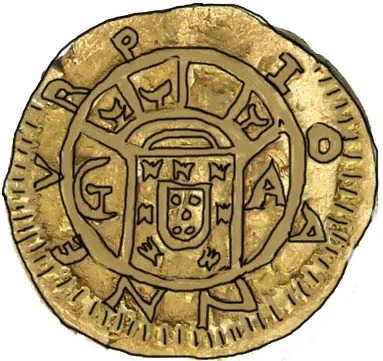
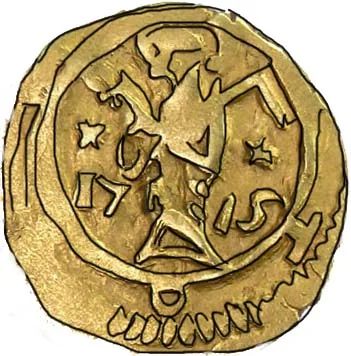
5 xerafins – Portuguese India
Add to wishlist
India
Context
Years: 1713–1750
Country: India
Issuer: Portuguese India
Ruler: João V
Currency:
(1706—1880)
Demonetized: Yes
Material
Diameter: 18 mm
Weight: 2.8 g
Gold Weight:: 2.80 g
Shape: Irregular round
Composition: Gold
Magnetic: No
Technique: Hammered
References
KM: #
Numista: #50721
Value
Bullion value: $431.03
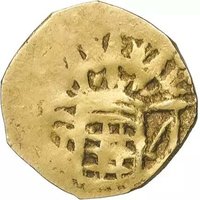
Obverse
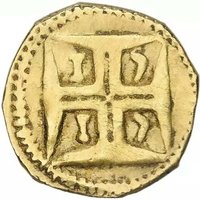
Reverse
Edge
Mints
| Name | Mark |
|---|---|
| Goa | — |
Mintings
| Year | Mint Mark | Mintage | Quality | Collection |
|---|---|---|---|---|
| 1713 | G-A | — | ||
| 1714 | G-A | — | ||
| 1715 | G-A | — | ||
| 1716 | G-A | — | ||
| 1717 | G-A | — | ||
| 1718 | G-A | — | ||
| 1720 | G-A | — | ||
| — | G-A | — |
Historical background
In 1713, the currency situation in Portuguese India was characterized by complexity and decline, mirroring the broader economic and political fragility of the Estado da Índia. The official currency was the Portuguese real, but its value and circulation were severely undermined. Decades of competition from Dutch and English East India Companies, loss of key trading forts, and a shrinking share of the lucrative spice trade had drastically reduced Lisbon's ability to inject sound, precious metal-based currency into its Asian holdings. Consequently, the monetary system in Goa, Damão, and Diu was starved of high-value coinage.
The local economy operated on a de facto multi-currency system, heavily reliant on a vast array of foreign coins that filled the vacuum left by the weakened Portuguese mint. Gold mohurs and silver rupias from the Mughal Empire were dominant in larger transactions, while a plethora of other coins—including Venetian ducats, Spanish pieces of eight, and currencies from neighboring Indian states—circulated freely. This reliance created chronic instability, as exchange rates fluctuated based on the metallic content and the perceived reliability of the issuing power, complicating trade and tax collection for the Portuguese administration.
Attempts by the Viceroy in Goa to standardize and control this system were largely ineffectual in 1713. While the Cruzado was used as a unit of account, its actual physical counterpart was scarce. The local population and merchants often preferred trusted foreign specie, leading to persistent currency flight and hoarding. Thus, the monetary landscape was one of ad hoc adaptation, where the official Portuguese currency system was a hollow shell, and real economic life was sustained by the heterogeneous coinage of the Indian Ocean world, underscoring Portugal's diminished commercial power in the region.
The local economy operated on a de facto multi-currency system, heavily reliant on a vast array of foreign coins that filled the vacuum left by the weakened Portuguese mint. Gold mohurs and silver rupias from the Mughal Empire were dominant in larger transactions, while a plethora of other coins—including Venetian ducats, Spanish pieces of eight, and currencies from neighboring Indian states—circulated freely. This reliance created chronic instability, as exchange rates fluctuated based on the metallic content and the perceived reliability of the issuing power, complicating trade and tax collection for the Portuguese administration.
Attempts by the Viceroy in Goa to standardize and control this system were largely ineffectual in 1713. While the Cruzado was used as a unit of account, its actual physical counterpart was scarce. The local population and merchants often preferred trusted foreign specie, leading to persistent currency flight and hoarding. Thus, the monetary landscape was one of ad hoc adaptation, where the official Portuguese currency system was a hollow shell, and real economic life was sustained by the heterogeneous coinage of the Indian Ocean world, underscoring Portugal's diminished commercial power in the region.
✨ Legendary