

1 xerafim – Portuguese India
Add to wishlist
India
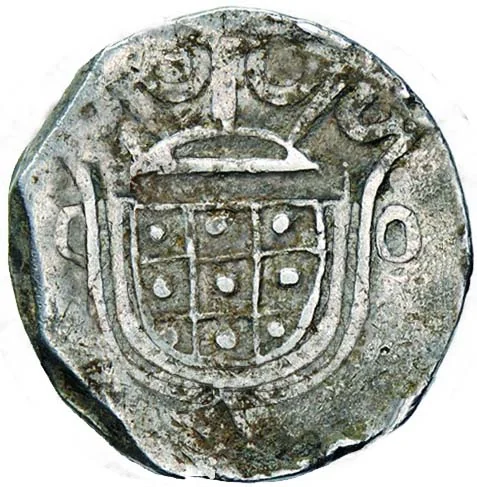
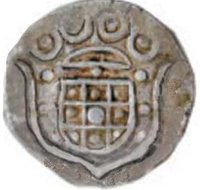
Obverse
Description:
Dio Coat of Arms flanked by mirrored D and O.
Inscription:
D-O
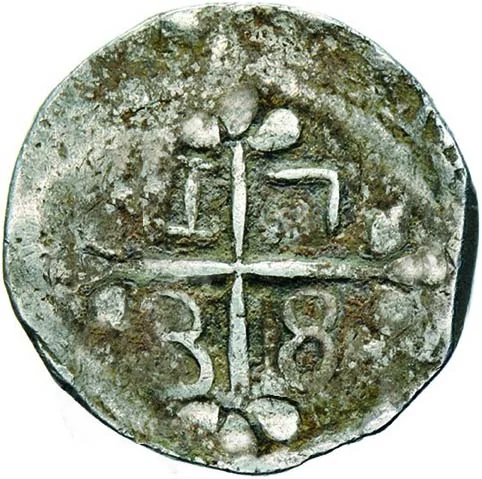
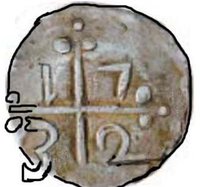
Reverse
Description:
St. Thomas Cross, dated corners.
Inscription:
1 | 7
3 | 8
3 | 8
Edge
Mintings
| Year | Mint Mark | Mintage | Quality | Collection |
|---|---|---|---|---|
| 1732 | D-O | — | ||
| 1737 | D-O | — | ||
| 1738 | D-O | — | ||
| 1739 | D-O | — |
Historical background
In 1732, the currency situation in Portuguese India was complex and fragmented, reflecting both the colony's diminished economic power and its position within a vibrant, multi-currency Indian Ocean trade network. The official currency, the Portuguese xerafim, circulated alongside a plethora of other coins, including the gold mohur and silver rupia from the Mughal Empire, various Venetian and Arabic coins, and even currencies from other European trading companies. This monetary pluralism was necessitated by trade but created chronic instability, as exchange rates between these coins fluctuated based on their intrinsic metal content and local demand.
The Portuguese administration in Goa struggled to assert monetary control. Decades of economic decline and military losses had eroded the credibility and supply of official coinage. Furthermore, a persistent shortage of precious metals, especially silver, plagued the Estado da Índia, leading to the frequent debasement of locally minted coins. This practice, intended to stretch limited resources, further undermined confidence in the Portuguese currency. Merchants and the public often preferred the more reliable and widely accepted Mughal rupees for significant transactions, effectively marginalizing the official monetary system.
Consequently, the currency landscape was one of de facto decentralization and practical adaptation. The Portuguese authorities, while issuing proclamations to fix exchange rates, had limited power to enforce them beyond their main strongholds of Goa, Damão, and Diu. The economy functioned on a system of assay and weight, where the value of a coin was determined more by its metal purity than its face value. This situation in 1732 highlights the transitional phase of Portuguese India, caught between its formal imperial structure and the competitive realities of regional commerce, where its monetary sovereignty was increasingly symbolic rather than absolute.
The Portuguese administration in Goa struggled to assert monetary control. Decades of economic decline and military losses had eroded the credibility and supply of official coinage. Furthermore, a persistent shortage of precious metals, especially silver, plagued the Estado da Índia, leading to the frequent debasement of locally minted coins. This practice, intended to stretch limited resources, further undermined confidence in the Portuguese currency. Merchants and the public often preferred the more reliable and widely accepted Mughal rupees for significant transactions, effectively marginalizing the official monetary system.
Consequently, the currency landscape was one of de facto decentralization and practical adaptation. The Portuguese authorities, while issuing proclamations to fix exchange rates, had limited power to enforce them beyond their main strongholds of Goa, Damão, and Diu. The economy functioned on a system of assay and weight, where the value of a coin was determined more by its metal purity than its face value. This situation in 1732 highlights the transitional phase of Portuguese India, caught between its formal imperial structure and the competitive realities of regional commerce, where its monetary sovereignty was increasingly symbolic rather than absolute.
✨ Legendary