

½ Bazaruco – Portuguese India
India
Context
Years: 1557–1578
Country: India 
Issuer: Portuguese India
Ruler: Sebastião I
Currency:
(1509—1580)
Demonetized: Yes
Material
References
KM: #Click to copy to clipboard24
Numista: #50267
Obverse
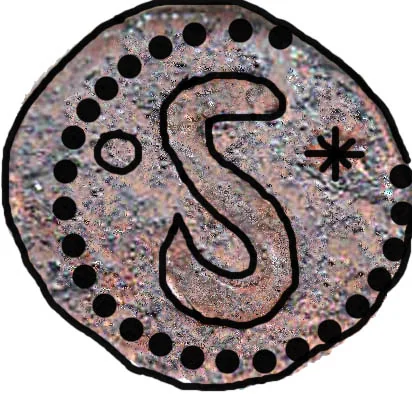
Description:
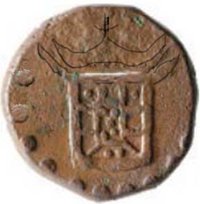
Gomes/2013: "Se 02.01" King's initial inside dotted circle.
Inscription:
ºS*
Reverse
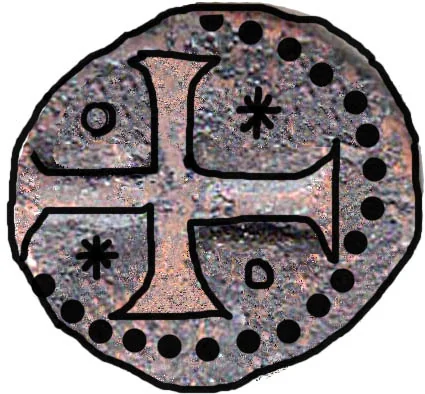
Description:
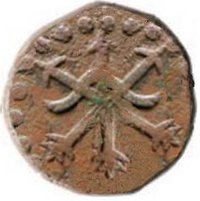
Cross in dotted circle. Dots at each cross tip.
Inscription:
º-*
*-º
*-º
Edge
Mintings
| Year | Mint Mark | Mintage | Quality | Collection |
|---|---|---|---|---|
| — | — | — |
Historical background
In 1557, the currency situation in Portuguese India was a complex tapestry of local, regional, and imperial systems, reflecting the Estado da Índia's role as a commercial hub rather than a territorial power. The Portuguese administration in Goa, the capital, officially minted its own silver coin, the tanga, and its fractional units like the bazarucos. However, these coins struggled to achieve dominance. The real economic lifeblood of the bazaars and long-distance trade was a multitude of foreign currencies, most notably the silver ryal or real of Spanish origin (often called the "Spanish dollar" of the East), and a vast array of gold coins like the Venetian ducat, the Ottoman sultani, and various Indian and Persian mohurs and pagodas.
This monetary pluralism existed because the Portuguese Crown lacked the sheer volume of precious metal required to impose a single currency across its vast network, which stretched from East Africa to Macau. Furthermore, the success of their trade—primarily in spices, textiles, and horses—depended on integrating into pre-existing Asian commercial circuits that had well-established trust in certain prestigious coins. Consequently, the Portuguese treasury in Goa effectively functioned as a large-scale money changer, constantly assaying, weighing, and converting this influx of foreign coinage. Official exchange rates (tabelas) were periodically published, but the actual value of a coin was ultimately determined by its intrinsic metal content and the dynamic demands of the market.
Thus, the currency situation was one of managed coexistence and pragmatic adaptation. While the tanga served for local Portuguese administrative payments and smaller transactions, large-scale trade and wealth storage were conducted in internationally recognized gold and silver coins. This system, though cumbersome, allowed the Estado da Índia to participate in the global flow of precious metals and sustain its commercial empire, all while the Crown continually, but unsuccessfully, sought ways to centralize and profit more directly from the circulation of money within its domains.
This monetary pluralism existed because the Portuguese Crown lacked the sheer volume of precious metal required to impose a single currency across its vast network, which stretched from East Africa to Macau. Furthermore, the success of their trade—primarily in spices, textiles, and horses—depended on integrating into pre-existing Asian commercial circuits that had well-established trust in certain prestigious coins. Consequently, the Portuguese treasury in Goa effectively functioned as a large-scale money changer, constantly assaying, weighing, and converting this influx of foreign coinage. Official exchange rates (tabelas) were periodically published, but the actual value of a coin was ultimately determined by its intrinsic metal content and the dynamic demands of the market.
Thus, the currency situation was one of managed coexistence and pragmatic adaptation. While the tanga served for local Portuguese administrative payments and smaller transactions, large-scale trade and wealth storage were conducted in internationally recognized gold and silver coins. This system, though cumbersome, allowed the Estado da Índia to participate in the global flow of precious metals and sustain its commercial empire, all while the Crown continually, but unsuccessfully, sought ways to centralize and profit more directly from the circulation of money within its domains.
✨ Legendary