

1 Soldo – Portuguese Malacca
Malaysia
Context
Years: 1550–1557
Country: Malaysia 
Issuer: Portuguese Malacca
Currency:
(1509—1580)
Demonetized: Yes
Material
References
KM: #Click to copy to clipboard17
Numista: #49548
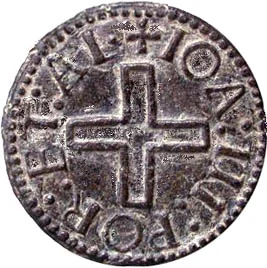
Obverse
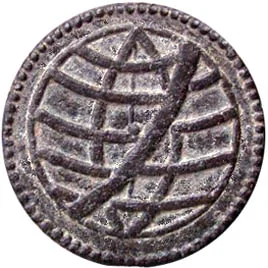
Reverse
Description:
Astronomical model of celestial orbits.
Edge
Mints
| Name | Mark |
|---|---|
| Malacca | — |
Mintings
| Year | Mint Mark | Mintage | Quality | Collection |
|---|---|---|---|---|
| — | — | — |
Historical background
In 1550, Portuguese Malacca was a bustling but strained hub in the global spice trade, and its currency situation reflected both its commercial importance and its administrative challenges. The Portuguese crown officially imposed a monopoly on high-value trade and attempted to enforce the use of Portuguese currency, primarily silver cruzados and smaller tostões and reis. However, the reality in the market was one of pronounced monetary pluralism. The city’s deep-rooted mercantile networks, dominated by Gujarati, Chinese, Javanese, and Arab traders, continued to rely on trusted regional currencies. These included silver Mexican reales (the precursor to Spanish dollars), various gold coins from neighboring sultanates, and even cowrie shells and tin "tinhas" for smaller local transactions.
This created a complex dual system: official Portuguese coins were used for duties, garrison payments, and transactions within the fortress administration, while a plethora of foreign and local currencies facilitated the actual daily trade in the city’s markets and ports. The Portuguese authorities often struggled with currency shortages, debasement, and the constant outflow of silver to India and beyond to pay for textiles and other goods. Consequently, they were forced to pragmatically accept and even tax trade conducted in foreign coins, as attempting to suppress them would have strangled the very commerce that made Malacca valuable.
Thus, the currency landscape was less a unified system and more a competitive monetary arena. The value and acceptance of coins fluctuated based on their metallic content, the credibility of the issuing authority, and mercantile custom. This fluid environment underscored a key reality: while Portugal held military and political control of the city, its economic sovereignty was incomplete. The market’s preference for trusted, widely accepted regional currencies over imposed Portuguese coinage revealed the limits of imperial power in the face of entrenched commercial traditions in 16th-century Southeast Asia.
This created a complex dual system: official Portuguese coins were used for duties, garrison payments, and transactions within the fortress administration, while a plethora of foreign and local currencies facilitated the actual daily trade in the city’s markets and ports. The Portuguese authorities often struggled with currency shortages, debasement, and the constant outflow of silver to India and beyond to pay for textiles and other goods. Consequently, they were forced to pragmatically accept and even tax trade conducted in foreign coins, as attempting to suppress them would have strangled the very commerce that made Malacca valuable.
Thus, the currency landscape was less a unified system and more a competitive monetary arena. The value and acceptance of coins fluctuated based on their metallic content, the credibility of the issuing authority, and mercantile custom. This fluid environment underscored a key reality: while Portugal held military and political control of the city, its economic sovereignty was incomplete. The market’s preference for trusted, widely accepted regional currencies over imposed Portuguese coinage revealed the limits of imperial power in the face of entrenched commercial traditions in 16th-century Southeast Asia.
✨ Legendary