

1 Ducat – County of Tyrol
Austria

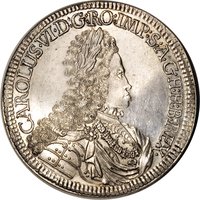
Obverse
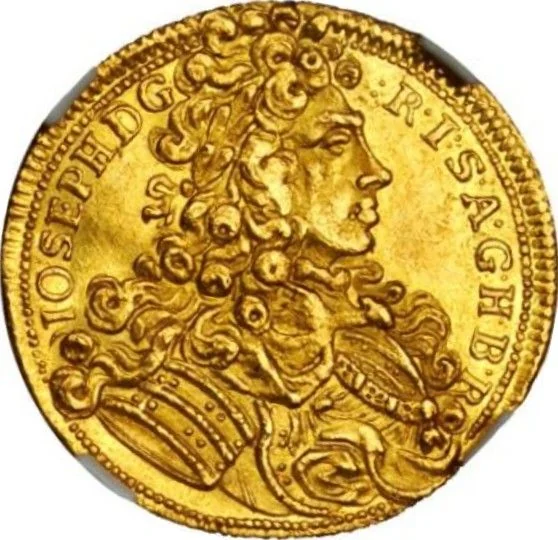
Description:
Armoured portrait facing right, with curly wig and Golden Fleece chain. Legend divided by head and bust. No inner circle.
Inscription:
IOSEPH D G R I S A G H B R
Script: Latin
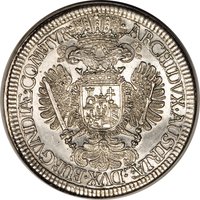
Reverse
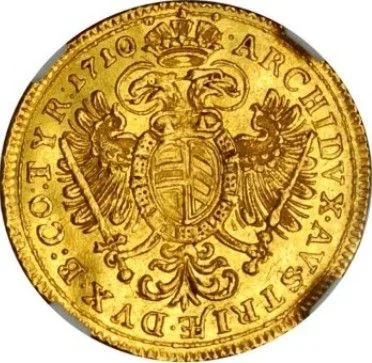
Description:
Imperial double-headed eagle with halos, holding an oval shield of Austria-Burgundy on its chest, encircled by the Golden Fleece chain. Date in legend.
Inscription:
ARCHIDVX . AVSTRIAE . DVX . B . CO . TYR : 1710
Script: Latin
Edge
Plain
Categories
| Object> Armour |
| Person> Monarch |
| Symbol> Crown |
| Symbols> Coat of Arms |
| Symbol> Double-headed eagle |
Mints
| Name | Mark |
|---|---|
| Hall | — |
Mintings
| Year | Mint Mark | Mintage | Quality | Collection |
|---|---|---|---|---|
| 1710 | — | — |
Historical background
In 1710, the County of Tyrol, a core province of the Habsburg Monarchy, was grappling with a severe and chronic currency crisis. The primary issue stemmed from the widespread debasement of coinage, a practice where the silver content of coins was reduced while their face value was maintained. This was largely driven by the financial demands of the ongoing War of the Spanish Succession (1701-1714), which pressured the Habsburg state to mint inferior coins from its mints, including the important one at Hall in Tyrol, to fund its massive military expenditures. Consequently, the trust in the currency eroded, leading to rampant inflation and economic instability within the region.
The situation was exacerbated by a chaotic circulation of diverse coins. Alongside the debased newer issues, older, full-value Tyrolean Kreuzers and Guldens remained in use, but were often hoarded or exported, following Gresham's Law where "bad money drives out good." This was compounded by an influx of even more inferior foreign coins from neighboring German states, creating a confusing and unreliable monetary environment. For Tyrol's economy, heavily reliant on transalpine trade, mining, and agriculture, this instability disrupted commerce, as merchants struggled with uncertain prices and values, and the populace suffered from diminishing purchasing power.
Local authorities and estates protested vigorously to the central government in Vienna, but effective remedies were slow to materialize. The crisis of 1710 was not an isolated event but a acute phase in a longer period of monetary disorder that would persist for decades. Ultimately, it highlighted the tension between the Habsburgs' imperial war finances and the economic health of their constituent territories, with Tyrol bearing the direct brunt of currency manipulations meant to sustain the dynasty's broader European ambitions.
The situation was exacerbated by a chaotic circulation of diverse coins. Alongside the debased newer issues, older, full-value Tyrolean Kreuzers and Guldens remained in use, but were often hoarded or exported, following Gresham's Law where "bad money drives out good." This was compounded by an influx of even more inferior foreign coins from neighboring German states, creating a confusing and unreliable monetary environment. For Tyrol's economy, heavily reliant on transalpine trade, mining, and agriculture, this instability disrupted commerce, as merchants struggled with uncertain prices and values, and the populace suffered from diminishing purchasing power.
Local authorities and estates protested vigorously to the central government in Vienna, but effective remedies were slow to materialize. The crisis of 1710 was not an isolated event but a acute phase in a longer period of monetary disorder that would persist for decades. Ultimately, it highlighted the tension between the Habsburgs' imperial war finances and the economic health of their constituent territories, with Tyrol bearing the direct brunt of currency manipulations meant to sustain the dynasty's broader European ambitions.
✨ Legendary