

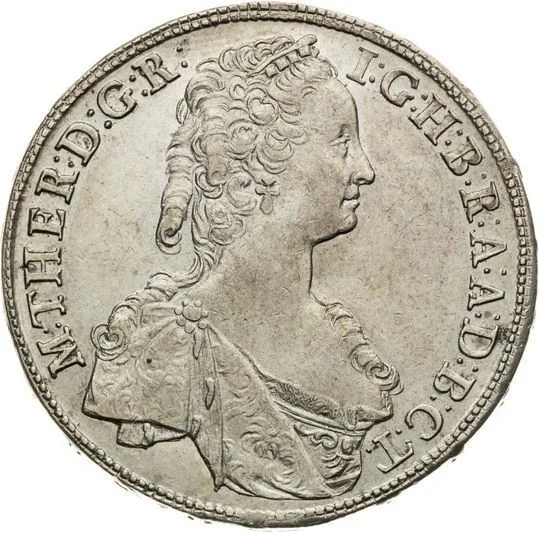

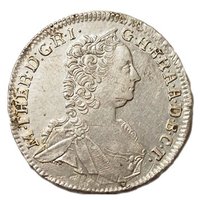
Obverse
Description:
Bust with curly hair and two long curls, bare right shoulder.
Inscription:
M · THER · D · R · I · G · H · B · R · A · A · D · B · C · T ·
Script: Latin
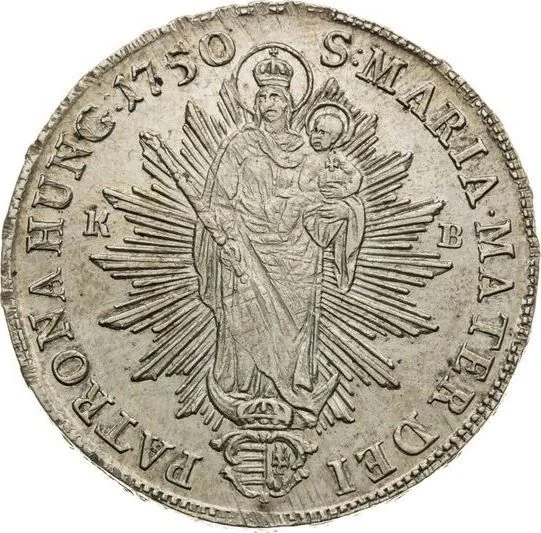
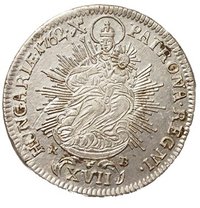
Reverse
Description:
Radiant crowned Madonna holding child and orb, with scepter, on crescent. Below, an oval-framed Hungarian coat of arms separates mintmark and lettering.
Inscription:
S · MARIA · MATER · DEI · PATRONA · HUNG · 1750 ·
Script: Latin
Edge
Inscripted
Legend:
IUSTITIA ET CLEMENTIA
Mints
| Name | Mark |
|---|---|
| Kremnica | K B |
Mintings
| Year | Mint Mark | Mintage | Quality | Collection |
|---|---|---|---|---|
| 1749 | K | — | ||
| 1750 | K | — | ||
| 1751 | K | — |
Historical background
In 1749, the currency situation in Hungary, then part of the Habsburg Monarchy, was characterized by the lingering instability and economic strain following the costly War of the Austrian Succession (1740-1748). The state treasury was deeply depleted, and the monarchy relied heavily on revenue from its Hungarian lands. To finance the war, the Vienna court had significantly increased the minting of debased coinage, particularly the small-denomination kreuzers used in everyday transactions within Hungary. This led to a classic case of inflation, where the value of this circulating money fell sharply, causing hardship for the population and distorting trade.
The primary response to this crisis was the implementation of the Ratio Monetaria (Monetary Regulation) in 1750, which was being prepared and negotiated throughout 1749. This ambitious reform, championed by Queen Maria Theresa's central government, aimed to standardize and stabilize the monetary system across the Habsburg lands, including Hungary. Its core principle was to create a unified silver-based currency, tying the Hungarian gold forint and silver tallér to a fixed standard and withdrawing the debased coinage from circulation. For Hungary, this meant aligning its currency more directly with the Austrian monetary system.
The year 1749 thus represents a pivotal moment of transition, caught between the immediate post-war monetary disorder and the impending top-down reform. While the devalued coins still caused daily economic difficulty, the authorities in Vienna were finalizing plans for a sweeping change. The success of this reform was not yet assured, as it faced challenges from entrenched interests and the practical difficulties of recalling old coinage, but it marked a decisive step toward a more centralized and stable Habsburg fiscal state, ultimately reducing Hungary's autonomous monetary traditions.
The primary response to this crisis was the implementation of the Ratio Monetaria (Monetary Regulation) in 1750, which was being prepared and negotiated throughout 1749. This ambitious reform, championed by Queen Maria Theresa's central government, aimed to standardize and stabilize the monetary system across the Habsburg lands, including Hungary. Its core principle was to create a unified silver-based currency, tying the Hungarian gold forint and silver tallér to a fixed standard and withdrawing the debased coinage from circulation. For Hungary, this meant aligning its currency more directly with the Austrian monetary system.
The year 1749 thus represents a pivotal moment of transition, caught between the immediate post-war monetary disorder and the impending top-down reform. While the devalued coins still caused daily economic difficulty, the authorities in Vienna were finalizing plans for a sweeping change. The success of this reform was not yet assured, as it faced challenges from entrenched interests and the practical difficulties of recalling old coinage, but it marked a decisive step toward a more centralized and stable Habsburg fiscal state, ultimately reducing Hungary's autonomous monetary traditions.
✨ Legendary