

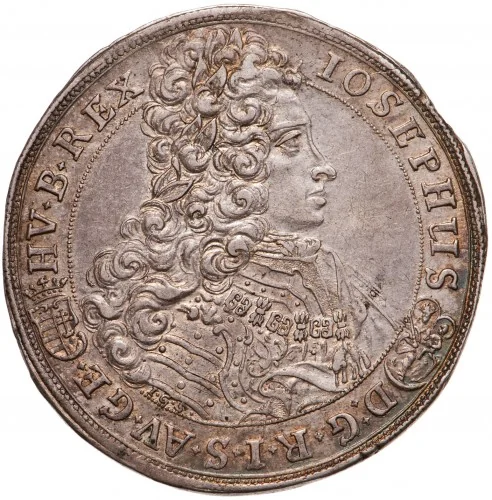
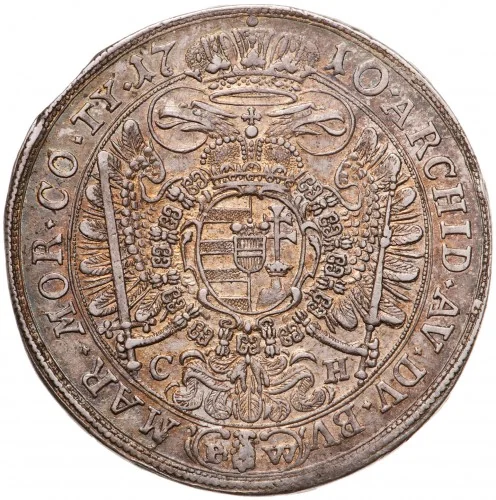

Obverse
Description:
Armored bust with curly wig, facing right. Inscription encircles, interrupted by a crowned Hungarian shield and Madonna with child.
Inscription:
IOSEPHUS D : G · R · I · S · AV · GE HV · B · REX
Script: Latin
Reverse
Description:
Imperial eagle with crown, date above, mintmark below. Hungarian and Austrian shields crowned, privy mark beneath.
Inscription:
ARCHID · AV · DV · BV · MAR · MOR · CO · TY · 17 08
C H
C H
Script: Latin
Edge
Plain
Mints
| Name | Mark |
|---|---|
| Bratislava | CH |
Mintings
| Year | Mint Mark | Mintage | Quality | Collection |
|---|---|---|---|---|
| 1706 | C-H | — | ||
| 1707 | C-H | — | ||
| 1708 | C-H | — | ||
| 1710 | C-H | — | ||
| 1711 | C-H | — |
Historical background
In 1706, Hungary’s currency situation was deeply unstable and a direct reflection of its political turmoil during the Rákóczi War of Independence (1703-1711). Prince Ferenc Rákóczi II’s kuruc forces, in rebellion against Habsburg rule, controlled significant territories but lacked the financial infrastructure of the Vienna-based court. To fund the war effort, the Rákóczi administration in Košice (Kassa) began issuing its own coinage, known as "kuruc pénz" or "insurrection money." These coins, minted from silver obtained from seized church treasures and mines under rebel control, were a necessary but inflationary measure, as their intrinsic metal value was often below their face value.
Simultaneously, the Habsburg authorities continued to circulate their own coins in the regions they controlled, primarily the thaler and its subdivisions. This created a dual-currency zone where the value and acceptance of money depended entirely on which army held the area. Furthermore, the prolonged conflict had severely disrupted trade and agricultural production, the traditional economic pillars of the kingdom. This scarcity of goods, combined with the influx of low-weight rebel coinage and the general uncertainty of war, led to severe price inflation and a profound loss of confidence in all currency.
The monetary chaos was compounded by the widespread circulation of older, debased coins and counterfeits, as well as the use of physical goods for barter in many transactions. Thus, the currency situation in 1706 was not merely one of two competing mints, but of a fractured and collapsing monetary system. The instability of the coinage mirrored the broader struggle for the country’s future, with the economy becoming another battlefield between the Habsburg monarchy and the Hungarian insurgents.
Simultaneously, the Habsburg authorities continued to circulate their own coins in the regions they controlled, primarily the thaler and its subdivisions. This created a dual-currency zone where the value and acceptance of money depended entirely on which army held the area. Furthermore, the prolonged conflict had severely disrupted trade and agricultural production, the traditional economic pillars of the kingdom. This scarcity of goods, combined with the influx of low-weight rebel coinage and the general uncertainty of war, led to severe price inflation and a profound loss of confidence in all currency.
The monetary chaos was compounded by the widespread circulation of older, debased coins and counterfeits, as well as the use of physical goods for barter in many transactions. Thus, the currency situation in 1706 was not merely one of two competing mints, but of a fractured and collapsing monetary system. The instability of the coinage mirrored the broader struggle for the country’s future, with the economy becoming another battlefield between the Habsburg monarchy and the Hungarian insurgents.

✨ Legendary